At the fifth conference of the Ho Chi Minh City Party Committee held recently, Secretary of the HCMC Party Committee Tran Luu Quang affirmed that the city will introduce fare-free bus services to help reduce residents’ travel expenses, promote the use of public transport, and gradually curb environmental pollution.
In light of recent reports by Sai Gon Giai Phong Newspaper, the current situation has underscored the need for the city’s transport sector to undertake comprehensive and substantive reforms. These efforts are aimed at enhancing service quality and restoring public confidence, thereby attracting more residents to use bus services.
Many barriers persist
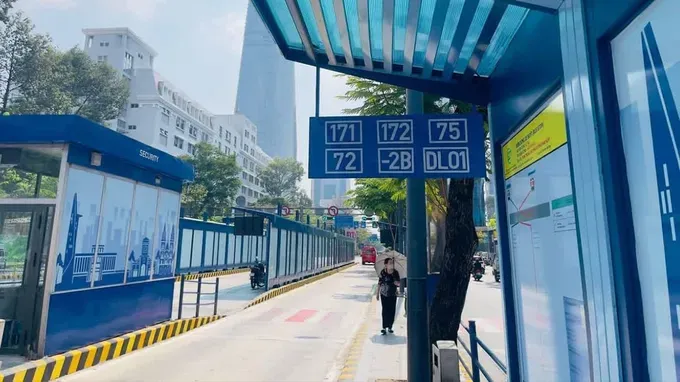
A deputy director of a Ho Chi Minh City department noted that although his residence is located on Nguyen Kiem Street in Duc Nhuan Ward—an area considered part of the city center—reaching the nearest bus stop requires a 1km walk, taking approximately 20 minutes. Due to the one-way traffic system, he must walk against the traffic flow toward Gia Dinh Park. While the distance itself is not excessive, the narrow sidewalks are frequently encroached upon for street vending, forcing pedestrians onto the roadway, where they must navigate through motorbike traffic and face significant safety risks.
Waiting time is also a major barrier. According to tracking on mobile applications, if a bus is expected to arrive in 20 minutes, commuters must leave home at least 25 minutes in advance. However, upon reaching the stop, the bus may still not have arrived, resulting in prolonged waiting times and considerable inefficiency in daily travel.
Consultations and feedback indicate that this is one of the major obstacles discouraging residents from choosing buses over private vehicles.
Mr. Viet Ho, a public servant, frequently commutes by bus from his home on Tan Hoa Dong Street in Binh Tri Dong Ward to his workplace on Nguyen Thi Minh Khai Street in Ban Co Ward. Although the distance from his residence to the nearest bus stop is not considerable, walking remains a significant challenge. He noted that sidewalks along many routes are encroached upon, forcing pedestrians onto the roadway, thereby increasing the risk of collisions with motorbikes and posing potential safety hazards.
In addition, the Go!Bus application—recommended by the transport sector for tracking bus routes—often provides inaccurate information. For instance, it displays a stop on “Tan Dong Hoa Street,” whereas the correct name is “Tan Hoa Dong.” Moreover, its bus arrival time predictions are unreliable, leaving passengers at a disadvantage in planning their journeys.
This reality is consistent with findings from the report “Assessment of Public Satisfaction with the Quality of Operations and Provision of Selected Public Utility Services in Ho Chi Minh City in 2024,” conducted by the Ho Chi Minh City Institute for Development Studies.
Dr. Nguyen Thi Cam Van of the Urban Management Research Division, representing the research team on public transport in Ho Chi Minh City, noted that the survey results reveal marked disparities in satisfaction levels with bus services when analyzed across operational areas (inner city, cross-city routes, and suburban areas); ownership models (companies and cooperatives); as well as across age groups and employment status.
The group that uses bus services most frequently is students, accounting for 46.04 percent of the total surveyed passengers. It is also the segment with the highest expectations regarding service quality. This underscores the need to prioritize the arrangement of bus routes serving areas with high concentrations of schools, colleges, and universities.
The second group comprises daily commuters who rely on buses to travel to work. While their usage is consistent, their satisfaction levels remain lower than the overall average, indicating the need for targeted improvements to better meet their expectations.
Furthermore, the quality of bus stops remains a significant constraint. According to the Ho Chi Minh City Public Transport Management Center, bus stops are categorized into two main types: signposts and sheltered stops. Among these, sheltered stops are considered more suitable, as they provide protection from rain and sun for passengers.
Survey findings indicate that the city requires approximately 5,000 sheltered bus stops; however, only around 1,000 have been installed to date, highlighting a substantial gap in infrastructure provision.
The underlying cause lies in the fact that many streets have narrow sidewalks, which do not meet the required standards for installing properly designed shelters, leaving authorities with no option but to set up basic signposts.
Planning and inter-agency coordination require time for review and adjustment in line with actual conditions. Therefore, the development of the bus shelter system must be carried out in a phased manner, prioritizing feasible locations while ensuring a balance between user demand and existing urban infrastructure conditions, said Pham Ngoc Dung, Director of the Public Transport Management Center under the Ho Chi Minh City Department of Construction.
Expanding routes and enhancing service quality
In recent years, Ho Chi Minh City has stepped up investment in bus system development to meet the growing travel demand of residents. Notably, since the operation of Metro Line No. 1, nearly 30 bus routes have been adjusted or newly introduced to provide direct connectivity with metro stations, thereby contributing to an increase in public transport ridership.
According to the Ho Chi Minh City Public Transport Management Center, since early March, the combined daily ridership of metro and bus services has reached approximately 340,000 passengers, marking a 35 percent increase compared to late February and a 12 percent rise year-on-year against the same period in 2025.
In response to this upward trend, the transport sector is implementing a range of measures to further improve service quality and operational efficiency.
Mr. Pham Ngoc Dung, Director of the Public Transport Management Center, stated that the center has reviewed and adjusted the route network while synchronizing service frequency between buses and the metro system. It has also strengthened coordination with operating units to monitor ridership, service quality, and passenger satisfaction as a basis for scaling up effective models.
For industrial parks, newly developed residential areas, and university villages—where travel demand is rising—the center is introducing new routes, increasing service frequency, and upgrading as well as adding more passenger amenities.
According to the report “Assessment of Public Satisfaction with the Quality of Operations and Provision of Selected Public Utility Services in Ho Chi Minh City in 2024,” the most frequently proposed recommendations from passengers regarding service expansion and quality improvement include increasing service frequency during peak hours (47.48 percent), extending operating hours on certain routes (39.25 percent), investing in additional bus shelters and enhancing sanitation, safety, and the provision of relevant information at stops (45.18 percent), as well as improving the quality of transport vehicles (45.50 percent).
While awaiting the added “pull factor” from the completion of additional metro lines, bus system managers and operators themselves must take a proactive role in implementing a range of measures to attract more users, thereby helping to reduce traffic congestion and environmental pollution.
According to architect Ngo Viet Nam Son, in the context of an existing urban environment characterized by high population density and constrained infrastructure, changing residents’ travel habits requires a comprehensive and coordinated approach. In addition to proposals from the transport sector, it is necessary to introduce dedicated bus priority lanes, arrange stops in proximity to commercial centers and schools, and roll out communication campaigns highlighting the benefits of public transport.
Dr. Pham Viet Thuan, Director of the Ho Chi Minh City Institute of Resources Economics and Environment, emphasized that the core objective of bus system development is to reshape travel behavior. Therefore, the city needs sufficiently strong, even decisive, policy measures. Public officials and civil servants should be encouraged to use buses, while students should be mobilized to adopt bus travel early on to help form sustainable habits.
In addition, the city should diversify its fleet by expanding the use of electric buses and introducing compact, flexible “electric taxi-bus” models suitable for inner-city routes and narrow alleys. This is particularly relevant given that many existing roads are only 5–6 meters wide, limiting accessibility for conventional bus services.
The integration of bus services with public bicycle systems, along with improvements to sidewalks and the organization of transit connections, should be further accelerated. In addition, Ho Chi Minh City should consider extending bus operating hours beyond 10:00 p.m. to better serve residents, suggested Doan Thi Hong Hanh, Chairwoman of Tan Tien Cooperative.