“In 2025, the Vietnamese film market is in a state of extreme polarization: winners win big, while subpar films fail immediately. The mid-tier revenue films common in previous years have largely disappeared,” observed Content Director Nguyen Hoang Hai of CGV Vietnam.
Box office data clearly illustrates this divide. The highest-grossing film of 2025 (and of all time) is “Mua Do” (Red Rain) with over VND714 billion (US$27.1 million), while the lowest was “Tiem Cam Do: Co Choi Co Chiu” (The Pawnshop: You Play, You Pay) with a mere VND153 million ($5,800).
According to Box Office Vietnam, 8 out of the top 10 highest-grossing films of 2025 surpassed the VND200 billion ($7.6 million) mark, an unprecedented record in Vietnamese cinematic history. The remaining two, “Mang Me Di Bo” (Abandoning Mother) and “Dia Dao: Mat Troi Trong Bong Toi” (The Tunnels: Sun in the Darkness), also posted impressive numbers, both exceeding VND170 billion ($6.5 million).
Amidst this general success, Director Tran Dang Cuong of the Cinema Department (Ministry of Culture, Sports and Tourism) highlighted two specific works: “Mua Do” and “Dia Dao: Mat Troi Trong Bong Toi.”
He noted that these results carry dual significance. Firstly, they confirm that audiences are always ready to embrace films that are well-invested, meticulously produced, and professionally distributed. Secondly, these artworks have shattered the long-standing prejudice that historical and revolutionary films are niche and difficult to finance. This signals a positive shift, encouraging investors to participate more boldly and attracting further resources to the industry.
However, contrasting with this promising detail is the fact that 7 out of the bottom 10 films earned less than VND1 billion ($38,000). Besides “Tiem Cam Do: Co Choi Co Chiu”, the list includes Vietnamese concert film “Chung Ta La Nguoi Viet Nam” (We are Vietnamese) (over VND200 million - $7,600)), “Doi Gi, Mo Di” (Dream On) (over VND300 million - $11,400), “The He Ky Tich” (The miracle generation) (VND400 million - $15,200), “Mua Tren Canh Buom” (Rain on Butterfly) (VND650 million - $24,700), “Bit Mat Bat Nai” (Blindfolded Deer) (nearly VND700 million - $26,600), and “Trai Tim Que Quat” (The Crippled Heart) (nearly VND900 million - $34,200).
It is worth noting that low revenue in this list does not necessarily equate to poor quality, as several are music documentaries, independent art films, or experimental works that naturally appeal to niche audiences.
A positive signal is that alongside the traditional Tet holiday and the April 30 and May 1 holiday, Vietnamese cinema is gradually establishing a new peak season around the National Day holiday (September 2). In 2025 alone, the market recorded nearly 50 Vietnamese releases. Experts forecast this number will rise in 2026, averaging at least one new Vietnamese film per week.
Discussing the market’s brutality, Director and Meritorious Artist Vu Thanh Vinh shared: “No one dares to confidently say a film will be profitable. Without proper balance and risk management, failure is almost certain. That is where the market’s ruthlessness lies.” He revealed that many projects, despite being in production for three years, remain unreleased due to various reasons, the most critical of which is the exhaustion of funds for marketing and distribution.
Another harsh reality involves independent, art-house, and experimental films, which often struggle to connect with mass audience tastes despite critical acclaim.
Most recently, “Quan Ky Nam” (Ky Nam Inn) became a topic of debate, with calls to rescue the film after it faced limited screenings and unfavorable time slots. Despite being praised for its aestheticism and high artistic quality in script, acting, and cinematography, the film suffered a dismal box office performance.
Previously, a trio of films released in close succession “Trai Tim Que Quat”, “Thai Chieu Tai” (Wealth Beckoning Fetus), “Pha Dam: Sinh Nhat Me” (Wrecking Mom’s Birthday Party) also failed commercially despite significant artistic contributions in experimentation and creativity.
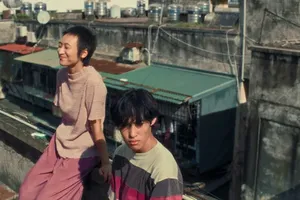
A prime example is “Mua Tren Canh Buom”. Released in early 2025 after winning the double honors of Best Film (IWONDERFULL Grand Prize) and Most Creative Film (Verona Film Club Prize) at the Venice International Film Critics’ Week 2024, it earned less than VND1 billion ($38,000) domestically.
While the box office race is undeniably fair, these failures pose a lingering concern for filmmakers, where high-quality artistic works still lack a suitable dedicated space to reach the public.