Answering interview questions of SGGP Newspaper on damages to road infrastructure across numerous localities after severe flooding lately as well as responsibilities and solutions of management agencies, Deputy Director Phan Thi Thu Hien of the Department for Roads of Vietnam (Construction Ministry) first mentioned the impairment scale.
Since the beginning of the year, natural disasters have inflicted serious damage on road infrastructure, particularly in northern provinces and throughout the Central and South-Central regions. This assessment does not even include infrastructure managed directly by local localities.
Road damage caused by floods primarily consists of positive slope landslides involving tens of millions of cubic meters of soil and rock, which is the leading cause of traffic congestion. This is followed by flooding that blocks roads, and currents sweeping away or damaging bridges, culverts, and road signage. Additionally, many routes have suffered subsidence, leading to road severances or reduced road width.
State agencies conduct regular reviews and inspections, ensuring infrastructure meets original regulatory design standards. However, 2025’s extreme weather shattered these benchmarks. By late November, Vietnam endured 15 typhoons and 6 tropical depressions, the highest frequency since 1961.
With rainfall and flooding far exceeding historical records, these unprecedented disasters overwhelmed the design limits of existing road infrastructure. Despite rigorous maintenance and prior approvals, the sheer intensity of the 2025 season proved that conventional engineering standards were insufficient against such extreme climate volatility.
On October 27 alone, the Bach Ma meteorological station (Hue City) recorded rainfall of 1,740mm in 24 hours, the highest in Vietnam’s history and the second-highest globally for 24-hour rainfall. This far surpasses the highest calculated risk levels for rain. Floods on the Ba and Dinh rivers have all exceeded historical records. This is the primary cause of road damage in 2025, prolonging recovery times and necessitating substantial funding.
The Ministry of Construction has issued directives; and currently, the Department for Roads of Vietnam is presiding over and coordinating with units, localities, experts, and scientists to urgently review and clarify the causes of landslides, flooding, bridge washouts, and road severances on traffic routes and expressways, especially those frequently prone to landslides.
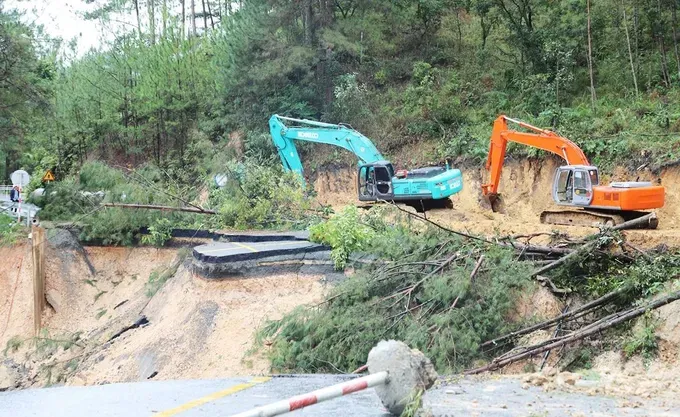
The Ministry requires clear identification of causes stemming from geology versus construction investment. The impact of transport infrastructure works on flood drainage capabilities in river basins must be assessed before remedial solutions can be proposed.
The Ministry also requires agencies to evaluate compliance with legal regulations on natural disaster prevention and control, and adherence to technical indicators in the system of standards and regulations during project formulation and design.
Units and localities need to assess the suitability or obsolescence of current technical standards to determine if adjustments or replacements are needed to cope with extreme climate change exceeding historical milestones, drawing on domestic and international experience.
After reviewing and synthesizing results, the Department for Roads of Vietnam will report to the Ministry for a comprehensive assessment and propose solutions and plans to solidify works, ensuring sustainability and adaptation to climate change.
Finally, Deputy Director Phan Thi Thu Hien discussed focused measures, along with the responsibilities of localities, to minimize similar landslides and road severances in the future whenever the rainy season approaches.
In the coming time, her department will assess the condition of operating infrastructure to identify vulnerable areas. Specifically, it will target road sections prone to flooding; steep passes; roads traversing complex geological, topographic, and hydrological terrain prone to landslides and subsidence; and bridges/culverts with insufficient aperture. These will be included in planning for construction investment and renovation.
Furthermore, the department will push for the application of science, technology, and advanced materials in disaster prevention, ranging from investigation and survey planning to topographic/geological surveys and structural assessment.
Cooperation with research institutes, universities, and international experts will be strengthened, aiming to build an industry-specific disaster prevention database connected to the national database and other sectors to serve road construction, management, and maintenance. Related localities, authorities and functional forces must continue to coordinate closely in building and deploying disaster prevention plans.
According to preliminary estimates, in 2025, total damage caused by natural disasters to road infrastructure managed by the Department for Roads in Vietnam is VND551.6 billion (US$21.7 million).
The most heavily damaged area spans from Da Nang City to Khanh Hoa Province, accounting for about VND250 billion ($9.5 million), primarily due to the consequences of typhoons No. 12 and 13, and the flood spell from November 15 to present.