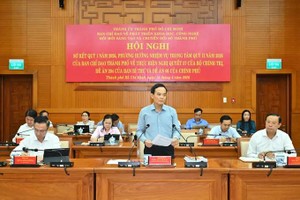
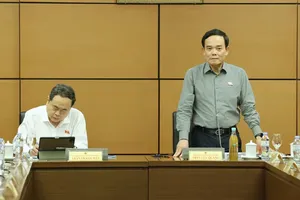
Ho Chi Minh City authorities, scholars and enterprises discussed price stabilization and measures to bring price-stabilized goods to remote areas at the program “Talk and Do” televised December 5 by the HCMC People’s Council in partnership with HCMC TV.
The council’s chairperson Pham Phuong Thao said goods prices have been prone to soar in the rest of this year, affecting many people and their living conditions.
Dr. Tran Hoang Ngan, deputy head of the HCMC University of Economics, said the consumer price index rose by 9.58 percent in the past eleven months; thus, this year we will see an inflation rate of above 11 percent.
He attributed the main cause of the inflation to the global economic crisis, which has affected hikes in local foods prices, interest rates and school fees.
Dr. Ngan said there should be short-term and long-term measures to control prices.
The price stabilization program is the city’s initiative to stabilize prices and ensure adequate supply of goods, he added.
However, he said, the city needs to reassure people that there will be sufficient goods during Tet (Lunar New Year) next February.
He said people should not stockpile goods, which causes food shortages and leads to price hikes.
Van Duc Muoi, General Director of Vissan Food Company, said Vissan has prepared adequate goods for Tet so the city’s residents shouldn’t worry about a shortage.
He said the city administration has ordered Vissan to prepare 900 tons of processed foods for Tet as part of the price stabilization program, but it has prepared over 4,000 tons just as a precaution.
Nguyen Ngoc Hoa, chairman of Saigon Union of Trading Cooperatives, also ensured adequate supply of goods for Tet.
He said the union’s Saigon Co-op supermarkets would close on only one day, over the Lunar New Year. This is in order that goods will be always available during the festival.
In addition, the supermarkets will increase their supplies during Tet by 40 percent as compared to last year’s festival.
Nguyen Thi Hong, vice chairperson of the HCMC People’s Committee, said prices of goods will be kept low and their quality high, because the city has provided 14 enterprises, who join the price stabilization program, with non-interests loans worth VND115 billion (US$5.75 million).
These companies can then produce and prepare goods well in advance for supplies during and after Tet, she added.
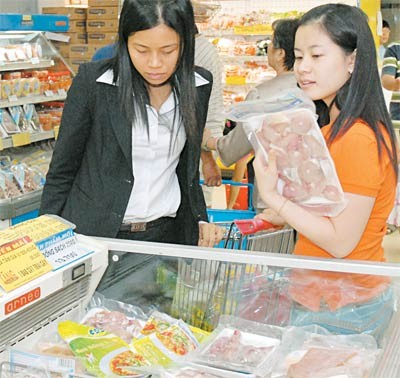
The price-stabilized goods include rice, sugar, cooking oil, red meat, poultry, poultry eggs, fruits and vegetables, and processed foods.
These goods will be 10-20 percent lower than market prices.
Bringing goods to remote areas
Vice chairperson Hong said the city currently has 2,088 points of sale; the figure will increase by 100 points by the end of January 2011.
She went on to state, “there are few points of sale established in remote areas, industrial parks and export processing zones”.
Lawyer Truong Trong Nghia, deputy head of the council’s Economy and Budget Committee, said supermarket systems have only helped some consumers.
Price-stabilized goods must be sold in traditional markets, which would then help low-income people and residents in remote areas, he added.
Actress Kim Xuan, an ambassador of Vietnamese goods, said price-stabilized goods need to be brought to workers’ dormitories.
Actor Quyen Linh, also an ambassador of Vietnamese goods, agreed with Ms. Xuan, saying that there should be periodic trips to bring goods to people in remote areas.
He said he bought a kilogram of sugar at VND27, 000 in Can Gio District, a remote district of HCMC, while nearer to the city center the cost was only VND23, 000.
To conclude, he said, remote residents need to be informed of the adequate supply of goods so they won’t worry about food shortages.