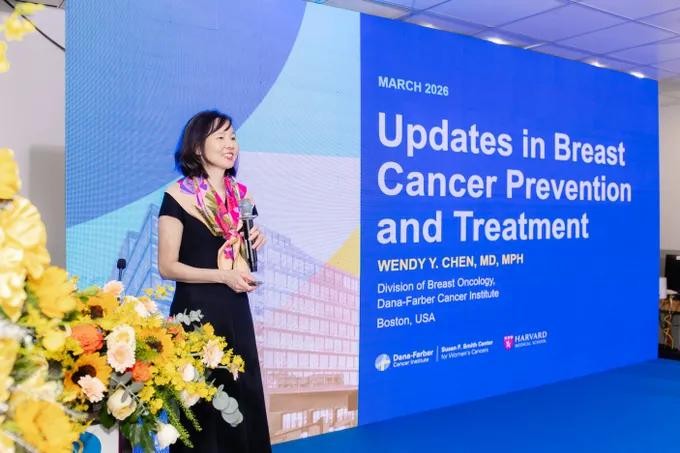
In Southeast Asian countries, including Vietnam, the incidence of breast cancer is much lower than in many other countries worldwide, but the mortality rate is higher. This information was shared by Associate Professor Wendy Y. Chen, Dana-Farber Cancer Institute, Harvard Medical School, at the "Updates on Advances in Cancer Treatment and Care" conference organized by Nam Saigon International General Hospital on March 14.
According to Dr. Chen, breast cancer is currently the most common type of cancer in women worldwide and is also the leading cause of cancer death in women. However, the epidemiological picture differs significantly between regions.
In the US, the number of breast cancer cases is quite high, but the mortality rate is low. Conversely, in many Southeast Asian countries, including Vietnam, the number of cases is lower, but the mortality rate is high. This is because many cancer cases in Vietnam are detected at a late stage.
Data from Ho Chi Minh City shows that from 1996 to 2015, the number of breast cancer cases increased by about 70 percent. However, only about 26 percent of cases were detected in stage I, while this figure in the US ranges from 50 percent–60 percent.
Conversely, about 26 percent of patients in Vietnam are diagnosed when the disease is already in stages III–IV, while this rate in the US is only about 10 percent.
According to Associate Professor Wendy Y. Chen, the reason is that cancer screening in Asian countries is not frequent enough.
In addition, cancer treatment outcomes in Vietnam and developing countries are less favorable due to limited access to medication.
At the same time, Associate Professor Wendy Y. Chen also noted that social psychology plays a significant role in late detection. In many Asian countries, fear of cancer still persists. Some women are hesitant to seek medical attention or disclose their condition due to concerns about treatment. Many also believe that a cancer diagnosis means chemotherapy or severe side effects.
“In reality, not all breast cancer patients need chemotherapy. Modern medicine has advanced significantly, and in some cases, treatment has even been reduced compared to the past,” asserts Associate Professor Wendy Y. Chen.