Amidst the wave of digital transformation, the digital citizen station model, which is integrated with digital health kiosks, has emerged as a practical solution, offering residents convenient and rapid access to public services and healthcare. Beyond alleviating the burden on medical facilities, this model establishes a new frontier in community health management.
A safe and reliable medical anchor
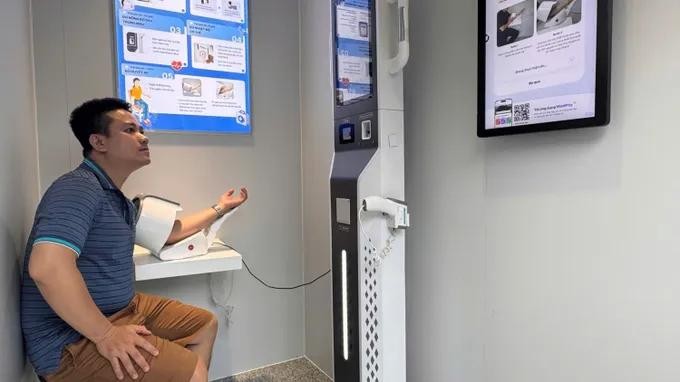
Following his morning exercise, 40-year-old Nguyen Khac Phuong carefully places his hand on the SpO2 and blood pressure monitoring devices at a digital citizen station located in the Diamond Island residential area in Binh Trung Ward. Within minutes, his full health report appears on the screen.
He revealed that he previously had to visit a hospital just to check these vitals. Now, he can do it right in the apartment lobby. In addition to blood pressure and oxygen levels, he can also track his height, weight, body fat, and hydration levels to adjust his lifestyle.
Similarly, 28-year-old Nguyen Lan Anh expressed her satisfaction after completing her health check. With a few simple taps on the touch screen, her current status, ranging from Body Mass Index (BMI) to heart rate, is clearly displayed. The interface is designed for ease of use across all demographics, including the elderly. This streamlined process significantly reduces travel time and enhances service accessibility.
According to Ms. Nguyen Do Quyen, Deputy General Director of FPT Retail, these digital health stations are integrated into the digital citizen station ecosystem, featuring an intelligent, closed-loop suite of features. From health screening and medicine purchases to scheduling vaccinations and consulting with pharmacists or doctors, all needs are met at a single touchpoint. Located directly within residential areas, these stations fulfill the goal of being "close to the people" serving as a dependable medical anchor.
A multi-utility integrated model
The digital citizen station is an initiative spearheaded by the Ho Chi Minh City Police Department, contributing to the effective implementation of the Government's Project 06 and the Politburo's Resolution 57 on digital transformation. By utilizing chip-based ID cards and the VNeID app to simplify procedures, the model bridges the gap between the government and its citizens. It represents a breakthrough in applying AI and digital technology to build a modern, transparent, and people-centric e-government.
While visiting the station at Cityland Park Hills in Go Vap Ward, 38-year-old Le Thi Phuong discovered that the station offers far more than health services. Core features include public administration, security alerts, civil utilities, traffic fine inquiries, and banking services.
“We can easily perform administrative tasks on the National Public Service Portal, such as submitting documents or making online payments. We can also report security issues, pay service bills, and register for health insurance. Notably, any incidents at the station can be reported instantly via an SOS button connected directly to local security forces,” Phuong noted.
Colonel Ngo Xuan Tho, Head of the Police Division for Administrative Management of Social Order (PC06) under the HCMC Police, stated that the stations are currently operational in major urban areas such as Celadon City, Vinhomes Ba Son, Diamond Island, and Cityland Park Hills. Plans are underway to expand the network across the city.
“The launch and replication of these multi-functional digital citizen stations mark a shift from administrative management to administrative service. This is a key criterion in building a grassroots police force that stays close to, respects, and serves city dwellers,” Colonel Ngo Xuan Tho emphasized.