The art exhibition called “Keepers of Time – Co lai hy" (Since ancient times, few people have lived to the age of 70) serves not only as a reunion of 12 veteran artists—the youngest of whom is already over 80 years old, while some are nearing 100—but also as the opening of a contemplative artistic space where time is reflected in every brushstroke, layer of color, and sculptural form. The exhibition embodies the enduring vitality of Vietnamese fine arts across generations of artists.
The sedimentary layers of time
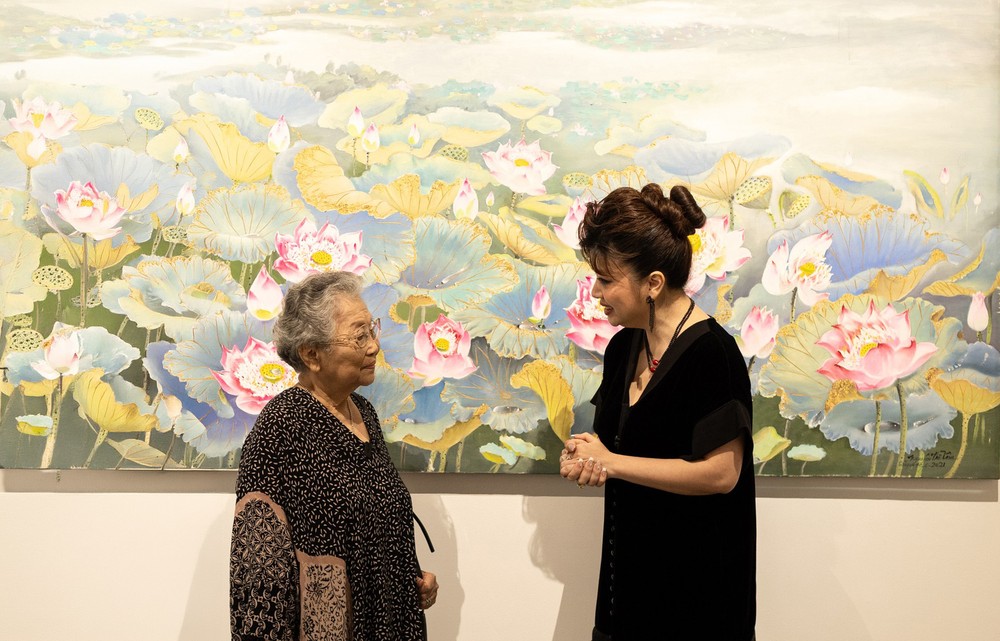
From now until May 31, at CHILLALA—House of Art at No. 75 Xuan Thuy Street in An Khanh Ward, Ho Chi Minh City, the exhibition “Keepers of Time—Co lai hy” presents works by 12 veteran artists, namely Ta Kim Dung, Le Trieu Dien, Hoang Minh Hang, Hong Linh, Uyen Huy, Quach Phong, Do Thi To Phuong, Ca Le Thang, Nguyen Thi Tam, Phung Chi Thu, Huynh Thi Kim Tien, and Doan Quoc.
According to Dr. Nguyen Hong Ngoc of Ho Chi Minh City University of Fine Arts, the exhibition’s art advisor, what makes this exhibition remarkable is not merely the gathering of elderly artists but the way time itself is embedded in their visual language. The exhibited works reflect how individuals have absorbed the world through years of living, working, observing, and experiencing historical and social upheavals.
In the realm of silk painting, while Hoang Minh Hang leaves a distinctive mark through delicate, lustrous layers of color and highly simplified forms that give way to visual stillness, Huynh Thi Kim Tien introduces a world where colors dissolve into emotions. Meanwhile, Do Thi To Phuong chooses to portray the pure beauty of everyday life, captivating viewers through the depth of memory and time.
In the field of sculpture and material-based art, Phung Chi Thu explores the compactness of form and the narrative quality of materials, while Doan Quoc draws attention with his distinctive embossed-aluminum technique, transforming cold, rigid metal into surfaces rich in rhythm and light.
Many visitors spent considerable time in front of each artwork, closely observing every layer of color, brushstroke, and surface texture. Nguyen Phan Yen Lan, 38, an office worker residing in Thu Duc Ward, said: “Some paintings appear very simple at first glance, yet the longer you look, the deeper the emotional resonance becomes. I believe what truly touches viewers is the lived experience that the artists have infused into their works.”
Meanwhile, Tran Gia Huy, a second-year student at Ho Chi Minh City University of Fine Arts, stated that he is particularly impressed by the artists’ restraint in expressing emotions and their handling of materials. Some works require very little explanation, yet they leave a lasting aftertaste.
A way of preserving memory
In the title of the exhibition, Co Lai Hy—a phrase meaning that “few people since ancient times have lived to the age of 70”—age itself is only one aspect. What is truly emphasized is the enduring artistic journey of individuals who have devoted nearly their entire lives to creative pursuits and the preservation of cultural values.
Artist Uyen Huy (whose real name is Huynh Van Muoi), former Chairman of the Ho Chi Minh City Fine Arts Association, shared that at a sufficiently mature stage in life, artists no longer create merely through the “physical eye" but through the “inner eye”—shaped by perception, intuition, and the contemplative depth distilled from lived experience. The exhibited works emerge as artistic practices that continue to evolve and engage in dialogue with the present through the accumulated depth of time.
Amid the constant motion of contemporary life, the “Keepers of Time – Co Lai Hy” exhibition creates a necessary moment of stillness for the public to reflect on the value of enduring artistic dedication. Rather than pursuing trends or market-driven effects, the artists allow their works to speak for themselves through the maturity of craftsmanship and the composure born of experience.
The exhibition, therefore, offers more than aesthetic appreciation; it also prompts reflection on the role of art as a means of preserving memory and cultural depth. Standing before these works, viewers not only observe colors and forms but also sense the quiet accumulation of time embedded within each creation.
Through diverse artistic practices ranging from realism and expressionism to abstraction and sculpture, the exhibition offers a glimpse into the Southern region’s fine arts after 1975, a period in which artists not only pursued creative endeavors but also engaged in art education, professional organizations, and the sustaining of urban artistic life.