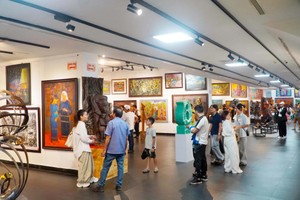
The Nam Su Hoa Kieng exhibition introduces a fresh approach to Southern glass painting, bridging familiar visual memories with contemporary creative experiments to extend the legacy of this heritage in modern life.
Southern glass painting finds new life at the Nam Su Hoa Kieng exhibition
Southern glass painting, or reverse glass painting, once held a ubiquitous presence in the lives of local people, appearing in everything from sacred altars to everyday living spaces. Depicting characters from classical opera (tuong), mythology, and folklore, these images served as more than mere decoration; they reflected the beliefs, ethics, and aesthetic systems of the community. However, over time, the art form has seen its presence diminish, becoming more of a cultural memory than a living practice.
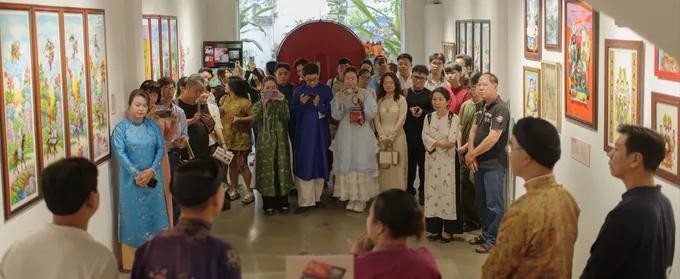
The exhibition, organized by the Saigon Vi Vu project, is currently being held at Annam Gallery at 371/4 Hai Ba Trung Street, Xuan Hoa Ward, Ho Chi Minh City, and will continue until May 2026. This exhibition presents glass painting not merely as an object of art, but as a "flow" embedded within a wider historical and social framework. In this context, each layer of glass serves as both a reflective medium and a container for time, memory, and the interplay of cultural significances.
Artisan Tran Van Nhanh, who has dedicated over 40 years to the craft, noted: "The difficulty of glass painting lies in the reverse-painting technique, but the greatest challenge is capturing the 'soul' of the image. Each stroke represents accumulated experience and memory. Without understanding the roots of the stories and characters, it is easy to misinterpret the spirit of the art." He expressed concern that while many can draw, few truly grasp the intrinsic value of this art form.
From a research perspective, antiques restoration expert Nguyen Duc Huy argued that restoring glass paintings is inseparable from understanding their cultural background. "Each painting is a fragment of memory. When we look at an old work today, we see a part of a life that once existed. If we view them only as ornaments, we miss the many layers of meaning behind them," he said. This approach helps the exhibition move beyond mere nostalgia toward a deeper understanding of why glass painting flourished and why it demands re-evaluation today.
The exhibition in HCMC showcases southern glass painting’s revival
A highlight of the exhibition is the effort to move glass painting beyond traditional spaces to dialogue with contemporary life. This is evident in both the meticulous restoration work and the creative experiments of the younger generation.
Dao Minh Duc, a third-year student at Van Lang University’s Faculty of Design, views glass painting as a transmutable "visual language." He explained: "My interest is not in copying old images, but in how aesthetic principles like composition, color, and symbolism can be reinterpreted in modern design. When integrated into interior decor, glass painting ceases to be a static object on a wall and becomes a living part of the environment."
Visitor Nguyen Minh Anh, a student at Saigon University, shared: "I used to see these paintings at my grandparents' house but never understood them. This exhibition made me realize that every piece has its own story. It's fascinating to see modern adaptations that make the art feel accessible and relevant, rather than something belonging solely to the distant past."
The Nam Su Hoa Kieng exhibition addresses the challenge of preservation while suggesting pathways for heritage to thrive in the modern era. By fostering encounters between artisans, researchers, artists, and the public, it creates a multi-dimensional dialogue for Southern glass painting. In this space, heritage is not "framed" in the past but opened up to endless possibilities for continuity.
Saigon Vi Vu is an art project established in 2016, focusing on the research, preservation, and dissemination of the cultural values and lifestyles of the former Southern urban area. Through various content activities, exhibitions, and publications, the project aims to bring art and heritage closer to the younger public, inspiring new perspectives on the beauty and memories of urban life.