Removing the barriers that are constraining heritage from generating economic value will help unlock the nation’s vast “gold mine” of traditional cultural assets.
Heritage values remain substantial but largely untapped
Politburo Resolution No. 80-NQ/TW on the development of Vietnamese culture sets forth the requirement that culture must become an endogenous driver of growth. Accordingly, cultural industries are expected to contribute 7 percent of GDP by 2030 and 9 percent by 2045, emerging as an important pillar of the national economy. However, a considerable gap remains between policy orientation and practical implementation, beginning with the very approach to heritage.
Many cultural experts have pointed to a long-standing paradox: despite Vietnam’s abundance of cultural heritage assets, the material value generated from them has yet to match their true potential. When heritage is confined merely to preservation, it cannot create new vitality. Only when it is retold through the language of the present, connected to the needs of contemporary society, and transformed into tangible products and services can heritage truly enter economic life.
However, how to transform ideas into marketable products remains a major challenge, as many cultural values exist merely as rich raw materials without a complete process to convert them into high-value products. Creative design remains fragmented, standards are lacking, and distribution systems are inefficient. As a result, cultural products struggle to reach market scale, compete effectively, and sustain long-term development.
According to lawyer Le Quang Vinh, who has more than 20 years of experience in intellectual property rights, the core bottleneck lies in the absence of proper identification for cultural and heritage products. Symbols, motifs, knowledge, and handicraft skills can all generate economic value, but without clear identification, they cannot be valued, traded, or protected under intellectual property frameworks. This has created a prolonged vicious cycle: without identification, there is no market; without market value, heritage cannot generate income; artisans struggle to sustain their craft; and there is insufficient funding for creative reinvestment and preservation efforts.
Making heritage “come alive” in contemporary society
Dr. Le Thi Minh Ly, member of the National Cultural Heritage Council, said that the essence of the “bottleneck” lies in a long-established mindset. For many years, conservation in the form of “freezing” heritage was regarded as an inevitable approach. Heritage was placed in exhibition spaces, separated from its natural living environment, and gradually became an object of observation rather than an integral part of real life. As a consequence, the gap between heritage and the community has continued to widen, particularly among younger generations. When heritage is no longer used and no longer connected to everyday livelihoods, it gradually loses its intrinsic vitality.
According to Dr. Le Thi Minh Ly, preservation and utilization are not two opposing approaches. On the contrary, appropriate utilization is itself a means of achieving sustainable preservation. When heritage generates economic value, communities will have stronger incentives to maintain and pass it on to future generations. When practitioners and artisans can earn stable incomes from their work, traditional knowledge stands a greater chance of being preserved and continued. If heritage cannot provide livelihoods, people will inevitably abandon it. Heritage must move beyond museum spaces and return to everyday life in new forms while still preserving its core values.
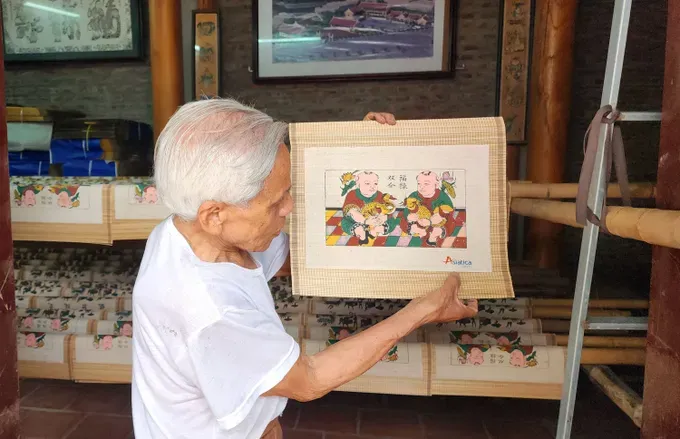
The story of Dong Ho folk paintings in Bac Ninh Province offers a vivid example of this approach. At the cultural exchange center established by Meritorious Artisan Nguyen Dang Che in Bac Ninh, heritage is not only preserved but also developed in ways that respond to market demand. The entire painting-making process continues to follow traditional methods and techniques. Artisans are able to practice and pass down their craft, while visitors can directly participate in the creative process, thereby gaining a deeper understanding of the value of folk paintings.
In addition, images from Dong Ho paintings have been adapted flexibly for use on calendars, notebooks, souvenirs, and many other everyday products. This demonstrates how heritage can be “translated” into the language of the market without losing its cultural identity.
The challenge of developing a heritage-based economy does not lie in the quantity of heritage assets but in removing existing bottlenecks, with intellectual property-related constraints playing a pivotal role. From identification and legal protection to commercial utilization, every stage requires a clear and professional approach. If one link is missing, the value chain will be disrupted; only when all three elements are in place can heritage truly become a sustainable source of economic value.