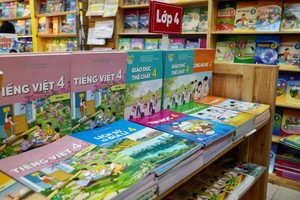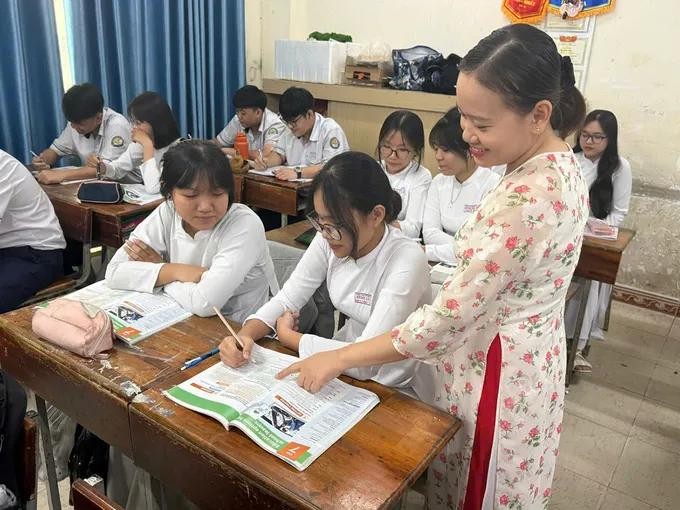
Teacher Nguyen Thi Huong, Head of the Literature Department at Quynh Luu 2 High School in Nghe An Province, believes that while the objectives regarding knowledge and skills for students remain unchanged compared to when multiple sets of textbooks were implemented, teachers need in-depth training to understand the approach and utilization of the materials in the "Connecting Knowledge with Life" textbook series, especially in localities and schools that have not yet taught this series. The training plan needs to be implemented early to allow teachers time to study and proactively implement the curriculum.
In Tuyen Quang Province, after the Ministry of Education and Training decided to select a unified national textbook series, the Provincial Department of Education and Training issued a document requesting secondary schools to inform parents, students, and teachers. Principal Phan Truong Giang of Thuong Lam Secondary and High School in Tuyen Quang Province said that his teachers have proactively studied the "Connecting Knowledge with Life" textbook series so that they will fully grasp the content when the department organizes training sessions.
According to him, in-depth training helps teachers understand the structure and spirit of the textbook's content, rather than simply relearning individual knowledge units. Teachers will still play an active role in determining the effectiveness of the educational program's implementation.
Meanwhile, Vice Principal Le Manh Tan of Nguyen Van Thoai High School in Da Nang City noted that before the training sessions, the textbook content must ensure absolute scientific accuracy, be updated, and align with new knowledge, avoiding obsolescence immediately upon use.
In addition, the textbooks need to have a logical and consistent structure across grades and subjects; a scientific, lively presentation suitable for the age group of students; and clear, accessible language.
Training content should focus on the core knowledge and skills that students need to achieve according to the curriculum requirements, but also ensure openness, creating space for teachers to flexibly choose teaching methods appropriate to their actual conditions and individual student groups.
In parallel with direct training, the management agency needs to develop additional instructional videos and lesson simulations to help teachers proactively study and learn anytime, anywhere, thereby improving the effectiveness of textbook implementation and meeting the requirements of educational reform.
Many teachers suggested that textbook training content should focus on lesson study, using a specific lesson to clearly demonstrate how the textbooks are implemented in practice; This allows teachers the flexibility to adjust, add, or remove content to suit different groups of students, ensuring personalized teaching.
he General Education Curriculum should be completed
In addition to stabilizing teaching with a unified set of textbooks, educators expect that the shift in policy on textbook use will help refine and improve the effectiveness of implementing the general education curriculum. Principal Ho Tuan Anh of Quynh Phuong Secondary School in Nghe An Province commented: “The main challenge for secondary schools today is not which set of textbooks to use, but the difficulties in implementing integrated subjects.”
He proposed splitting Natural Sciences into three subjects: Physics, Chemistry, and Biology. He also suggested separating History and Geography into two subjects. Arts should be divided into Music and Fine Arts.
According to him, the current subjects do not truly function as integrated subjects. They simply combine multiple disciplines into one textbook. In practice, many teachers still teach each part separately.
At the upper secondary level, these integrated subjects are again divided into independent subjects, making the merging and splitting of subjects confusing and inconsistent with educational objectives. “If they are not separated, using a single set of textbooks would not be very meaningful,” Tuan Anh emphasized.
A representative of the Ho Chi Minh City Department of Education and Training stated that adopting a unified set of textbooks does not mean imposing a single teaching method on schools and teachers. The 2018 General Education Curriculum is designed as an open framework, and textbooks serve only to specify requirements rather than act as rigid templates for all teaching activities.
For the 2026–2027 academic year, the Ho Chi Minh City Department of Education and Training requires teachers to further promote pro-activeness and creativity in organizing teaching, selecting appropriate methods and learning materials tailored to different groups of students and actual school conditions. Teaching should move away from rote reading and copying of textbook content and instead ensure the development of students’ qualities and competencies in line with educational reform goals.