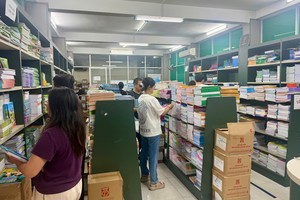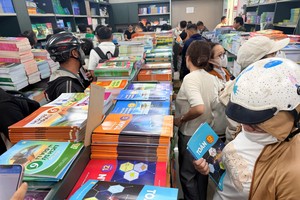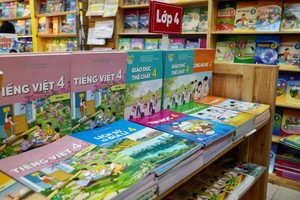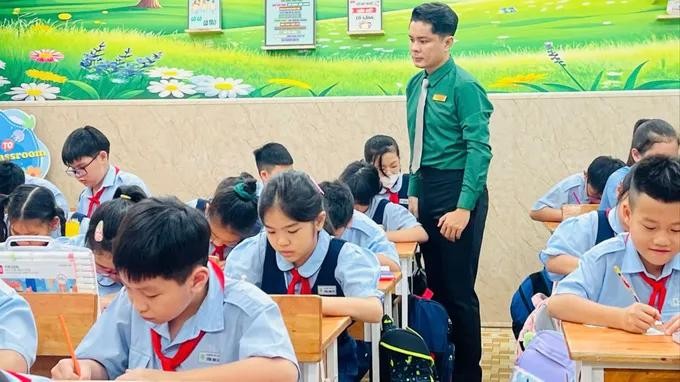
The Politburo’s Resolution 71-NQ/TW on breakthroughs in education development, identifies as a central task the review of the general education curriculum and the provision of a unified national set of textbooks. Reflecting on the four historical textbook reforms, this shift not only aims to standardize teaching content but also ensures equitable access to education.
Vietnam has undergone four textbook reforms
According to a representative of the Vietnam Education Publishing House, Vietnam has undergone four changes in general education textbooks. Before 1956, the education system was structured into three levels: primary (4 years), secondary (3 years), and high school (2 years). During the period 1956-1975, the education sector transitioned from a 9-year to a 10-year education system. In this system, primary school covered grades 1 to 4; secondary school covered grades 5 to 7; and grade 3 was from grade 8 to grade 10.
During this reform, the education program incorporated substantial learning content from socialist countries and was grounded in the principles of mass access, national identity, and scientific rigor. Following the transition, textbooks were revised to align with the new curriculum. The Textbook Editorial Board, under the then Ministry of Education, was responsible for compiling textbooks, while the Education Publishing House, a state-owned enterprise, oversaw their publication.
The period from 1976 to 2000 marked a major turning point with the unification of the education systems in the Northern region and the Southern region. Following the liberation of the South and national reunification on April 30, 1975, the Government Council, in line with the Politburo’s resolution on education reform, assigned the Ministry of Education to develop textbooks and instructional materials for subjects under the reformed program.
Between 1976 and 1981, in the absence of a unified textbook framework, the North operated a 10-year education program while the South maintained a 12-year system. After extensive preparation, reformed textbooks were introduced for Grade 1 in the 1981–1982 school year. From 1982 to 1988, the Education Publishing House completed the development of reformed textbooks for Grades 1 through 9. By 1989, reformed textbooks had been fully implemented for Grades 10, 11, and 12.
To provide high school students (grades 10, 11, and 12) with more opportunities to choose and study appropriate textbooks, the Ministry of Education directed the production of multiple textbooks for Literature and Mathematics. The Literature and Mathematics textbooks for high school were used for 10 years (1990-2000), and in 2000 they were revised and merged into a single set.
The general education curriculum and textbooks underwent their third revision in the period 2002-2008, as required by Resolution 40/2000/NQ-QH10 of the National Assembly, dated December 9, 2000, on reforming the general education curriculum to meet the requirements of developing human resources to serve the industrialization and modernization of the country.
At that time, the Ministry of Education merged with the Ministry of Higher Education and Vocational Training and the General Department of Vocational Training to form the Ministry of Education and Training (MOET). After completing the general education curriculum framework, the Ministry of Education and Training directed the Education Publishing House to compile and publish textbooks in a phased manner from grade 1 to grade 9. Specifically, in the 2002-2003 school year, new textbooks were implemented in grades 1 and 6; in the 2003-2004 school year for grades 2 and 7; in the 2004-2005 school year for grades 3 and 8; in the 2005-2006 school year for grades 4 and 9; and in the 2006-2007 school year, textbooks were completed for grade 5.
Also in 2006, the detailed education curriculum was issued, and textbooks from grades 1 to 9 were printed in a larger format and with a more attractive design than textbooks in previous periods. By 2008, the Ministry of Education and Training directed the Education Publishing House to continue compiling and publishing textbooks for grades 10, 11, and 12.
From 2013 to the present, the education sector has implemented tasks in accordance with Resolution 29-NQ/TW on fundamental and comprehensive reform of education and training to meet the requirements of industrialization and modernization in the context of a socialist-oriented market economy and international integration; and the National Assembly’s Resolution 88/2014/QH13 on reforming the curriculum and textbooks for general education. During this period, textbooks were compiled and published according to the principle of "One curriculum, many sets of textbooks," eliminating the textbook publishing monopoly as in previous periods.
Vietnam to adopt unified textbook system starting 2026–2027 school year
Permanent Deputy Minister of Education and Training Pham Ngoc Thuong affirmed that implementing a unified textbook system nationwide is a strategic step toward achieving a breakthrough in education and training, in line with the Politburo’s Resolution 71-NQ/TW. This approach ensures that all Vietnamese students, whether in urban centers or remote areas, have access to a standardized and equitable foundation of knowledge.
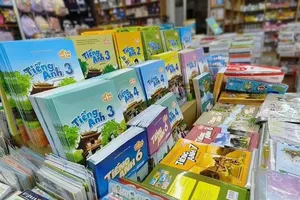
Among the textbook systems implemented during the "One Curriculum, Many Textbooks" phase, the "Connecting Knowledge with Life" textbook system was chosen as the unified textbook system from the 2026-2027 school year, as it is the most widely used nationwide. Therefore, the unified implementation of this textbook system will not cause significant disruption to the organization of teaching and learning in secondary schools.
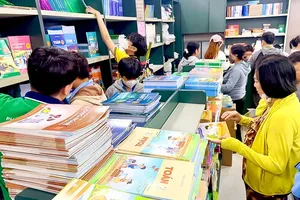
Furthermore, the “Connecting Knowledge with Life” textbook series is owned by the Vietnam Education Publishing House, a wholly state-owned enterprise with the technical capacity, warehousing, and distribution systems necessary to ensure a reliable supply of textbooks to students nationwide, including those in remote and island areas.
A representative from the Ministry of Education and Training affirmed that the implementation of the unified textbook series does not negate the scientific, pedagogical, and practical value of the previously reviewed and approved textbook series. In particular, during the transition period, the remaining textbook series will not be eliminated but will shift from their role as core textbooks to reference materials and supplementary learning resources. School libraries will continue to store, access, and use these textbooks, providing teachers and students with additional reference materials and enriching the content of teaching and learning.
The Ministry of Education and Training will strengthen its communication efforts to ensure that teachers, parents, and the broader public fully understand the policy of implementing a unified set of textbooks nationwide. This approach is expected to ease the burden on teachers, standardize teaching content, promote equitable access to knowledge for students, and reduce costs.