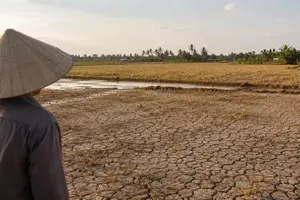
This afternoon, in an interview with the press, Nguyen Hong Khanh, Deputy Director of the Department of Irrigation Works Management and Construction under the Ministry of Agriculture and Environment, cautioned that localized water shortages may hit the Southeast and Central Highlands in late March and April, while saltwater intrusion in the Mekong Delta is expected to intensify, threatening farmland and daily water supplies.
Moreover, the drought and saltwater intrusion in southern provinces during the 2025–2026 dry season remain broadly in line with previous years, though certain areas face heightened risk of localized water shortages at the peak of the season.
According to Deputy Director Nguyen Hong Khanh, meteorological and hydrological agencies forecast rainfall and river flow in the Southern region (South Central, Southeast, and Mekong Delta) to be approximately at the average level of previous years. However, due to entering the peak of the dry season, the total water volume remains low. Water reserves in irrigation reservoirs and some hydroelectric reservoirs serving agricultural production currently reach approximately 70 percent-80 percent of their designed capacity.
In the South Central region, the total storage capacity of irrigation reservoirs currently reaches approximately 80 percent of their designed capacity, about 9 percent higher than the multi-year average. In the Southeast region, storage capacity reaches approximately 71 percent, 9.7 percent higher than the multi-year average.
At present, the water resources derived from irrigation and hydroelectric systems largely satisfy the requirements for winter-spring crop production. Nevertheless, regions that fall outside the coverage of irrigation infrastructure or those with limited-scale projects remain vulnerable to drought and water scarcity towards the conclusion of the dry season, as reported by Mr. Nguyen Hong Khanh.
Mr. Nguyen Hong Khanh cautioned that the Southeast region and the southern Central Highlands may face localized water shortages towards the end of March and during April. In the Mekong Delta, saltwater intrusion is presently occurring at levels comparable to the multi-year average. In certain areas, this has impacted water resources essential for both production and daily living.
He warned that from now until October, approximately 18,000 hectares of agricultural land in this area are likely to be affected by saltwater intrusion.
The Deputy Director of the Department of Irrigation Works Management and Construction forecast that from now until May, flows from the upper Mekong River to the Mekong Delta will continue to decline. The peak of saltwater intrusion at the Mekong River estuaries is expected around March 19–23, when the 4 grams-per-liter salinity boundary may push 42–55 kilometers inland.
At the Vam Co and Cai Lon river mouths, saltwater intrusion could occur in several waves from March 19 to 23, March 30 to April 4, and April 18 to 21 with the 4g/liter salinity line penetrating about 65–70 kilometers inland.
According to representatives from the Department of Water Resources Management and Construction, thanks to the irrigation system already invested in the Mekong Delta, the current ability to control saltwater intrusion is relatively proactive, so the risk of widespread water shortage is not significant. However, water resources in this area still depend heavily on the flow from the upper Mekong River, therefore close monitoring of the operation of hydropower reservoirs upstream is necessary.
In addition, some downstream areas still need to be wary of the risk of localized water shortages, including Tay Ninh, Dong Thap, Vinh Long, and Ca Mau provinces especially in irrigation systems such as Go Cong, Nam Mang Thit, Long Phu - Tiep Nhat and Nhat Tao - Tan Tru.




)