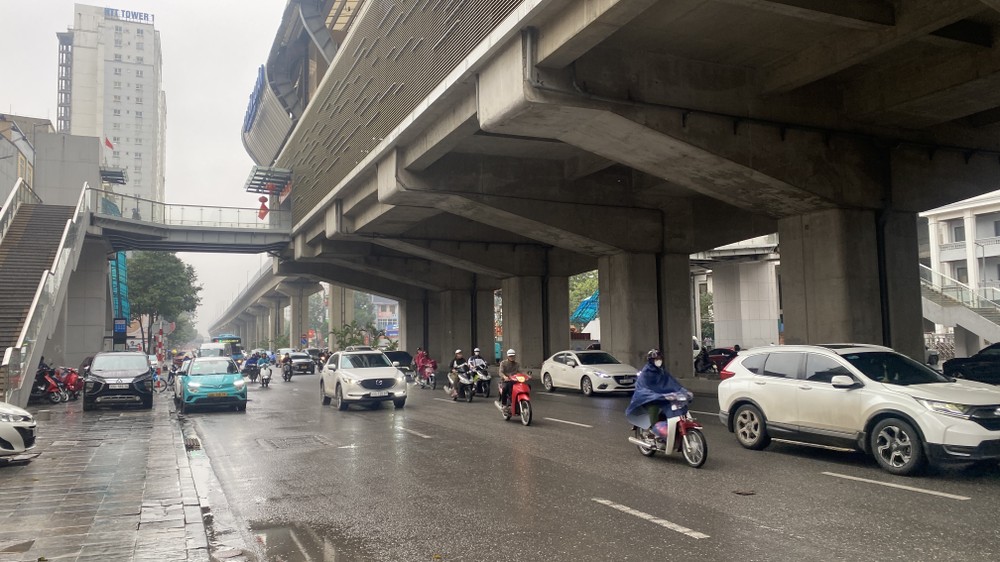
Light rain was recorded in Hanoi, the Northeastern region, and Thanh Hoa Province on February 24. In Hanoi, widespread fog and persistent drizzle left roads slick throughout the day, reducing visibility and affecting traffic. However, traffic density after the Lunar New Year holiday remained relatively low, preventing serious congestion during peak hours.
According to the National Center for Hydro-Meteorological Forecasting, the precipitation in Hanoi on February 24 was typical spring drizzle with light rainfall totals. From February 25 to 26, scattered showers are expected across the Northern region, as well as Thanh Hoa and Nghe An provinces, with common rainfall ranging from 10 to 30 mm and isolated areas exceeding 70 mm.
Between February 26 and 27, the Southern region, along with Khanh Hoa and Lam Dong provinces, is forecast to experience unseasonal showers and thunderstorms, mainly in the late afternoon and evening. Rainfall is projected at 10 to 20 mm, with localized totals surpassing 50 mm.
Meteorological authorities attributed the rain in the Northern and North Central Coast regions to a convergence zone in the upper atmosphere combined with disturbances within the easterly wind belt. Meanwhile, the unseasonal rain in the Southern region, the South Central Coast, and the Central Highlands is linked to a reinvigorated equatorial low-pressure trough, coupled with localized atmospheric disturbances.
Meteorologists noted that the unseasonal showers in the Southern region, Khanh Hoa and Lam Dong, on February 26–27 may temporarily ease temperatures. However, given that the rainfall will be scattered, short-lived, and intermittent, sunny conditions are expected to quickly return afterward, with localized heat in some areas. Daytime temperatures could rise rapidly, indicating that the current hot spell has not fully subsided but will merely be interrupted during the rainy period.