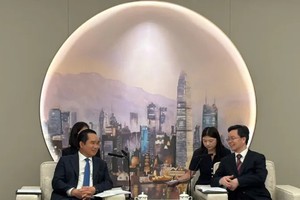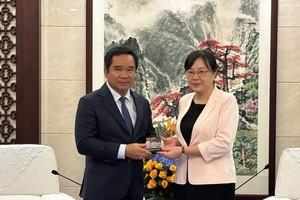
As the architect of the long-term urban vision to develop HCMC into a global megacity, Director Vo Hoang Ngan outlined the objectives and missions of the municipal Department of Planning and Architecture for the upcoming phase.
It has advised on the plan to establish planning frameworks for the city. Its mission now encompasses the formulation, appraisal, and approval of the HCMC General Plan; the formulation, appraisal, and approval of underground space planning; and TOD (Transit-Oriented Development) area planning in accordance with Resolution No.188/2025/QH15 of the National Assembly.
Additionally, it handles specialized technical infrastructure planning under the approval authority of the HCMC People’s Committee, as well as the formulation, appraisal, and approval of urban and rural planning falling under the city’s jurisdiction as prescribed by regulations.
Furthermore, under the Resolution amending and supplementing Resolution 98/2023/QH15, planning across the city will be consolidated into a single “Comprehensive Master Plan.” This will be based on concretizing national and regional planning contents while integrating and embedding the contents of provincial planning and the general city planning. Thus, formulating this Comprehensive Master Plan is considered the essential, central task of the city in the immediate future.
The Director then stressed three specific benefits of the newly approved resolution to HCMC in planning work:
- The Resolution simplifies planning tiers and accelerates investment by mandating a single locally approved Comprehensive Master Plan. This autonomy allows HCMC to resolve infrastructure bottlenecks and attract strategic investors. Additionally, removing requirements for planning tasks and enabling simultaneous zoning significantly streamlines approvals, drastically shortening project preparation timelines.
- The HCMC People’s Committee is empowered to decide on economic-technical indicators and land-use planning indicators that differ from the National Technical Regulations. This flexibility allows for easier adjustments to planning to suit specific practicalities, especially in the post-merger context.
- Piloting the TOD urban development model assists HCMC in restructuring urban space, developing public transport, and generating financial resources through land value capture.
With these decisive policies, the city can proactively accelerate planning timelines and project implementation while simultaneously creating breakthroughs in urban space and attracting strategic future investment.
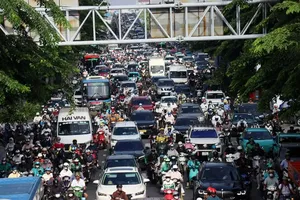
Regarding the priorities of HCMC after merging in terms of inadequacies in traffic infrastructure, land and housing management, construction administration, Director Vo Hoang Ngan shared that his department intends to propose several breakthrough strategies when organizing the formulation of the Comprehensive Master Plan. Among these, transport infrastructure planning is paramount.
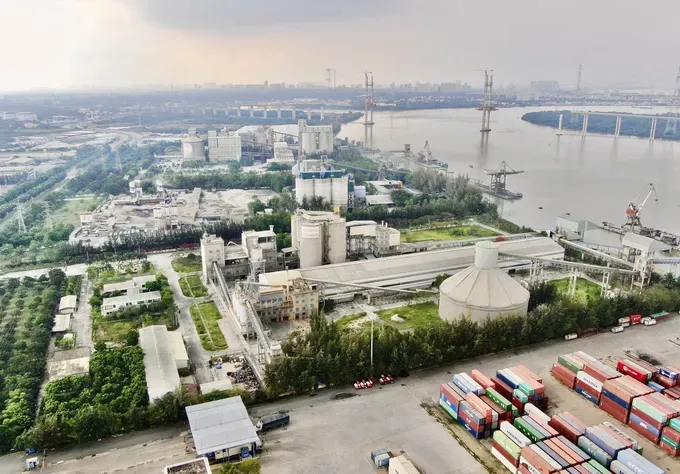
Specific strategies include segregating cargo flows from urban traffic flows; establishing Ring Road 3 as a distribution belt for urban-industrial traffic; and collecting/diverting inter-provincial vehicles to reduce pressure on the inner city. Meanwhile, Ring Road 4 will serve as a logistics-industrial belt connecting industrial zones (in the former Binh Duong area) to seaports (Cai Mep – Thi Vai) and expressways.
Subsequently, the department will plan main connecting transport axes between production centers, urban areas, and logistics hubs (seaports, airports). For instance, the Northeast Axis (Industrial cluster) will link the central core to the seaport gateway in the former Binh Duong area (satellite urban industrial cluster) and the former Ba Ria - Vung Tau area (deep-water ports). The Airport-Seaport-Logistics axis will connect Long Thanh International Airport with ICDs (Inland Container Depots), logistics centers, and the Cai Mep – Thi Vai seaport complex.
HCMC’s transport planning aims to align with a “multi-polar” development orientation. Each pole will have a distinct transport role:
- The Central Pole (HCMC Core): Prioritizes public transport and traffic demand management (reducing personal vehicles, increasing metro/bus capacity, organizing smart traffic).
- The Industrial-Logistics Pole (Former Binh Duong): Prioritizes freight corridors and ICDs, with fast connections to expressway ring roads, limiting container trucks from passing through residential areas.
- The Seaport – Heavy Industry – Marine Tourism Pole (Former Ba Ria - Vung Tau): Prioritizes connections to the port hinterland and cargo flows, ensuring that high-quality passenger transport routes (tourism/weekend travel) are separated from container traffic flows.
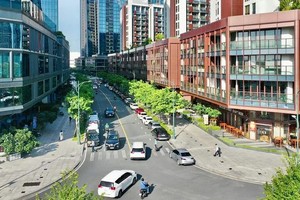
Regarding TOD planning, the Planning and Architecture Department will develop urban areas surrounding high-capacity public transport axes (such as metro and monorail lines), exploiting the TOD land bank to generate capital for direct reinvestment into railway infrastructure.
Finally, Director Vo Hoang Ngan mentioned a possible planning standard set for a “special urban area” after the merger.
HCMC post-merger possesses a massive scale, an expanded development space, and a multi-center, multi-functional nature, featuring an interweaving of existing central urban areas, industrial zones, and ecological spaces.
Currently, existing sets of standards and regulations are primarily built on an urban management foundation suitable for the nature and characteristics of the provinces prior to the merger. Therefore, a distinct set of planning standards for a special urban area post-merger is absolutely essential.
This is because a new set of planning standards will systematize regulations to suit the holistic nature of the post-merger city, ensuring unity and synchronization in technical infrastructure, social infrastructure, and urban space.
Simultaneously, it will address issues such as human quality of life and the environment. Furthermore, building this set of standards serves as a tool to orient the implementation of specific strategies and goals, acting as a basis for executing the details of the Comprehensive Master Plan.

)