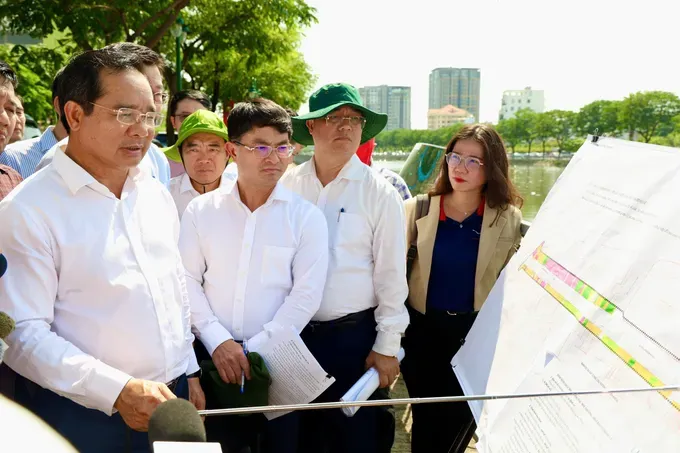
On March 18, Chairman Nguyen Van Duoc led a working delegation to inspect the progress of compensation and site clearance for key infrastructure projects across the city, including the environmental improvement project of Xuyen Tam Canal, the northern embankment of Doi Canal, and the Nguyen Khoai bridge-road project.
At the Nguyen Khoai bridge-road project, with a total investment of over VND3.7 trillion (US$140.7 million), compensation, support, and resettlement efforts are being implemented for 147 affected cases, including 126 households and 21 organizations, with a total land acquisition area exceeding 8,200 square meters. Among these, 12 households are subject to full land recovery, while 135 cases involve partial acquisition.
To date, 109 out of 147 cases have agreed to the compensation plans. Around 99 cases have received payments, accounting for approximately 67 percent of the total; and 81 cases have handed over the site, equivalent to 55 percent. However, 38 cases have yet to reach an agreement due to various reasons, including land disputes; complaints regarding land area and compensation prices; and incomplete inheritance procedures.
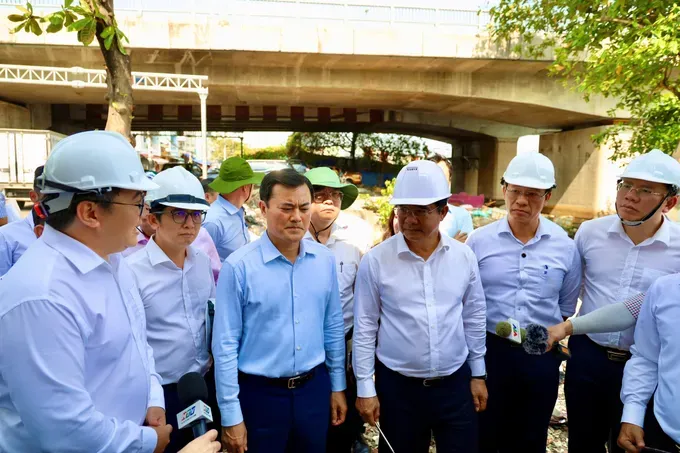
After hearing the report, Chairman of the Ho Chi Minh City People’s Committee Nguyen Van Duoc requested relevant units to accelerate site clearance efforts, with a focus on resolving bottlenecks and outstanding issues. Matters beyond their authority must be promptly reported for timely handling, thereby ensuring the scheduled commencement of the projects.
The Nguyen Khoai bridge-road project holds significant importance as it connects the southern area with the city center. The project has a total length of approximately 2.5 kilometers, including bridges spanning Te Canal and Ben Nghe Canal, along with approach roads, collector roads, and expansion components along Vo Van Kiet Boulevard.
Regarding the construction project of the northern embankment of Doi Canal, according to the Ho Chi Minh City Urban Infrastructure Construction Investment Project Management Board, the project affects a total of 1,604 cases, of which 128 cases have yet to hand over land. Although the overall progress generally meets requirements and is likely to exceed the planned schedule, the project still faces obstacles related to the relocation of technical infrastructure, particularly medium-voltage power lines and transformer stations.

For the Hiep An 2 Bridge project, a technical opening to traffic is expected on April 30; however, progress is currently hindered by the incomplete relocation of the power system. In response, Chairman of the Ho Chi Minh City People’s Committee Nguyen Van Duoc instructed relevant units to clearly define specific timelines for the relocation of technical infrastructure. At the same time, immediate temporary solutions must be implemented to remove bottlenecks and facilitate synchronized construction.
Regarding the Xuyen Tam Canal environmental improvement project, the total investment is estimated at approximately VND17.229 trillion (US$657 million), of which compensation costs account for over VND14 trillion (US$532 million). The project spans multiple wards, affecting a total of 2,190 cases. To date, compensation has been disbursed to 2,011 cases, achieving a high rate of implementation.
However, to ensure the implementation of key construction packages, particularly XL-01, XL-02, and XL-03, localities have been required to urgently complete site handover within this month. In cases where full clearance cannot be achieved, a phased handover approach should be adopted to avoid idle land, prevent resource wastage, and minimize impacts on construction progress.
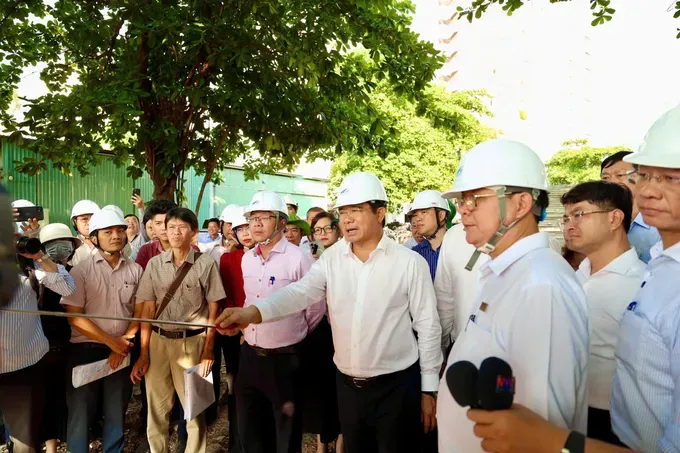
Concluding the working session, the Chairman of the municipal People’s Committee called for an acceleration of site clearance across all projects, with particular emphasis on the Xuyen Tam Canal project. Accordingly, the full handover of land must be completed no later than June 2026.
He also directed relevant wards to step up advocacy and public communication efforts to encourage residents to comply with established policies. For cases where compensation has been received but relocation has not yet taken place, clear commitments on handover timelines must be secured. Non-compliant cases will be subject to enforcement measures in accordance with the law, which may include fines, legal action, or other penalties aimed at ensuring compliance with the established policies.
Additionally, Mr. Nguyen Van Duoc underscored the responsibility of local authorities in ensuring adequate resettlement conditions. Where permanent resettlement housing is not yet available, temporary accommodation must be proactively arranged to help residents stabilize their lives and prevent any delays in project implementation.

)