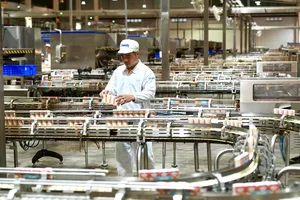
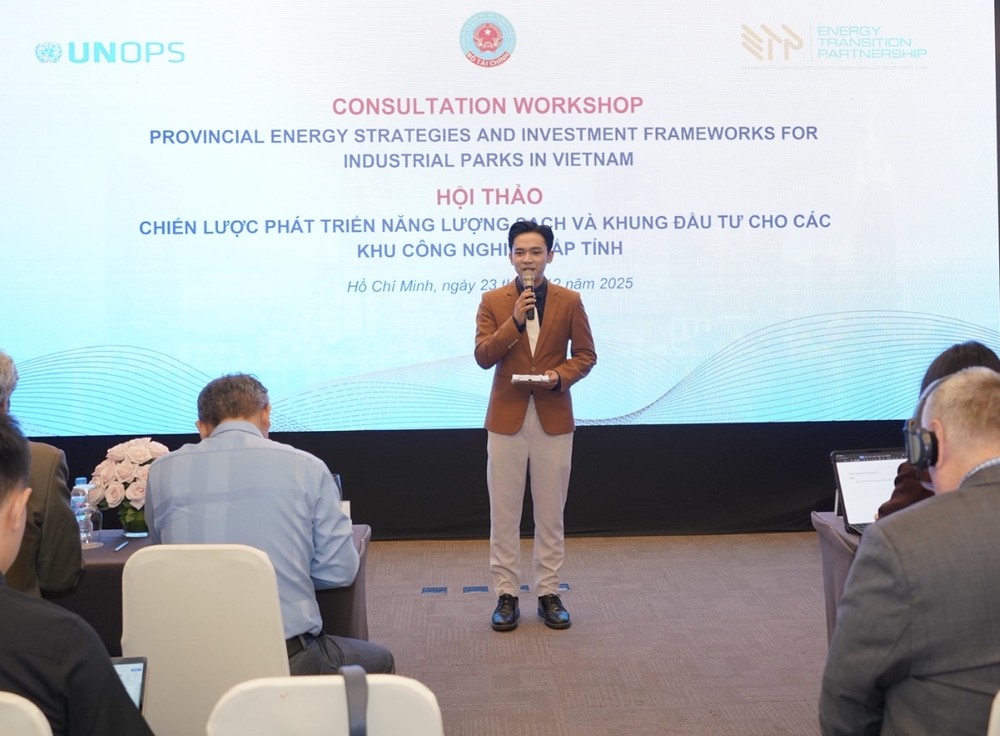
The Ministry of Finance, in coordination with several agencies, convened a seminar on the “Provincial Energy Strategies and Investment Frameworks for Industrial Parks in Vietnam” on December 23 in HCMC.
According to the Vietnam Energy Association (VEA), the European Union’s Carbon Border Adjustment Mechanism (CBAM) has been fully enforced since early 2025 for key sectors, including steel, aluminum, cement, and electricity. At the same time, RE100 commitments—a global initiative that requires companies to source 100 percent of their electricity from renewable energy—by multinational corporations such as Samsung, Apple, and Intel, are exerting mounting pressure across supply chains operating in industrial parks.
In practice, roughly 80 percent of foreign direct investment (FDI) enterprises now give priority to industrial parks equipped with green energy infrastructure. VEA projects that by 2030, renewable electricity demand in industrial parks could account for around 25 percent to 30 percent of total industrial load. Notably, businesses are seeking not only “clean power” but also Energy Attribute Certificates (EACs) to meet sustainability reporting and emissions accounting requirements. Among these, I-REC and Guarantees of Origin (GO) are widely used to verify that electricity consumption is sourced from renewable energy.
Rooftop solar power is increasingly viewed as a solution well-suited to Vietnam’s industrial park conditions. Nationwide, Vietnam currently has 428 industrial parks and more than 1,000 industrial clusters, hosting nearly 80,000 enterprises. The rooftop solar potential across industrial parks is estimated at 20,000 to 25,000 MWp.
During the 2024–2025 period, total installed rooftop solar capacity within industrial parks exceeded 3,200 MWp, with approximately 25 percent of systems integrated with Battery Energy Storage Systems (BESS). Electricity generated from self-produced, self-consumed rooftop solar is currently about 10 percent to 15 percent cheaper than peak-hour grid electricity prices.
BESS is widely regarded as a critical component for maximizing the efficiency of renewable energy deployment. With rapid response capabilities and surplus power storage, BESS helps reduce peak loads and enhance grid stability. In particular, the sharp decline in lithium-ion battery prices—from around US$800 per kWh to below $120 per kWh over the past decade—has brought many storage projects close to economic viability. Lithium-ion technology currently accounts for more than 90 percent of the global BESS market.
Under the adjusted National Power Development Plan 8, Vietnam aims to develop 10,000 to 16,300 MW of BESS capacity by 2030. However, VEA notes that the absence of mechanisms for ancillary service payments, storage pricing frameworks, and a clear legal corridor for intra-park power sharing remains a major bottleneck.
As an estimated 80 percent of manufacturing sectors across Asia are expected to face supply-chain emissions control requirements by 2030, accelerating policy completion for rooftop solar and BESS in industrial parks is increasingly seen as imperative to strengthening the competitiveness of Vietnamese enterprises.





)