In the new year of 2026, several expressway projects in the Mekong Delta have been put into operation, including the Can Tho–Ca Mau Expressway. This key segment completes the eastern North–South Expressway, linking Lang Son in the North to Ca Mau. The newly operational routes are set to drive robust socio-economic growth across the “Land of Nine Dragons.”

Removing bottlenecks
In the early days of the New Year, residents of Ca Mau celebrated the inauguration of the Can Tho–Ca Mau Expressway. This milestone marks the “first spring” in which people can travel nonstop by expressway from Ca Mau to Ho Chi Minh City.
Reflecting on the historic moment, Nguyen Van Khen, who lives in An Xuyen Ward, shared that he is nearly 70 and often goes to Ho Chi Minh City for medical treatment. Each trip used to mean more than seven exhausting hours on a coach. Now it’s much better, the expressway has nearly halved travel time. A long-standing dream of Ca Mau residents has finally become a reality.
Dr. Tran Khac Tam, Chairman of the Soc Trang Business Association, noted that bringing the expressway into operation helps untangle three key bottlenecks.
First, travel efficiency, shorter transit times between production, processing and distribution hubs give enterprises greater flexibility in organizing shipments, particularly for perishable agricultural and seafood products.
Second, supply chain reliability, by easing congestion and reducing the risk of accidents or delays, the expressway enhances supply chain consistency and helps curb previously high indirect logistics costs.
Third, regional connectivity, stronger links to strategic transport gateways such as Can Tho International Airport, seaports and logistics centers streamline cargo movement and lower overall transshipment costs.
While official figures are not yet available, experience from other operational expressways suggests average savings of 15 percent to 25 percent in total operating costs (fuel, depreciation, labor) per trip along main routes.
For the Mekong Delta, shortening transportation and distribution time is vital. It enhances the added value of agricultural and seafood products while enabling them to better comply with the rigorous standards of global markets.
Opening up new opportunities
Beyond cost savings, many experts believe the Can Tho–Ca Mau Expressway will have a significant impact on attracting investment and transforming production mindsets. Improved transport infrastructure will serve as a “magnet” for major investors, particularly foreign-invested enterprises in agricultural and seafood processing.
Processing plants are likely to relocate closer to raw material areas, setting up in industrial parks along the expressway to optimize inbound and outbound logistics. The large and stable demand from these factories will, in turn, require changes in agricultural production, moving away from fragmented, small-scale traditional practices toward more organized and large-scale models.
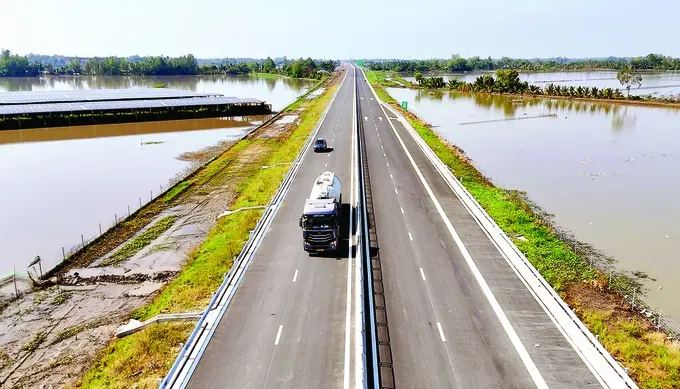
Mr. Nguyen Phuong Lam, Director of the Mekong Delta Branch of the Vietnam Chamber of Commerce and Industry, noted that once the expressway becomes operational, the region’s longstanding weaknesses in transport infrastructure and logistics costs will be quickly addressed. Localities should seize this opportunity to make focused investments in remaining infrastructure. As logistics costs decline, both domestic enterprises and foreign investors are expected to increasingly turn to the Mekong Delta, accelerating regional economic growth.
Mr. Nguyen Ho Hai, Secretary of the Ca Mau Provincial Party Committee, emphasized that the Can Tho–Ca Mau Expressway is a key segment that completes the eastern North–South Expressway, linking Lang Son in the North to Ca Mau. This breaks Ca Mau’s long-standing road transport isolation and creates a high-speed transport corridor connecting the province with key Mekong Delta localities and the economic hub of Ho Chi Minh City.
Shorter travel times and reduced logistics costs will enable the province’s key products, especially seafood, marine products, and high-quality agricultural goods, to reach markets faster and enhance their competitiveness.
The completion of the Can Tho–Ca Mau Expressway, followed by a series of projects including the Ca Mau–Dat Mui Expressway, the road to Hon Khoai Island, the dual-use Hon Khoai Port, and the upgrade of Ca Mau Airport, will form a comprehensive strategic infrastructure system. This integrated network will play a decisive and breakthrough role in Ca Mau’s development in the coming years.