After being upgraded by FTSE Russell to Secondary Emerging Market status in October 2025, the Southeast Asian country’s stock market is now awaiting the results of the March 2026 mid-term review, which is expected to be announced on April 8. This is seen as a critical confirmation step, paving the way for Vietnamese equities to be officially included in FTSE indices from September 2026.
To meet upgrade criteria, since early 2026, the Ministry of Finance and the State Securities Commission of Vietnam (SSC) have implemented a series of coordinated reforms. Notably, Circular 08/2026, which is effective on February 3, allows foreign investors to trade through global brokerage firms without opening accounts at domestic securities companies, simplifying procedures and aligning with international practices.
At the same time, SSC and the Vietnam Securities Depository and Clearing Corporation (VSDC) have developed a system to automatically verify cash and securities balances between custodian banks and securities firms, effectively removing the pre-funding requirement which is one of the biggest bottlenecks in previous assessments.
Many securities firms are optimistic that, with these reforms, Vietnam’s stock market has a high likelihood of being confirmed by FTSE Russell as on track for an upgrade in the upcoming review. In particular, allowing foreign investors to trade via international intermediaries is seen as the “final piece” enabling the market to fully meet all criteria.
At a recent meeting with the State Securities Commission of Vietnam, Chief Executive Officer Fiona Bassett of FTSE Russell praised the country’s reform efforts, calling them an important step in global financial integration. Wanming Du, Head of Index Policy for Asia-Pacific, noted that removing the pre-funding requirement has brought the market closer to international standards.
Expectations of a reversal in foreign capital flows
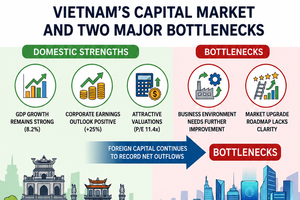
Despite increasingly clear upgrade prospects, foreign investor activity continues to show net selling on the market. After a record net outflow of around VND135 trillion (over US$5.1 billion) in 2025, foreign investors continued to post net sales of approximately VND16.75 trillion in March 2026. Cumulatively, net selling since the beginning of the year has exceeded VND30.5 trillion, up about 18 percent year-on-year.
Explaining this trend, CEO Thieu Thi Nhat Le of UOBAM Vietnam pointed out that the main cause is exchange rate pressure, which has driven capital from Asian funds toward more stable markets, rather than stemming from internal weaknesses of Vietnam’s stock market. Nonetheless, she remains positive about market prospects due to strong domestic growth drivers. The upgrade will mark a turning point, shifting Vietnam from a short-term investment destination to a long-term strategic allocation for international funds. In practice, although overall net selling persists, foreign investors continue selective net buying in fundamentally strong stocks.
According to SSC, major financial institutions such as UBS and Morgan Stanley have recently engaged actively with regulators and are preparing to collaborate with domestic securities firms to enter the market. From a long-term perspective, many economists view the upgrade as a structural development, opening the door to passive inflows from ETFs tracking global FTSE indices, with estimated inflows of US$5 billion–US$6 billion over time.
Head Do Minh Trang of Research at ACB Securities Company (ACBS) estimates that passive inflows could reach US$1.5 billion–US$1.8 billion, while active funds may bring in US$2 billion–US$3 billion in the medium term. The year 2027 is expected to mark a period of stronger and more sustainable foreign capital inflows. Investment opportunities will likely concentrate in large-cap stocks with high liquidity and remaining foreign ownership room.
Capital demand for the 2026–2030 period is estimated at a minimum of VND38.5 quadrillion. Of this, the state budget can only meet about 20 percent, equivalent to more than VND7.7 quadrillion, with the remainder to be mobilized from the broader economy.
As monetary policy space becomes increasingly limited, the capital market, especially the stock market, will play a crucial role in providing medium- and long-term funding for the economy. This presents both a significant challenge and a major opportunity for market development, while creating room for businesses and investors to participate more deeply in economic growth.
Minister of Finance Nguyen Van Thang