A “digital brain” for smart airport operations
The airport’s entire information technology infrastructure has been designed in line with the latest standards of the International Air Transport Association (IATA) and the International Civil Aviation Organization (ICAO), with the flexibility to expand and adopt new technologies in the future.
A key component of the airport’s technology system is the Smart Airport Operations Center (Smart APOC), which serves as the “digital brain” of Long Thanh Airport. It centrally monitors and manages technical systems, security, transportation and airport operations.
Core technologies at Smart APOC include the Airport Operational Database (AODB), the Airport Collaborative Decision Making (A-CDM) system, AI and Big Data for forecasting, alerts and operational optimization, and the Airport Management System (AMS), a comprehensive platform for smart airport management.
These technologies have been researched, developed and mastered by Airports Corporation of Vietnam (ACV).
Passenger journeys are also being digitized at multiple stages. Travelers can check flight information, check-in areas and departure gates through the iACV app, while online check-in and biometric registration are available via iACV and VNeID.
Automated procedures have also been integrated into 96 check-in kiosks and 64 biometric-enabled Self Bag Drop systems, allowing passengers to check in and drop off their luggage themselves.
Long Thanh Airport is equipped with 12 automated facial-recognition security lanes, 28 CT scanners and 28 Automatic Tray Return Systems (ATRS).
CT scanning technology generates 3D images, shortening screening times by eliminating the need for passengers to remove laptops, liquids and electronic devices from their luggage.
Moving toward a green airport
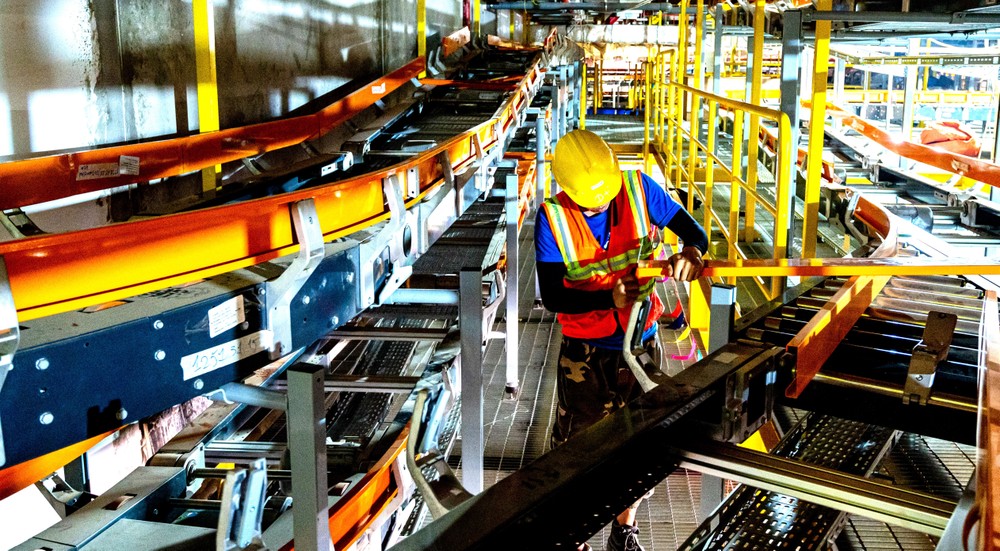
Another key technology system is the smart baggage handling system (BHS), which uses ICS technology and has a processing capacity of 9,157 pieces of baggage per hour, with conveyor belts stretching a total of 24 kilometers.
ACV’s technical team has directly integrated the BHS with the AODB and other operational systems, allowing baggage data to be connected to the airport operations center for monitoring and information processing.
Technology is also being widely deployed on the aircraft apron, with an integrated IASS system coordinating equipment in aircraft parking areas, along with cameras, Internet of Things (IoT) devices, sensors and interconnected safety systems.
The airport has 130 smart Visual Docking Guidance Systems (VDGS) equipped with optical cameras, laser sensors and radar to automatically assist pilots in positioning aircraft accurately, even in low-visibility conditions.
While digital technology provides the airport with its “brain,” green solutions provide the foundation for sustainable development.
Notably, the water treatment and reuse system uses advanced biotechnology modeled on the natural roots of plants, reducing the required area by 70-80 percent and increasing treatment efficiency by 30-35 percent. About 30 percent of treated water will be reused for landscaping, toilet flushing and road cleaning.
Long Thanh International Airport is also planned to have a solar power system and infrastructure ready for green transportation, with a charging network capable of supplying 3,000 kW and serving 180 cars, 24 buses, 70 taxis and 450 electric motorcycles simultaneously.
Another notable feature is the underground aircraft fueling system, which integrates automated monitoring and control through Fuel Control & SCADA. The system monitors pressure, flow rate, temperature and valve conditions while providing leakage warnings.
The underground fueling system is also designed for direct connection, eliminating the need for tanker trucks to transport fuel.
According to ACV’s development strategy, the goal is not simply to introduce technology into the airport, but to gradually make technology a natural part of passengers’ journeys and airport operations.
Once operational, Long Thanh International Airport is expected not only to ease pressure on Tan Son Nhat International Airport but also to become a catalyst for a new development hub connecting Ho Chi Minh City, Dong Nai City and other localities in the region.
With its technology infrastructure being developed from the outset and a focus on mastering core technologies, Long Thanh Airport is expected to pursue green and sustainable development while having the capacity to compete with major airports in the region.