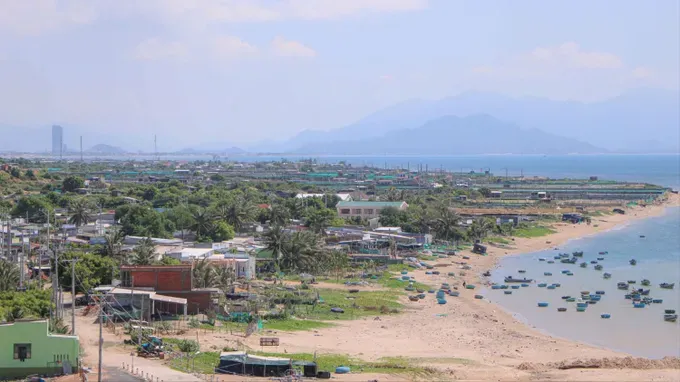
In Phuoc Dinh Commune, the project’s core area, local authorities are working to untangle a complicated web of land records, legal issues and personnel shortages, while residents remain concerned about losing their livelihoods and starting over in an uncertain new environment.
The project affects 1,129 cases across 515 hectares, according to the Phuoc Dinh Commune People's Committee. By early August, 1,074 cases, or 95.1 percent, had undergone land-use origin verification. However, compensation plans had been approved for only 235 cases, while just 56 had received payments.
Under the Khanh Hoa provincial government’s schedule, site clearance for the project was supposed to be completed in June 2026, but the work has fallen behind schedule.
Nguyen Minh Tuan, Acting Chairman of the Phuoc Dinh Commune People's Committee, said that the site clearance process is facing a complicated system of land records.
After reviewing 19 major groups of cases, authorities identified 55 cases in which other individuals were listed as nominal landholders for a total area of 43.5 hectares. Various methods had allegedly been used to create land records to circumvent landholding limits, while handwritten transfer agreements had been backdated, resulting in discrepancies between legal documents and actual land use.
One case involves L.V.S., who has 22.9 hectares of land. About 10 hectares was registered under the names of nine other people. However, verification showed that the entire area actually belonged to S.
Similarly, 13 people were listed as landholders for 1.8 hectares used by the household of N.V.C. Verification found that the entire area was actually under C.’s use.
Such discrepancies have put local authorities in a difficult position. Relying solely on land-use certificates could result in incorrect compensation, while excluding listed holders from compensation could infringe on legitimate rights.
In addition, 21 land-use certificates issued between 2023 and 2025 are being reviewed over suspected regulatory violations.
A representative of the Phuoc Dinh Commune People’s Committee said that the workload was substantial, while the local implementation team was understaffed. The commune’s Economic Division currently has only two people handling compensation for the mega-project.
The Ninh Thuan nuclear power project consists of two plants, including Ninh Thuan 1, with a capacity of about 2,400MW in Phuoc Dinh Commune, and Ninh Thuan 2, with a capacity of about 2,200MW in Vinh Hai Commune.
The project was suspended in 2016 to balance resources before the 13th Party Central Committee officially agreed to resume it on November 25, 2024. Under the development plan, the two plants are expected to begin operation between 2031 and 2035.
At the Ninh Thuan 2 project in Vinh Hai Commune, authorities have approved compensation, support and resettlement plans for 814 of the 841 affected cases, or nearly 96.8 percent, with a total budget of VND1.767 trillion (US$67.3 million). Of these, 726 households have received more than VND1.616 trillion (US$61.6 million).
Despite the progress, the site has not yet been fully cleared. In the plant area alone, 65 households have yet to receive compensation due to property disputes, complaints over compensation prices for grape-growing land, or requests for resettlement.
To resolve the problems, the Phuoc Dinh Commune People's Committee has asked the Khanh Hoa provincial government to seek guidance from the Ministry of Agriculture and Environment on consistent application of the law, reducing risks and avoiding complaints. It has also proposed extending the site-clearance deadline to allow for more thorough reviews.
The commune has proposed determining compensation eligibility based on actual verification results, temporarily suspending approval of land areas covered by the 21 land-use certificates under review, and applying compensation limits to each component project.
It has also proposed establishing a specialized task force to directly appraise compensation and resettlement plans while the local administrative apparatus is being reorganized and staffed.
While authorities continue to grapple with documents, procedures and legal issues, residents in Vinh Truong Hamlet, where the Ninh Thuan 1 plant will be located, remain stuck in uncertainty.
After living in the planned project area for 15-20 years, residents are urging authorities to resolve the outstanding issues and provide clear outcomes so they can stabilize their lives.
About 85 percent of workers in Phuoc Dinh earn their living as hired laborers at snail-farming ponds. When land acquisition notices were accompanied by a ban on aquaculture activities for the project, many residents lost their jobs and became unemployed.
The head of a bank lending group in Phuoc Dinh Commune said residents were facing growing financial pressure as compensation payments had yet to be made and the new resettlement area remained unfinished. The situation is particularly challenging for households that borrowed money for production. Some have outstanding loans of VND200 million-VND400 million (US$7,600-US$15,200), while the lending group, comprising more than 100 households, has total outstanding loans of over VND22 billion (US$838,000).
Nguyen Thanh Du, a resident of Vinh Truong Hamlet, said residents were concerned that the proposed compensation rate of about VND3 million-VND3.2 million (US$114-US$122) per square meter for residential land, including support, would not be sufficient for them to rebuild their lives.
The amount would not be enough to build a new house comparable to their current homes, he said, adding that multi-generational families unable to subdivide their land are particularly concerned that additional households may not be eligible for separate resettlement plots.
Trinh Minh Hoang, Vice Chairman of the Khanh Hoa provincial People's Committee, said most policy and institutional obstacles had been resolved, but verifying land origins and actual land users remained the biggest challenge.
The provincial leader asked Phuoc Dinh Commune to settle outstanding cases and strictly punish violations involving attempts to exploit policies for personal gain.
With the principle of “acting quickly, thoroughly and correctly,” compensation and resettlement work must both meet the project schedule and protect residents’ legitimate rights while ensuring compliance with the law, he said.
Residents said authorities should quickly publicize a clear compensation roadmap, apply prices close to actual market conditions and, in particular, accelerate construction of the project’s resettlement infrastructure, which remains largely an unfinished, cleared site.
People living in the project area are seeking clearer support as they prepare to “start their lives over” after two decades of waiting.
On March 30, 2026, the National Assembly Standing Committee issued Resolution No. 121/2026/UBTVQH15, supplementing and adjusting special mechanisms and policies for investment in the Ninh Thuan nuclear power project under National Assembly Resolution No. 189/2025/QH15.
Under the resolution, eligible land users whose land is acquired, as well as owners of assets attached to the acquired land, will receive compensation at 1.5 times the prescribed rate.
People whose eligible agricultural land is acquired and who qualify for support for vocational training, job conversion and employment assistance will receive cash support of up to five times the agricultural land price in the land price table, multiplied by 1.5 for land within the prescribed limit.
Eligible people for resettlement will be exempted from 100 percent of land-use fees for the minimum resettlement allocation.
For people whose acquired agricultural land, other than rice land, had been converted to another use without requiring permission but whose land-use changes had not been registered, compensation will be based on the actual land use.