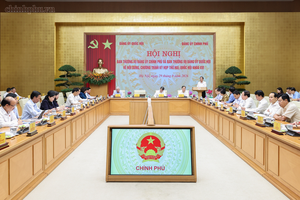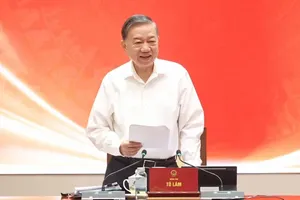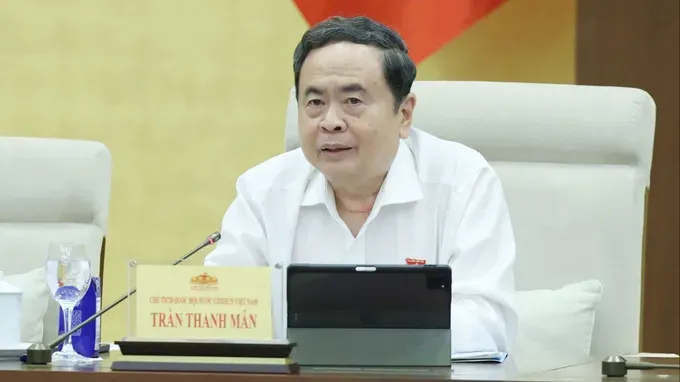
The statement was made by National Assembly (NA) Chairman Tran Thanh Man at the fifth session of the NA Standing Committee on Monday morning, August 17, to review the explanation, reception, and revision of the draft Law on Urban Development.
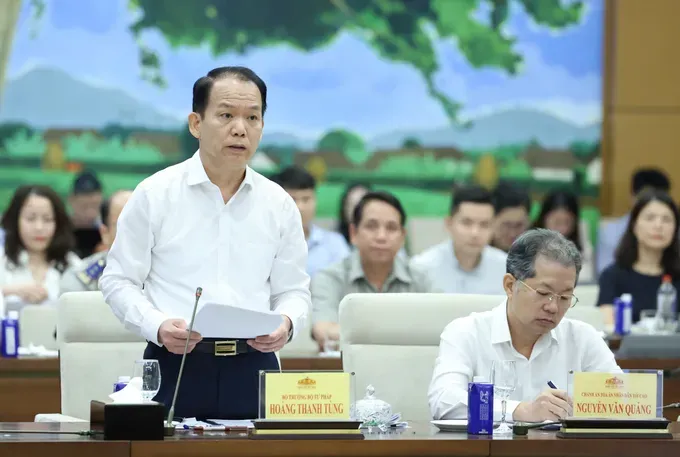
Presenting the report at the meeting, Minister of Justice Hoang Thanh Tung stated that, incorporating lawmakers' feedback, the draft transfers the authority to approve condominium redevelopment and reconstruction projects from the Municipal People’s Committee to the Municipal People’s Council to better safeguard citizens' property rights and housing interests.
Regarding administrative sanctions, the draft empowers the Municipal People’s Council to impose fines up to double the national standard for certain administrative violations in areas such as fire safety, search and rescue, and traffic safety.
The verification report by the Standing Committee of the National Assembly’s Committee on Law and Justice focused on eight major points, emphasizing that the addition of any new policies must strictly adhere to procedures stipulated under the Law on Promulgation of Legal Documents.
Addressing proposals on free trade zones and logistics hubs in provinces, the review committee advised against expanding the bill's scope to cover these areas, as they fall outside the draft law’s jurisdiction.
Concerning land reclamation in urban areas, the Government proposed adding a new chapter to the draft bill featuring multiple incentive policies to attract strategic investors for sea reclamation projects valued at VND100 trillion (US$3.82 billion) or more. However, noting that this represents a major, new policy shift, the review committee demanded a thorough impact assessment, public consultation, and full compliance with the legislative procedure, cautioning against immediately embedding the provision into the draft before conditions are met.
Clarifying the matter, Minister Hoang Thanh Tung added that sea reclamation was not part of the Government's official submission for this session.
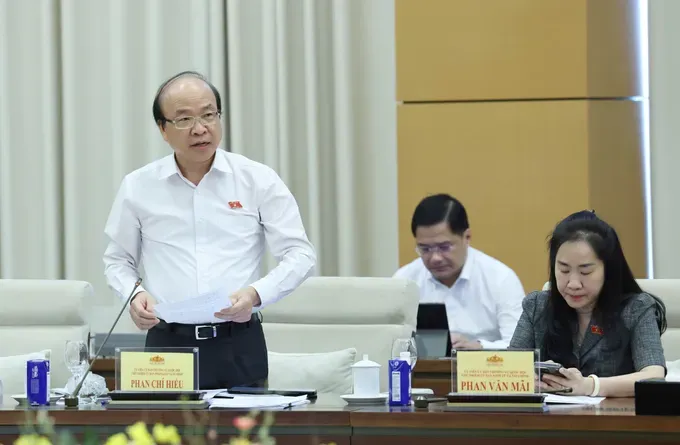
The Government has directed the drafting of an “integrated draft table” incorporating provisions on land reclamation at sea so that competent authorities can have a comprehensive overview. However, this does not mean that these provisions have been officially submitted in accordance with the prescribed procedures, the Minister of Justice clarified.
Minister Hoang Thanh Tung expressed full agreement with the reviewing agency’s view that all necessary steps must be completed, including appraisal, review, organization of consultation workshops, and other relevant procedures, before the draft is submitted to the National Assembly for consideration and approval. The Government will continue to report on the matter for the National Assembly Standing Committee to provide its opinions in the coming period.
Offering recommendations to further refine the draft law, National Assembly Chairman Tran Thanh Man noted that despite the tight timeline, the draft had been supplemented and revised with many important provisions.
Regarding sea-reclaimed urban areas, the NA Chairman agreed that a framework of regulations should be incorporated into the law rather than separate regulations being issued for individual localities, as was the case with the 1,500-hectare project in Da Nang. The Government, he said, would be responsible for the specific regulations to be issued subsequently.
The core objective of the law is to remove bottlenecks and create momentum for the development of major urban areas. The law must be finalized swiftly and streamlined so that it can take effect on October 1, ensuring that Ho Chi Minh City is not placed at a disadvantage and has a sufficient legal basis to implement its development policies without falling behind schedule, National Assembly Chairman Tran Thanh Man emphasized.
Concluding the session’s discussions, National Assembly Vice Chairman Nguyen Khac Dinh underscored the firm commitment to meeting both the timeline and procedural requirements. If new policies are added, the legislative agenda must be adjusted to allow National Assembly deputies sufficient time to discuss them in group and plenary sessions before voting, with the goal of passing the law during this session.