The Ministry of Science and Technology has announced the results of the 2026 Provincial Innovation Index (PII). Ho Chi Minh City ranked second nationwide and led in 12 of the 52 component indicators. However, it remained 6.35 points behind top-ranked Hanoi, scoring 59.33 compared with Hanoi’s 65.68, while its scores were close to those of Hai Phong and Quang Ninh, which ranked next.
Ho Chi Minh City improved its input score from 60.59 to 65.21 compared with the previous year, reflecting factors such as science and technology infrastructure, the business environment, and research and development (R&D) activities. However, its output score fell from 58.36 to 53.44, dropping the city to fourth place in this category. This indicates that although the city enjoys leading advantages in institutions, infrastructure, markets, and human resources, its outcomes—including patents, science and technology enterprises, productivity, and production value—have yet to match these favorable conditions.
The city’s ranking for institutions rose from 30th to seventh, while it ranked first in infrastructure. Administrative reform, e-governance, and education spending also improved, indicating that progress has largely been driven by the public sector. Meanwhile, the share of budget spending on science and technology, at around 0.05 percent of gross regional domestic product (GRDP); the number of science and technology enterprises; collective trademarks; and local government dynamism as measured by the Provincial Competitiveness Index (PCI) have stagnated.
At the same time, the business sector and innovation outputs have weakened. Labor productivity growth was close to zero, ranking the city 33rd out of 34 localities. Fair competition, as measured by the PCI, R&D personnel, and the proportion of trained workers also declined.
The result is a dynamic city that has yet to translate its institutional, infrastructural, and technological advantages into stronger outcomes. Beyond several objective factors, the main reason is that businesses have not become the center of innovation. R&D investment accounts for just 0.08 percent of GRDP, while links between businesses and research institutes and universities remain weak. As a result, innovation has yet to translate into productivity gains.
These shortcomings have been highlighted at various forums and consultation conferences. They include the lack of tangible outcomes from sandbox mechanisms designed to allow controlled risk-taking, as well as limited results from the “triple helix” cooperation model involving the State, scientists, and businesses. In particular, the State has yet to fully exercise its role as the first customer for businesses and researchers.
Although more than a year has passed since the Politburo issued Resolution No. 57-NQ/TW on breakthroughs in science and technology development, innovation and national digital transformation, the resolution has yet to deliver tangible outputs, and Ho Chi Minh City has even fallen in the rankings compared with its own previous performance. With science and technology and digital transformation identified as strategic pillars, the weak impact of their outcomes on production and business activities clearly shows that much more remains to be done.
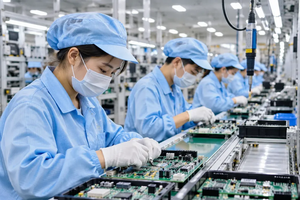
The city has an open policy framework, extensive infrastructure, reputable universities and research institutes, and funding. However, long-standing weak links between universities, research institutes, and businesses have prevented the city from creating leverage to attract business investment. Science and technology enterprises account for only 1.05 per 1,000 businesses, while innovative startups make up just 2.24 percent of newly established enterprises. This is partly due to an economic structure heavily reliant on trade, services, and contract manufacturing, meaning innovation has yet to translate into higher productivity. Labor productivity barely increased in 2024, while the city’s ranking for indicators measuring the impact on production and business activities fell from 24th to 32nd out of 34 localities.
Ho Chi Minh City will make greater efforts to return to the top two in terms of output indicators. More importantly, it must genuinely turn inputs into practical, usable results. This also demonstrates the goal of translating Resolution No. 57 into tangible action.
Specifically, businesses must be placed at the center of innovation through a range of measures, including increasing budget spending on science and technology in line with Resolution No. 57; using seed funding to mobilize business investment in research and development (R&D); commissioning research to address business needs; recognizing science and technology enterprises; and implementing productivity improvement programs for manufacturing businesses.
The city should consider assigning each sector targets for surveying businesses on R&D and innovation while reviewing labor productivity data. It should also address gaps in output indicators and the business environment by promoting collective trademarks, geographical indications, and the One Commune One Product (OCOP) program; improving weak indicators in the Provincial Competitiveness Index (PCI); and increasing the proportion of trained workers in areas formerly part of Binh Duong and Ba Ria–Vung Tau.
Ultimately, outputs that reach society and the market will be the decisive measure of success.