Ho Chi Minh City is progressively implementing transit-oriented development (TOD) urban planning, integrating residential spaces, employment hubs, and services with its public transportation system.
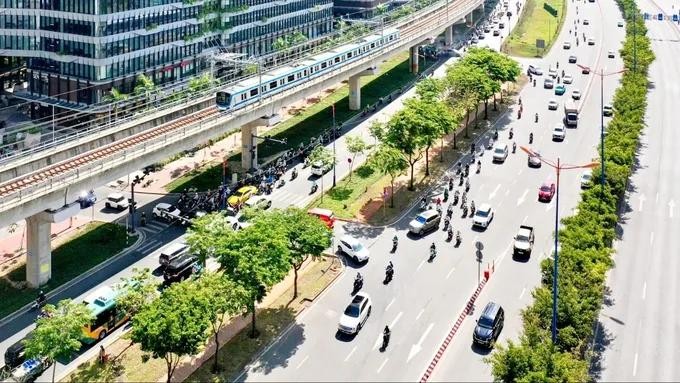
If executed synchronously, TOD will contribute to shaping compact urban areas, redistributing the population, and easing pressure on the city center.
Shaping urban spaces around metro stations
The Ho Chi Minh City People's Council recently passed Resolution No. 56/2026/NQ-HDND, which regulates the preparation, appraisal, approval, and adjustment of alignment and facility location plans for local railway lines. The resolution also governs TOD area planning, land-use parameters, economic-technical criteria, planning land-use targets, and spatial organization requirements across TOD areas within the city.
The resolution implements Points b and c, Clause 1, Article 13 of the Law on Urban Development. Speaking with reporters from SGGP Newspaper, Phan Van Tuan, Deputy Director of the Ho Chi Minh City Department of Planning and Architecture, noted that under Resolution No. 56, the planning research scope for TOD areas is set at a maximum radius of 1,000 meters from the designated center of urban railway (metro) stations and depots.
From a technical standpoint, this boundary considers two key factors: public transit accessibility and the demand for harmoniously integrated urban functions and amenities. Assuming a walking speed of 4–5 km/h, a 500-meter walk takes approximately 6–8 minutes, 1,000 meters takes roughly 12–15 minutes, and 2,000 meters takes around 24–30 minutes, excluding road-crossing wait times and movement inside the stations.
In Singapore, public transit accessibility guidelines reference an 800-meter or 10-minute walk to MRT stations. Similarly, the TOD program in the state of New South Wales, Australia, applies a 400-meter walking radius around selected stations.
Based on the TOD planning boundaries established under Resolution No. 56, the land-use structure is studied toward mixed-use development that combines housing, commerce, services, offices, social infrastructure, and public spaces, tied directly to station accessibility.
HCMC aims to enhance convenience for residents
According to Director Tran Quang Thang of the Ho Chi Minh City Institute of Economics and Management, the city should establish tailored TOD models for different zones, such as central urban renovation areas, existing residential areas, and new urban zones. Each model would carry distinct metrics for density and floor area ratios.
According to Associate Professor Le Trung Chon, Director of the Institute for Sustainable Development Research at Ho Chi Minh City University of Natural Resources and Environment, transit-oriented development (TOD) should be understood in its fundamental sense as a planning model that integrates housing, employment, services, and public spaces with the public transportation network.
He noted that the key challenge is to organize urban space around metro stations in a way that makes daily life more convenient, improves residents’ access to jobs and essential services, and encourages the regular use of public transport.
Le Hoang Lan Nhu Ngoc, Senior Director and Head of Strategic Consulting at Cushman & Wakefield Vietnam, emphasized that the ultimate goal of TOD development is to enhance accessibility, land-use efficiency, and urban productivity.
While the city center continues to hold a primary role, areas along Metro Line No. 1 have strong potential to evolve into new commercial, service, and employment hubs.