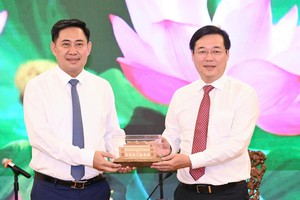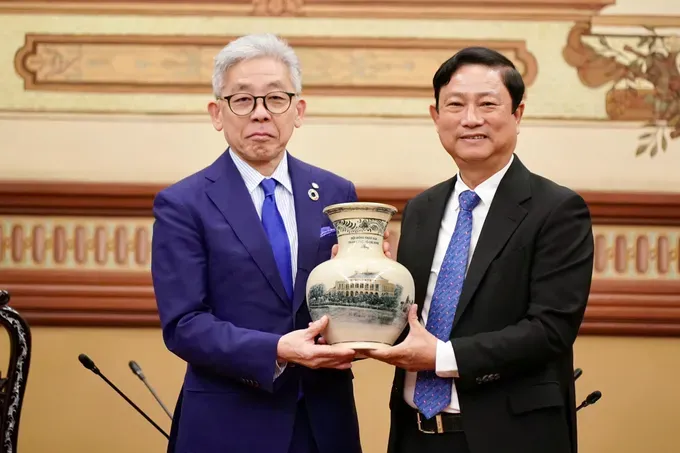
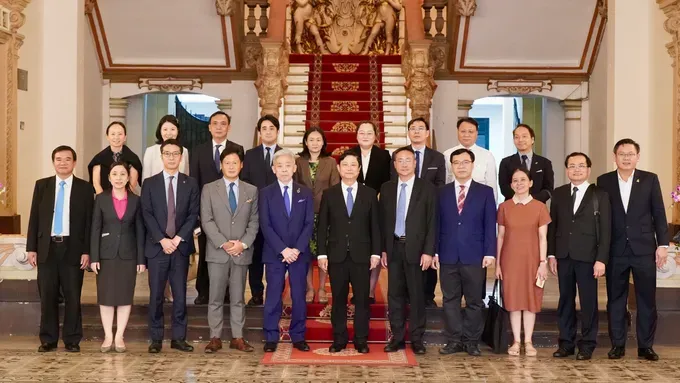
On January 16, Vice Secretary of the Ho Chi Minh City Party Committee and Chairman of the municipal People’s Council, Vo Van Minh, together with leaders of relevant departments and agencies, received Mr. Hirohisa Fujiwara, Permanent Board Member and International Business Director of Tokyu Corporation, and executives of Becamex Tokyu Co., Ltd. to discuss cooperation in researching and developing MRT (mass rapid transit) and LRT (light rail transit) lines in Ho Chi Minh City.
At the meeting, Chairman of the Ho Chi Minh City People’s Council, Vo Van Minh, commended Tokyu Corporation for its substantive contributions to the city in recent years. He noted that Tokyu’s investments in high-end residential developments, shopping centers, integrated service systems, and bus networks have played a significant role in improving living standards and shaping a modern, civilized urban landscape.
Regarding Ho Chi Minh City’s development needs, Mr. Vo Van Minh said the scale of investment in the current phase is substantial, requiring the active participation and partnership of both domestic and international stakeholders, particularly corporations with proven experience in urban development closely linked to public transportation systems.
In terms of urban transport development, the city has identified approximately 30 transit-oriented development (TOD) locations along Metro Line 1 (Ben Thanh–Suoi Tien) and Metro Line 2 (Ben Thanh–Tham Luong), with preparations for investment already underway. At least two stakeholders have submitted proposals and feedback on the TOD framework.
On that basis, Ho Chi Minh City has proposed that Tokyu Corporation, drawing on its experience in transit-oriented development linked to urban rail systems, continue in-depth research and take part in the development of TOD zones in the city. For the two metro lines in question, the city has expressed its hope that Becamex will take the lead in implementation while accelerating associated TOD projects to help generate financial resources for the expansion of the urban rail network.
The Chairman of the Ho Chi Minh City People’s Council also said that in the coming period, Ho Chi Minh City aims to promote transit-oriented development as a means of generating revenue for reinvestment in rail infrastructure, while shifting its investment model toward greater use of state budget funds rather than reliance on official development assistance (ODA). The city is also studying the adoption of the mechanism of Engineering, Procurement, and Construction (EPC), or a consortium-based approach, bringing together domestic and international companies to shorten implementation timelines.
Ho Chi Minh City has expressed its hope that Tokyu will continue to show interest and work closely with Becamex Tokyu Binh Duong and the Ho Chi Minh City Urban Railway Management Board in studying and participating in new metro lines in the period ahead.
Speaking at the meeting, Mr. Hirohisa Fujiwara expressed his appreciation for the attention and cooperative spirit shown by Ho Chi Minh City’s leadership and reaffirmed Tokyu’s desire to contribute its expertise and capabilities to the city’s urban development and transport infrastructure.
The corporation is particularly interested in studying light rail transit lines, which the group views as a critical foundation for promoting the integrated development of Ho Chi Minh City’s urban transport system in the future, he added.
He also voiced his hope for further in-depth exchanges with the city’s departments and agencies to jointly study and align approaches to transit-oriented development, while underscoring the pivotal importance of unified procedures and institutional mechanisms within the government system to create a solid foundation for public–private partnerships in urban rail development.