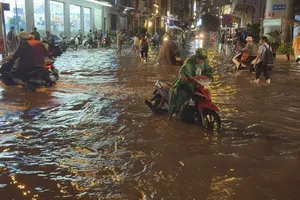
Vice Chairman of the Ho Chi Minh City People’s Committee, Bui Minh Thanh, has signed Official Dispatch No. 9178/UBND-DT, calling for accelerated implementation of disaster prevention and mitigation projects, strengthened warnings and public communications, and proactive measures by departments, agencies, and local authorities to respond to flooding.
The directive also calls for reviews of vulnerable areas, clearance of waterways to improve drainage, preparation of rescue personnel and equipment, and round-the-clock duty.
Equipment prepared at 43 flood-prone locations
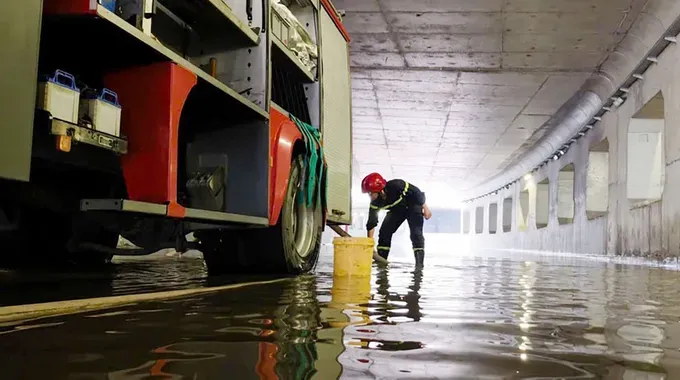
On October 4, speaking to a reporter from Sai Gon Giai Phong Newspaper, Senior Lieutenant Colonel Vu Trung Giang, head of the firefighting and rescue team on the river under the Fire Prevention and Fighting and Rescue Police Division (PC07), the Ho Chi Minh City Department of Public Security, said the unit had advised the city police leadership to implement a proactive plan to respond to flooding.
Under the plan, regional teams have been instructed to remain on standby and prepare personnel and equipment at 43 locations that are frequently affected by flooding.
The plan was developed based on forecasts from the Southern Regional Hydro-Meteorological Station. PC07 updates information daily and coordinates with relevant units to identify areas at risk of flooding during heavy rains, allowing pumps, specialized vehicles, and personnel to be deployed in advance.
According to Senior Lieutenant Colonel Vu Trung Giang, fire prevention, firefighting, and rescue forces will coordinate with youth volunteers, the military, and other relevant forces to address deeply flooded areas and assist with water pumping at apartment complexes, markets, and other flooded locations affecting residents’ daily lives.
When heavy rainfall is forecast, regional teams will have pumps and specialized vehicles ready to coordinate with other forces in responding to flooding and minimizing losses for residents, Senior Lieutenant Colonel Vu Trung Giang said.
PC07 currently has 228 pumps with a capacity of approximately 14 liters per second, which can be deployed at various locations, including areas where floodwater is around half a meter deep. Meanwhile, pump-station vehicles with a capacity of more than 100 liters per second are used in deeply flooded areas where suction systems can be deployed. When necessary, the forces can set up a sequential pumping system to drain water from flooded areas in sections.
According to Senior Lieutenant Colonel Vu Trung Giang, regional teams are stationed across different areas, enabling them to quickly reach flooded locations, deploy equipment, and provide on-site assistance to residents.
Mobilizing multiple resources to reduce flooding
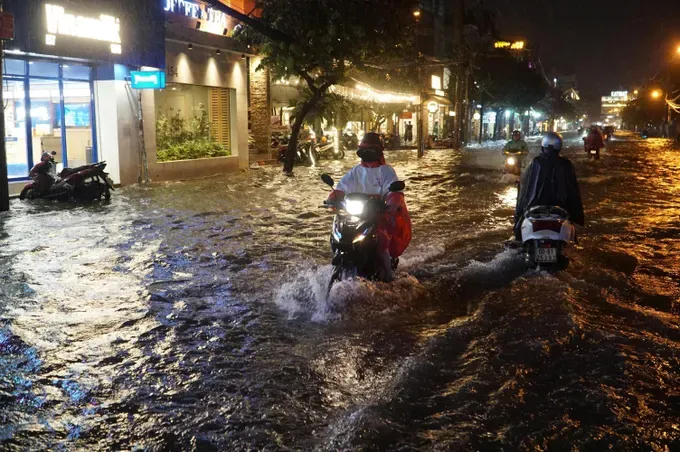
In Thong Tay Hoi Ward, Nguyen Van Khoi Street has been a flood-prone location for many years. Mr. Dang Cong Tuan, head of the ward’s Division of Economy and Infrastructure, said a project to upgrade the drainage system is currently underway in the area. As the section in An Hoi Tay Ward has yet to be connected, heavy rains can cause slow drainage, with floodwater at times reaching around 50 centimeters.
Mr. Tuan said pumps deployed by fire prevention, firefighting, and rescue forces would be effective in areas where flooding is deep and drainage is slow.
According to Ms. Dao Thi My Thu, chairwoman of the Thong Tay Hoi Ward People’s Committee, Nguyen Van Khoi Street is the most severely flooded location in the ward, with flooding lasting for several hours. The ward is working to clear and improve drainage systems, urging residents not to block drainage inlets, while deploying police and militia forces to regulate traffic during flooding.
Mr. Truong Ngoc Thanh Nhan, vice chairman of the Tan Vinh Loc Commune People’s Committee, said the locality had mobilized pumps from irrigation, drainage, and transport infrastructure units, as well as fire prevention and firefighting forces and local residents, to address flooding. Residents have also been encouraged to clear drains and stormwater inlets. Response measures are implemented according to the severity of flooding, starting with on-site forces and escalating to the mobilization of high-capacity equipment when necessary.
The key is for agencies to be well prepared so that, when an incident occurs, they can immediately implement the response plan based on the ‘four on-the-spot’ principle: on-the-spot command, on-the-spot forces, on-the-spot logistics, and on-the-spot equipment and supplies, he said.
In Thu Duc Ward, a representative of the ward People’s Committee said pumps deployed by contractors in local alleys had helped reduce flooding and prevent water from entering residents’ homes. However, pumping effectiveness also depends on water levels inside and outside the affected area.
When tidal levels rise and water outside the affected area has yet to recede, pumping capacity can be limited. The deployment of mobile pumps, however, can improve the effectiveness of drainage efforts. The local authorities are coordinating with contractors to reinforce embankments and position vehicles and pumps at vulnerable locations to proactively respond to heavy rain and high tides.
Speaking to a reporter from Sai Gon Giai Phong Newspaper, a representative of the Ho Chi Minh City Road Traffic and Technical Infrastructure Management Center under the municipal Department of Construction said that upon receiving information about a flooded location or a request for assistance, the center would proactively mobilize personnel and equipment to address the situation. At Alleys 39 and 41 in Tan Vinh Loc Commune, for example, when the commune’s pumps were of limited capacity, the center deployed two additional pumps, each with a capacity of 168 cubic meters per hour, to provide support.
According to the representative of the Ho Chi Minh City Road Traffic and Technical Infrastructure Management Center, the mobilization of pumps needs to be flexible and timely. Flood-control forces, local authorities, police, and relevant agencies should continue coordinating closely, as they have done in recent times, so that equipment can be deployed as quickly as possible whenever flooding occurs, minimizing disruptions to residents’ travel and daily activities.
According to Official Dispatch No. 9178/UBND-DT, city departments, agencies, and units, as well as the People’s Committees of wards, communes, and special zones, will continue to effectively implement Directive No. 43/CT-UBND, issued by the city People’s Committee on March 30, 2026, on strengthening disaster prevention and response efforts in 2026. They are also required to remain proactive and ready to implement disaster prevention and response plans across the city.
City departments, agencies, and units, along with the People’s Committees of wards, communes, and special zones, are required to deploy personnel to guard, control, issue warnings, and provide traffic guidance. Under no circumstances should people or vehicles be allowed to travel through areas that are deeply flooded, affected by landslides, or at risk of landslides if safety cannot be ensured. Measures must be implemented to respond to urban flooding while ensuring the safety of dikes, reservoirs, dams, embankments, and protective structures safeguarding production areas. Personnel and equipment must be kept ready to assist residents with evacuation, rescue, and emergency response when necessary.
The Department of Construction is tasked with reviewing and pruning trees and taking measures to minimize the risk of trees breaking or falling and causing accidents during thunderstorms and heavy rain.
The city People’s Committee has asked the Southern Irrigation Exploitation One Member Co., Ltd., Tri An Hydropower Company, and agencies managing reservoirs in the city to review their operations and proactively regulate water levels to prepare for incoming floods, ensure the safety of infrastructure, and reduce flooding downstream. They are also required to avoid adverse combinations of high tides, heavy rain, and flood releases.
The city People’s Committee has requested the city’s news agencies and press organizations to regularly and promptly provide warnings and forecasts on natural disasters and adverse weather conditions during the rainy and stormy season, enabling authorities at all levels and residents across the city to proactively implement appropriate response measures.





)