Under Ho Chi Minh City’s master plan for 2025–2050, which extends its vision over a 100-year period, the city intends to complete 18 metro lines by 2050, covering approximately 960 km in total.
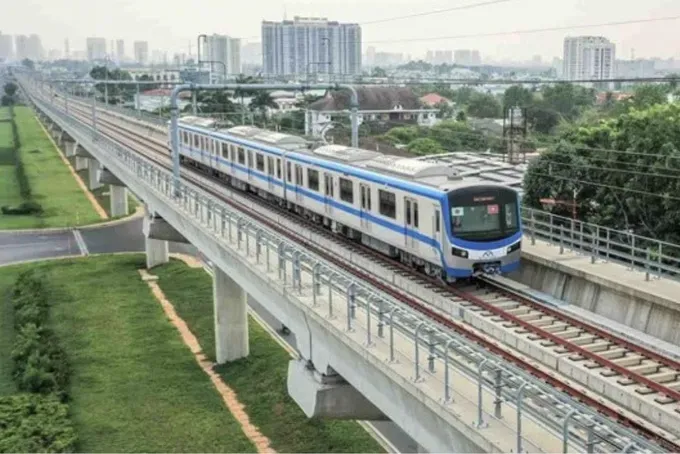
The Ho Chi Minh City People’s Committee has approved the master plan for 2025–2050, with a 100-year vision. It designates the railway and metro network as the foundation of public transportation and a central force shaping spatial planning and urban development.
The plan stipulates that by 2050, Ho Chi Minh City will have completed 18 urban railway (MRT) lines, totaling approximately 960 km, alongside a network of light rail and tramway (LRT/Tramway) lines spanning about 450 km.
In line with Resolution 09 of the Politburo, the city is simultaneously advancing 8 projects, with the goal of establishing a 255 km-long metro network by 2030. Projects currently under construction include Metro Line 2 (Tham Luong – Ben Thanh section and Ben Thanh – Thu Thiem section) and the high-speed railway connecting Ben Thanh to Can Gio.
Between now and the end of 2026, the city plans to commence construction on 5 additional lines including the Thu Thiem – Long Thanh railway; Metro Line 2 (the section from Tham Luong to the Tay Ninh provincial border); Metro Line 6, Phase 1 (Phu Huu – Tan Son Nhat); the Thu Dau Mot – Ho Chi Minh City metro line; and Metro Line 1 (Binh Duong New City – Suoi Tien).
By 2035, the city expects to complete seven additional lines, bringing the total length of the urban railway network to 532 km.
In addition to the metro system, the master plan outlines the development of national and specialized railway lines connecting the Hiep Phuoc port, the Cai Mep - Thi Vai port complex, and the Can Gio international transshipment port with industrial zones, logistics hubs, airports, and seaports.
Furthermore, the city plans to adopt a Transit-Oriented Development (TOD) approach, centering urban growth on public transportation. This strategy aims to gradually create a more polycentric urban structure and reduce dependence on private vehicles.