The 50th anniversary of Ho Chi Minh City bearing the name of President Ho Chi Minh offers an opportunity to reflect on a development journey marked by significant milestones while reaffirming the mettle of a metropolis that consistently leads and dares to think, act, and take responsibility.
Sai Gon Giai Phong (SGGP) Newspaper reporters interviewed Chairman of the Ho Chi Minh City People’s Committee Nguyen Van Duoc on key development pillars and decisive choices for the coming period.
The responsibility of being the leading economic locomotive
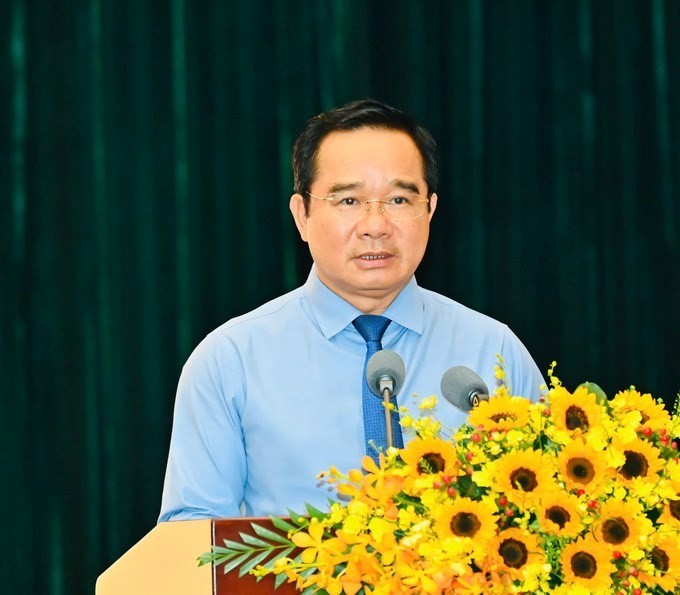
According to Chairman of the municipal People’s Committee Nguyen Van Duoc, Ho Chi Minh City is fully aware that bearing the name of President Ho Chi Minh is not only a great honor but also a major political responsibility. The city's role as an “economic locomotive” is not measured solely by its economic scale but more importantly by its capacity to pioneer institutional breakthroughs, development models, and new approaches.
Accordingly, under all circumstances, the city has demonstrated strong political will and determination, overcoming numerous difficulties and challenges and achieving many significant and meaningful accomplishments.
First and foremost, Ho Chi Minh City has served as a cradle and a source of many major national policies, particularly in relation to the development of the market economy. It is the country’s leading center of finance, commerce, and economic activity and serves as a gateway connecting the region with the world. At the same time, the city is also a major center for culture, education, science and technology, and innovation.
In addition, Ho Chi Minh City is known as a “compassionate and humane city,” with social welfare and social protection policies designed to ensure the well-being of its people, consistently placing the interests of the people at the center and as the top priority in the development process.
It can be affirmed that over the past 50 years of proudly bearing the name of President Ho Chi Minh, despite experiencing various periods of ups and downs, Ho Chi Minh City has consistently maintained its role as the country’s leading economic locomotive. This stands as clear evidence of the city's persistent and continuous efforts over half a century, fulfilling its responsibility to contribute “for the whole country and with the whole country" in a spirit of unity, concerted action, dynamism, and creativity, generating numerous breakthroughs and exemplary highlights for the nation.
The statement by Party General Secretary and State President To Lam that Ho Chi Minh City is a place where the Central Government can confidently assign new, difficult, and major tasks is both a recognition and a very high demand placed on the city's governance capacity and sense of responsibility in the coming period.
First of all, this requires the city to continue improving the quality of urban governance in a modern, effective, and efficient direction, making a strong shift from administrative management to governance and public service, placing people and businesses at the center, and using substantive outcomes as the key measure of performance. The city must become more proactive in forecasting, policy formulation, implementation, and risk control, ensuring that all decisions are timely, closely aligned with realities on the ground, and highly feasible.
Along with this, the spirit of daring to think, daring to act, and daring to take responsibility—a long-standing tradition of the city—must continue to be strongly promoted in the new context. The difficult and large-scale tasks assigned by the Central Government not only require a high level of political determination but also demand new and more innovative approaches, particularly in transforming the growth model and advancing economic development.
In addition, it is necessary to further accelerate institutional reform, in which the development of a draft Law on Special Urban Areas is expected to create a more flexible policy space for Ho Chi Minh City to boldly pilot new mechanisms and development models.
Ho Chi Minh City is fully aware of its responsibilities and remains determined to continue “pioneering and paving the way,” not only for its own development but also to make a positive contribution to the rapid and sustainable development of the country in the new period.
Ho Chi Minh City must make breakthroughs, accelerate growth, and strongly transform its growth model to realize the goal of rapid and sustainable development, commensurate with its role as a leading urban center of the country and as the city bearing the name of President Ho Chi Minh, the Chairman of the Ho Chi Minh City People’s Committee stated.
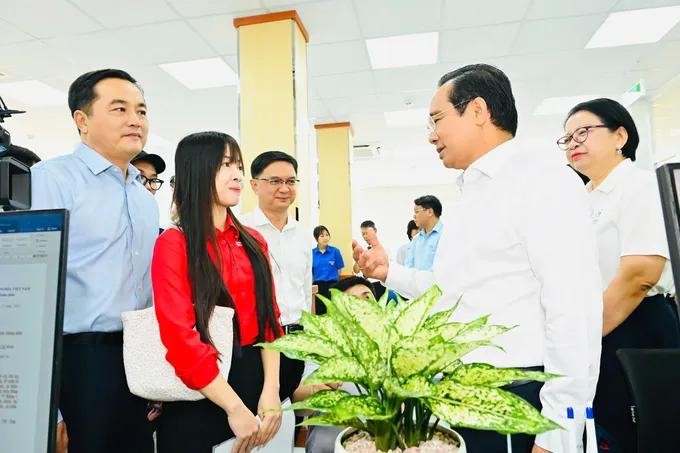
Breaking through institutional barriers, expanding opportunities for development
The Law on Special Urban Areas must represent a breakthrough in governance thinking, rather than a mere aggregation of existing special mechanisms. It should embody strong decentralization, granting the city greater autonomy in decision-making and accountability across key and core sectors.
The city has identified six core values to be incorporated into this draft law, with the expectation of creating genuine and substantive differentiation.
First, regarding the two-tier local government model:
The law should empower Ho Chi Minh City to decide on special administrative units within the overall framework of a two-tier local government system. These are not intended to constitute a new administrative level with an apparatus and authority broader than the current commune level, but rather flexible governance units designed to meet modern urban governance requirements and align with international practices.
Second, regarding urban planning and urban development:
The law should continue to establish a single comprehensive master plan for Ho Chi Minh City, with the authority for approval and adjustment vested in the Chairman of the City People’s Committee. At the same time, it should open up new development spaces that are not yet fully covered by existing legal regulations, including digital space, underground space, low-altitude and high-altitude space, as well as ocean space and the marine economy. These are regarded as important new development frontiers and growth reserves for the city.
Third, regarding urban finance:
The law must grant substantive financial autonomy, including the authority to proactively introduce city-specific fees and charges, tap into land-based revenue sources associated with transit-oriented development (TOD), and collect carbon credit fees. Additionally, the city should be allowed to retain locally generated new revenue streams that are not yet specified under existing regulations, particularly those linked to the development of new growth spaces.
Fourth, regarding resource mobilization for development:
The law should open access to modern financial instruments that are not yet fully permitted or remain limited under general legislation, such as public–private partnership (PPP) models in the city's priority sectors, the issuance of municipal bonds and project bonds in international markets, and the attraction of capital from global financial channels. These are funding mechanisms that major cities in the region have already been operating effectively.
Fifth, regarding the Ho Chi Minh City Region:
The law should clearly define the concept and scope of the region, together with a comprehensive connectivity mechanism across all areas, including the economy, infrastructure, planning, and environment. More importantly, inter-regional issues should be assigned to Ho Chi Minh City and relevant localities for unified coordination and resolution. This should be accompanied by a Regional Development Fund mechanism, as well as coordination and transshipment functions, in which Ho Chi Minh City plays a leading role.
Finally, the law must be designed for immediate implementation upon approval by the National Assembly. It is necessary to delegate authority to localities to issue implementing regulations and operational guidelines within their competence, ensuring that the law is quickly translated into practice in line with the spirit of substantive decentralization and delegation as directed by the Central Government.
To enable Ho Chi Minh City to fully play its role as a special urban center and a “growth lever of the whole country,” the city has identified that breakthroughs must first come from completing its development institutions.
Specifically, the formulation of the Law on Special Urban Areas should focus on establishing outstanding mechanisms and policies that promptly and decisively remove bottlenecks, ensure consistency and coherence across all sectors, and thereby strongly unlock social resources.
On that foundation, the city is focusing on developing into a major service hub of both the country and the region, with priority given to establishing an international financial center associated with the development of digital finance models, fintech, digital asset management, and specialized trading platforms.
At the same time, the city is promoting green finance and green credit to drive sustainable development and enhance international competitiveness.
In parallel, Ho Chi Minh City is prioritizing the development of the maritime economy, building a smart logistics port cluster in Cai Mep – Thi Vai – Can Gio, operating under a digital mega-port model. This system will be data-driven, leveraging big data technologies, and will be closely connected to regional and international supply chains.
The city has identified the private sector as an important driving force and will continue to improve a level playing field for the business environment while removing barriers related to land, credit, and planning and effectively implementing Central Government resolutions on private sector development.
At the same time, state-owned enterprises will be strengthened to play a leading role in key industries, alongside support for the collective economy through a new-generation cooperative model.
In addition, the City will develop venture capital funds and an innovation-driven startup ecosystem, while promoting technology transfer from the foreign direct investment (FDI) sector. With this comprehensive approach, Ho Chi Minh City aims to build a modern and dynamic institutional foundation capable of leading development in the new era.
Accelerating transformation, enhancing growth quality
Entering a new phase of development, a series of mechanisms and policies are being progressively refined, carrying particular significance for Ho Chi Minh City. Alongside institutional breakthroughs, the city has identified science and technology, innovation, digital transformation, and green transition as the foundation for forming a new, modern productive force.
The city will focus on developing a knowledge-based economy, investing in strategic technology sectors such as artificial intelligence (AI), cloud computing, big data, blockchain, and the semiconductor industry, with the objective of becoming a regional high-tech hub.
Ho Chi Minh City will also promote industrial restructuring toward high technology, a circular economy, and emissions reduction. At the same time, it will develop science and technology parks and internationally standardized research and development (R&D) centers, while implementing sandbox mechanisms to pilot new business models.
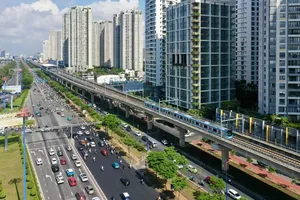
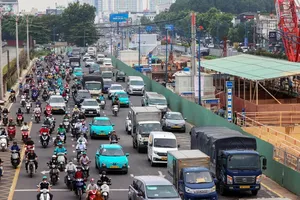
In addition, priority will be given to developing an integrated and smart transport system, ensuring regional and inter-regional connectivity, including ring roads, expressways, urban rail networks, and logistics infrastructure.
On the other hand, the city will develop a synchronized digital infrastructure that is compatible with 5G networks, data centers, and cloud computing platforms, with the goal of completing the digital government by 2030, thereby improving governance efficiency and public service delivery.
Ho Chi Minh City will also promote the development of renewable energy, offshore wind power, and the circular economy, while building a green logistics ecosystem and reducing emissions across supply chains. The planning of new development spaces, combined with infrastructure investment and environmental protection, will help address pressing urban challenges and enhance the quality of life.
With a comprehensive, synchronized, and modern approach, Ho Chi Minh City aims for rapid yet sustainable development, becoming a smart city and an innovation hub where residents increasingly benefit from higher-quality development outcomes.