A sharp increase in supply, bottlenecks in export testing, and quality concerns have sent durian prices plunging across the Mekong Delta, Southeast region, and Central Highlands, leaving thousands of farmers facing heavy losses. In response, the Ministry of Agriculture and Environment is stepping up efforts to tighten quality control and improve transparency across the production chain.
Prices hit record lows
Standing in his durian orchard littered with fallen ripe fruit, farmer Le Thai Huan of Cai Lay Commune in Dong Thap Province said he had never seen prices for the “King of fruits” fall this low.
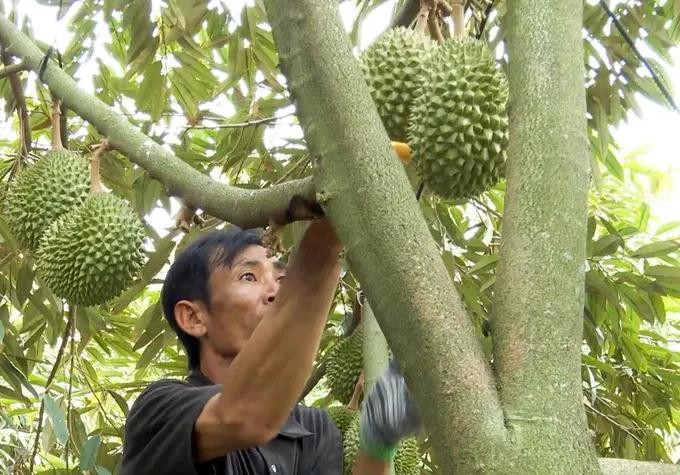
He revealed that traders are currently buying Ri6 durians at the orchard for only VND25,000-VND30,000 per kilogram. That price applies only to selected fruit. If they buy the orchard in bulk, the price is below VND20,000 per kilogram. "At these prices, farmers are suffering heavy losses because production costs are nearly VND40,000 per kilogram", he moaned.
Durian prices in the Central Highlands are facing a similar situation even as the region has just entered the harvest season.
Tran Van Ngoc, a durian grower in Dak Lak Province, said first-grade durians with uniform quality are fetching only VND35,000-VND50,000 per kilogram.
The grower despaired, saying that prices are so low that his family has delayed selling fruit from the more than three-hectare orchard. In recent days, rain and strong winds have caused more fruit to fall.
To minimize losses, many orchard owners in provinces such as Dong Thap, Tay Ninh, and Can Tho have resorted to selling entire orchards at fire-sale prices of VND18,000-VND20,000 per kilogram. Some farmers have harvested the fruit themselves and transported it to roadside locations along national highways for retail sale, but demand remains weak.
According to Vo Tan Loi, chairman of the Dong Thap Durian Association, durian prices have “bottomed out” largely because of oversupply.
Major durian-growing areas in the Mekong Delta, including Dong Thap and Tay Ninh, are now entering the peak harvest season. Dong Thap alone has more than 32,000 hectares of durian plantations, with output in May and June 2026 estimated at around 111,200 tons. Other major producing regions, including the Central Highlands and Southeast region, have also begun harvesting.
Durian exports snagged by testing and traceability flaws
Durian exporters in the Mekong Delta said the sharp decline in prices is mainly due to bottlenecks in export testing procedures.
Many testing laboratories in the region have either suspended operations or limited sample intake because of discrepancies between results issued by Chinese-approved laboratories in Vietnam and China’s post-clearance inspection authorities. The uncertainty has made exporters reluctant to purchase durians, leaving farmers struggling during the peak harvest period.
Agricultural experts said weak traceability and inconsistent production standards have also contributed to falling prices and export difficulties.
In many localities, durian traceability systems face four major obstacles including inconsistent procedures, disconnected databases, fragmented information sharing among agencies, and farmers’ limited familiarity with digital management systems.
Some areas have also reported cases of growers borrowing plantation area codes to complete export procedures, while production data remain inconsistent and quality control processes insufficiently strict.
In response, local authorities have instructed relevant agencies to urgently inspect plantation area codes and packaging facility codes to strengthen quality control, particularly regarding cadmium levels and output management. Authorities are also seeking to boost domestic consumption and expand processing activities to ease pressure on fresh fruit sales.
Nguyen Phuoc Thien, vice chairman of the Dong Thap Provincial People’s Committee, said the province has urged the Ministry of Agriculture and Environment to direct approved testing centers to increase durian testing capacity. The province also proposed that the ministry work with China’s General Administration of Customs to establish a more suitable post-clearance inspection mechanism and accelerate approval for qualified local testing laboratories to support durian and other fruit exports.
The Ministry of Agriculture and Environment said it is focusing on tightening quality control and improving transparency throughout the production chain.
A pilot durian traceability program has been in place since Jan. 1, 2026, and is scheduled for nationwide implementation from July 1, 2026. The system is designed to monitor the entire process from cultivation and harvesting to packaging and export in order to stabilize exports, maintain market access, and strengthen competitiveness.
The ministry is also guiding durian-producing localities to adopt VietGAP standards and integrated plant health management (IPHM) programs to reduce risks related to chemical residues and improve compliance with import market requirements.
At the same time, authorities are increasing oversight of plantation area codes and packaging facilities to curb violations of export regulations.