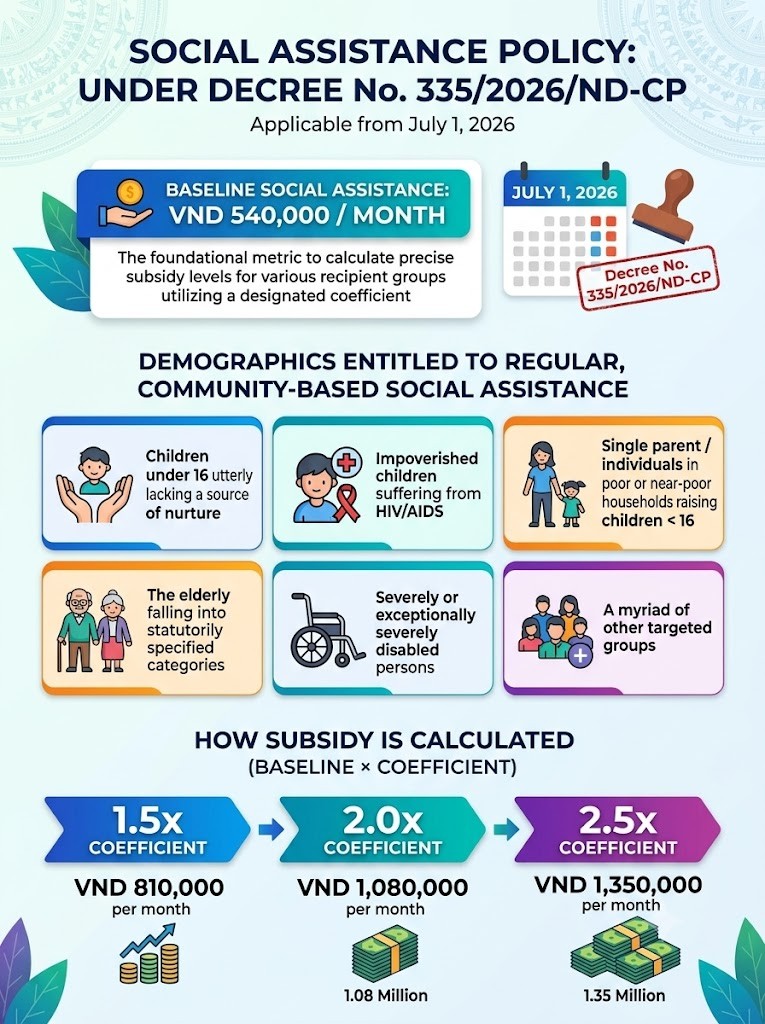
Pursuant to Decree No. 335/2026/ND-CP, the baseline social assistance of VND540,000 (US$20.8) per month intrinsically serves as the foundational metric to calculate the precise subsidy level for various recipient groups utilizing a designated coefficient, applicable from July 1, 2026.
Demographics entitled to receive regular, community-based social assistance encompass:
- Children under 16 utterly lacking a source of nurture,
- Impoverished children suffering from HIV/AIDS,
- Single individuals classified under impoverished households, near-poor households currently raising children under 16,
- The elderly falling into statutorily specified categories,
- Severely or exceptionally severely disabled persons,
- A myriad of other targeted groups.
The exact subsidy amount is meticulously calculated utilizing a coefficient directly corresponding to each specific demographic. Based on the VND540,000 ($20.8) monthly baseline:
- A 1.5 coefficient yields exactly VND810,000 ($31.2) per month,
- A 2.0 coefficient translates to VND1.08 million ($41.6) per month,
- A 2.5 coefficient guarantees VND1.35 million ($52) per month.
Notably, certain specific groups are reportedly subjected to either a 1.0 or a 3.0 coefficient.
The decree concurrently stipulates comprehensive policies governing care and nurturing, whether orchestrated within the community or at dedicated social assistance facilities. It also mandates deploying immediate, emergency social assistance for citizens stricken by natural disasters, devastating fires, crippling epidemics, or those grappling with extraordinarily dire circumstances per the regulations.
Significantly, the decree officially authorizes localities boasting sufficient socio-economic conditions to submit proposals to the corresponding People’s Council to proactively dictate a baseline social assistance level and an overarching assistance framework surpassing the general national mandate, whilst integrating additional disadvantaged groups previously omitted from the regulations.
This essentially forms the bedrock empowering localities to proactively broaden their social security nets in perfect alignment with their stark, on-the-ground realities.
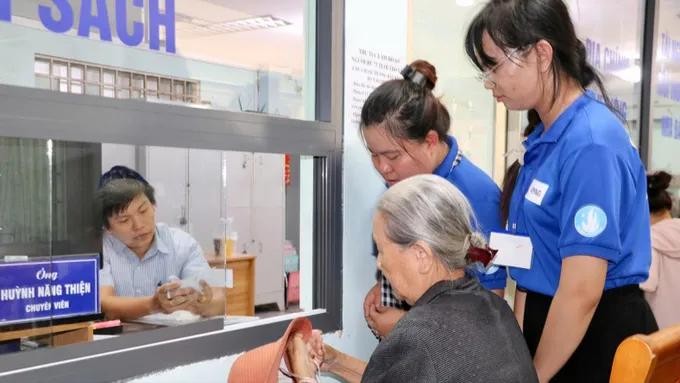
In HCMC, the social assistance baseline has reportedly been strictly enforced per Resolution No.35/2025/NQ-HDND since September 2025. Set at a robust VND650,000 ($25) per month, it’s invariably morphed into a reliable cornerstone for countless individuals enduring extraordinary circumstances.
Following a harrowing 2022 traffic accident, 36-year-old Nguyen Thi Bich Nga from Long Hai Commune tragically lost portions of her right arm and leg. Ever since that fateful day, her life has undeniably grown exponentially tougher. Currently, she receives approximately VND900,000 ($34.6) monthly directly from the municipality’s subsidy policy. She meticulously allocates this vital sum to cover absolute necessities like electricity and water bills. “I’m genuinely hoping the subsidy level continues improving so it can slightly alleviate the crushing burden of my daily life,” she candidly expressed.
Mrs. Le Thi Thanh Hang, a 67-year-old residing in Duc Nhuan Ward, cares for a daughter suffering from intellectual disabilities. Every single month, she collects a combined subsidy of VND7 million ($270). This notably incorporates a VND650,000 ($25) allowance specifically earmarked for caregivers of exceptionally severely disabled individuals. This practical financial support enables her to settle numerous living expenses for both herself and her child.
Currently, the sheer volume of individuals reaping benefits from social subsidy and pension policies across HCMC is remarkably substantial. Duc Nhuan Ward manages over 2,100 cases, An Phu Dong Ward oversees nearly 1,800, while Long Hai Commune boasts 895 individuals actively receiving stipends.
Taking the entire metropolis into account, upwards of 315,800 eligible people are paid monthly allowances. Alongside guaranteeing full disbursements to rightful beneficiaries, localities proactively mobilize social resources to care for those in dire straits. They provide housing support, medical treatments, health insurance cards, plus emergency relief, whilst vigorously creating employment opportunities.
Deputy Director of the HCMC Department of Health Nguyen Tang Minh stated the city will persist applying the VND650,000 ($25) baseline since it exceeds general standards. Consequently, individuals currently receiving regular subsidies don’t have to resubmit paperwork. He assessed that upholding this superior baseline vividly illustrates the city’s unwavering commitment to vulnerable demographics.
Pursuant to Article 28 of the Law on Urban Development, the HCMC People’s Council is authorized to mandate social policies geared toward expanding the beneficiary base while architecting a modernized, sustainable social security network. Currently, the city is conducting a sweeping review of all social security policies executed before as well as after recent administrative boundary rearrangements, meticulously evaluating their suitability alongside the municipality’s capacity to balance resources.
The Deputy Director of the HCMC Department of Health affirmed they’ll advise the People’s Committee to present proposals for reviewing necessary policies in 2026. Consequently, the city might research integrating supplementary demographics enduring unique hardships, readjusting support levels, plus perfecting care policies aligning with practical conditions.
For sociologist Nguyen Tran Phuoc, the new legislation explicitly grants HCMC proactive jurisdiction to architect healthcare policies perfectly suited to a booming megacity. Regulations spanning subsidized disease prevention, out-of-hospital emergency care, plus broad social assistance should fundamentally be viewed as an integrated policy system managing societal risks amidst rapid urbanization, rather than isolated initiatives.
He firmly believes HCMC should gradually pivot from providing reactive assistance to proactively mitigating societal risks. This strategy must seamlessly blend financial support with essential social services, robust community care, plus equal access to fundamental needs like housing or education.
Individuals possessing the capacity to secure livelihoods could be supported through universal public services, whereas those facing higher risks require profound State intervention. When properly executed, social security isn’t merely about doling out subsidies; it fundamentally morphs into a strategic investment targeting the metropolis’s stability, resilience, plus long-term social equity.
Injecting supplementary policies to support specific demographics
During its recent session, the HCMC People’s Council passed 24 resolutions aggressively deploying the Law on Urban Development. Notably, Resolution 44 reportedly subsidizes 100 percent of health insurance (HI) premiums for 12 months for residents who’ve donated blood over 20 times and don’t currently possess a card. With nearly 40,000 outstanding donors citywide, those maintaining biannual donations will see this vital support perpetually maintained.
Furthermore, Resolution 50 completely subsidizes HI co-payments for severely disadvantaged children plus adults afflicted with stage 5 chronic kidney disease requiring cyclical dialysis.
These two recently promulgated policies fundamentally aid in slashing crippling medical expenses while radically expanding healthcare access for extremely vulnerable demographics. It’s undeniably a concrete step materializing the decentralized authority explicitly bestowed upon the municipality to proactively architect tailored healthcare plus welfare policies perfectly aligned with a special-class urban hub.






)