Officials in Ho Chi Minh City presented several proposals to bolster the city's drainage capacity during a socio-economic press conference held by the municipal Party Committee’s Commission for Information and Education, and the Department of Culture and Sports on October 8.
Deputy Head of the Infrastructure Office at the municipal Department of Construction, Pham Quoc Huy, reported that recent heavy downpours inundated several previously known flood-prone locations. However, the severity of the flooding varied depending on rainfall, tidal levels, or a combination of both.
Several roadways saw longer flood durations, deeper water levels, and slower recession times. Affected areas included Phan Huy Ich Street in Tan Son and An Hoi Tay Wards, and Quoc Huong, Thao Dien, and R12 streets in An Khanh Ward. Local officials also reported flooding on smaller streets and alleys, including Ma Lo Street in Binh Tri Dong Ward, as well as alleys along Cong Nghe Moi (new technology), the inter-hamlet 123 road, and the 2-3 flood-control dike road in Tan Vinh Loc Commune.
Analyzing the root causes, the Department of Construction cited rainfall exceeding the existing drainage system's designed capacity as the primary factor. The city's current drainage network is designed to handle rainfall of up to 85.3 mm over three hours. However, on September 30 and October 1, several monitoring stations recorded over 100 mm of rain within 45 to 60 minutes. Furthermore, widespread and prolonged rain over consecutive days raised water levels in rivers and canals, restricting drainage, compounded by high tides.
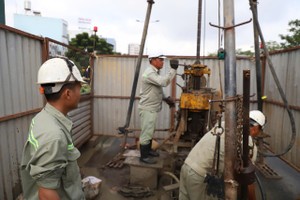
The department also noted that ongoing construction on certain infrastructure projects has hindered drainage capacity. Inconsistent operations of sewage systems managed by some commune and ward authorities, alongside encroaching structures on drainage canals, further exacerbated the issue.

In response, the Department of Construction advised the Ho Chi Minh City People's Committee to issue action plans to mitigate flooding. The department plans to coordinate with relevant agencies to step up maintenance, dredge drainage systems, clear blockages, and resolve construction-related obstructions. Emergency crews will be deployed to clear waste at catch basins, open manhole covers, operate mobile pumps, and manage traffic at flooded spots. The city will also focus on completing major anti-flooding projects while reviewing the network of culverts, canals, and discharge gates to address bottlenecks.
On the same day, the Southern Regional Hydro-Meteorological Center reported widespread heavy rain across Ho Chi Minh City and the Southern region in recent days. Forecasters project the rainy spell will persist through October 10, with widespread showers continuing from late afternoon into the evening, potentially accompanied by tornadoes, lightning, and strong wind gusts.
The center also warned that water levels in local rivers and canals will rise in the coming days due to the high tide cycle at the start of the ninth lunar month. Peak tides are expected twice daily—in the early morning and late afternoon. The late afternoon high tide coincides with peak rainfall hours, heightening the risk of flooding in low-lying and riverside areas. Peak tide levels could occur between October 10 and 12, with river levels in Ho Chi Minh City likely exceeding alarm level 3 by 0.1 to 0.17 meters.