Members of the community digital technology team in Neighborhood No.19 of Cat Lai Ward have just gone door-to-door assisting residents in installing and utilizing various digital applications. During this rollout, they explicitly prioritized the elderly, those with severe mobility impairments, alongside incredibly busy street vendors.
For Mr. Nguyen Dinh Truc, an elderly local, installing the eTax Mobile app on his smartphone proved a daunting challenge until a neighborhood official arrived directly at his doorstep to provide hands-on guidance. Similarly, for Mr. Dang Van Luong, declaring his non-agricultural land tax on the app was initially overwhelming. After receiving dedicated guidance from a local official, he successfully finalized his dossier and fully grasped the intricate declaration process.
Neighborhood No.19 Chief Nguyen Van Quan noted that previously, whenever residents stumbled upon technical hurdles using digital apps, they were forced to visit the ward’s Public Administration Service Center. Nowadays, citizens can simply drop by the neighborhood headquarters. For cases involving severe mobility issues or incredibly tight schedules, dedicated officials will proactively visit their homes offering on-the-spot assistance.
According to the Cat Lai Ward People’s Committee, the entire ward successfully launched 24 “Smart Neighborhoods,” meticulously focusing on the digital governance, digital economy, digital society, digital infrastructure, alongside smart security. These neighborhoods are instructing locals on navigating the National Public Service Portal, VNeID, VssID, plus other essential digital applications.
In the foreseeable future, Cat Lai Ward will continually review and comprehensively cleanse its multi-sectoral data, significantly replicate the “Digital Literacy Campaign,” and install supplementary security camera systems. This incrementally paves the way for systematically constructing a synchronized data connection infrastructure across the entire ward.
Concurrently, Binh Tan Ward reportedly commended four distinct neighborhoods achieving a plethora of highly positive outcomes following an eight-month implementation of the “Digital Neighborhood” model. Binh Tan Ward’s comprehensive criteria set includes 42 benchmarks carefully categorized into six groups of digital awareness and institutions, digital infrastructure and human resources, cyber information security, digital governance intertwined with public services, digital economy and digital society.
Chief Phan Anh Quan of Neighborhood No.28 in Binh Tan Ward stated the most palpable result stemming from this model’s application is that residents finally figured out how to submit dossiers online, constantly maintaining an inherently proactive learning spirit. A substantial number of locals can now independently operate these systems from the sheer comfort of their homes. Whenever they encounter a stubborn glitch, they’ll call up neighborhood officials to receive troubleshooting instructions.
According to the Binh Tan Ward People’s Committee, evaluation results are systematically classified into outstanding, advanced, and basic tiers. Neighborhoods that haven’t quite hit the highest echelons will relentlessly continue formulating strategic plans boosting their overall scores next year.
Over in Tan Hung Ward, the systematic development of digital neighborhoods is determinedly rolling out to essentially forge supplementary interactive channels bridging the government and its citizens.
For Mrs. Trinh Thi Lan, a resident of Neighborhood No.26, the tech transition proved immensely beneficial. She noted that since early 2026, she’s utilized the “Digital Neighborhood” application to seamlessly track announcements of the ward People’s Committee, submit critical feedback, and smoothly look up neighborhood maps as well as direct contact info of local leaders. Furthermore, the cutting-edge app boasts an incredibly responsive virtual assistant designed to address citizens’ pressing inquiries on a 24/7 basis.
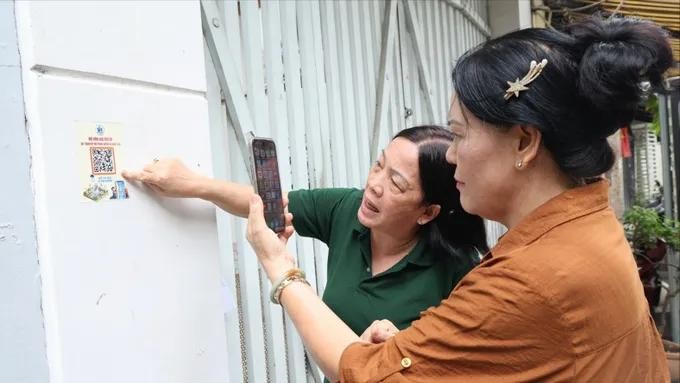
According to Head Nguyen Thi Quy of the Women’s Union in Tan Hung Ward’s Neighborhood No.26, 100 percent of households in the vicinity successfully pasted “one-touch” QR codes at the front of their house, effectively connecting the grassroots government with the local populace. To achieve this unprecedented feat, the neighborhood’s dedicated task force had visited every single house guiding residents, ultimately helping them comprehensively grasp and effortlessly utilize the application’s profound conveniences.
Vice Chairman of the Tan Hung Ward People’s Committee Nguyen Minh Thien noted that during the pilot phase, five neighborhoods successfully checked off all rigorous criteria, officially launching the “Digital Neighborhood” model in mid-May 2026.
Up to this point, the ward incrementally forged a highly robust digital ecosystem, including a WebGIS map, a “one-touch” QR code for rapidly looking up neighborhood info, and streamlined administrative procedures. It deployed an interactive virtual assistant plus a dedicated channel receiving feedback with electronic dossiers. This invaluable data is systematically aggregated onto a centralized executive dashboard, inherently empowering ward leaders to tackle operational tasks remarkably well.
Through a simple QR code scan, locals can effortlessly look up vital information, acquaint themselves with complex administrative procedures, submit poignant feedback, and seamlessly track the government’s handling results without commuting back and forth endlessly.
Tan Hung Ward is currently steering its strategy toward synchronously upgrading digital neighborhoods across all 35 neighborhoods. By firmly establishing data as the bedrock and utilizing residents’ satisfaction levels as the ultimate yardstick, they’re paving the way to construct a comprehensive “Digital Tan Hung Ward” that flawlessly interfaces with the city’s shared digital platforms.
Back in June 2026, the HCMC People’s Committee rolled out a sweeping pilot implementation of the commune-level smart city model in Phu Nhuan Ward, Vung Tau Ward, and Con Dao Special Zone.
This overarching model aims to radically optimize local directing and administrative operations through the profound application of cutting-edge digital technology platforms, such as the Digital Twin alongside the Intelligent Operations Center.










)