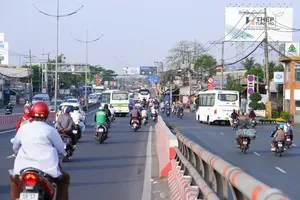
After years of delays, the first phase of the Ho Chi Minh City Tidal Flood Control Project, which takes climate change into account, has reached about 95 percent completion. The VND10 trillion (US$385 million) project, commonly known as the VND10 trillion tidal flood-control project, is expected to be completed in November 2026.
Tidal flood-control project set for handover in November
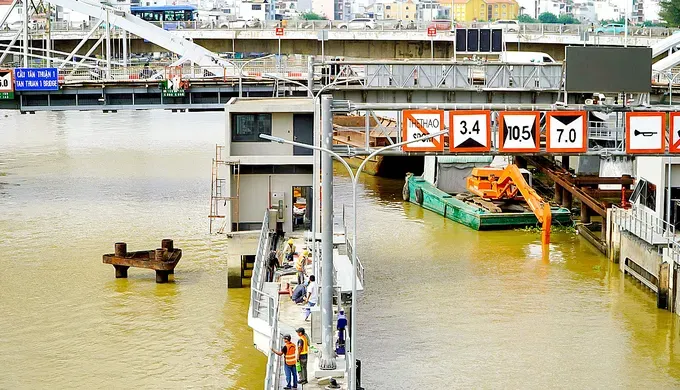
The project is now 95 percent complete, with more than 1,000 workers continuously deployed across construction sites to complete the remaining works. The project is expected to be completed and handed over in November, said Nguyen Van Bao, deputy director of Trungnam An Trieu Co., Ltd., the investor.
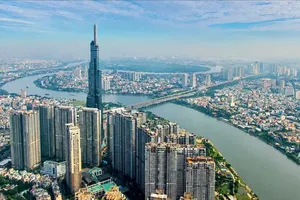
The VND10 trillion tidal flood-control project, implemented under a build-transfer (BT) arrangement, is one of the largest water infrastructure projects in Ho Chi Minh City. Work began in 2016, with the project expected to help protect a 570-square-kilometer area on the right bank of the Saigon River and in the city center from tidal flooding and the increasingly pronounced impacts of climate change.
The project comprises six tidal-control sluice gates, including Ben Nghe, Tan Thuan, Phu Xuan, Muong Chuoi, Cay Kho and Phu Dinh, nearly 8 kilometers of embankments along the Saigon River, an operations center and a Supervisory Control and Data Acquisition (SCADA) system for automated, digitized data management.
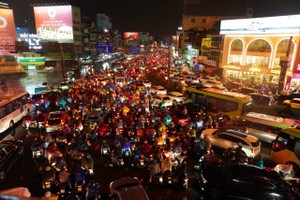
Following recent heavy rains coinciding with high tides, which left many roads across Ho Chi Minh City deeply flooded, residents have been looking forward to the project's completion even more.
Huynh Thi Phuong Thao, a resident of Ben Phu Dinh Street in Phu Dinh Ward, said residents had been waiting for nearly 10 years.
“We hope the project will be completed soon so that flooding on the roads can be reduced and travel will become more convenient,” Thao said.
Ho Chi Minh City to build 56 km drainage system to tackle flooding
In addition to the VND10 trillion tidal flood-control project, the Ho Chi Minh City People’s Committee has approved the Saigon west basin drainage, wastewater and climate change adaptation improvement (CRUS2), with a total investment of VND7.688 trillion.
The project will span eight wards in the western part of the city, including Dong Hung Thuan, Trung My Tay, Tan Thoi Hiep, An Hoi Tay, Tan Son, Tay Thanh, Tan Son Nhi, and Binh Hung Hoa.
It will develop a drainage system for the Saigon West basin and convey wastewater to a new wastewater treatment plant, whose location is planned for the area of the Binh Hung Hoa Wastewater Treatment Plant. The project will also build primary, secondary, tertiary, and quaternary wastewater collection and combined drainage systems.
In addition, wastewater separation wells and interceptor sewers will be built along the Tham Luong-Ben Cat and 19-5 canals, extending to the end of the Saigon West basin.
“We are carrying out the necessary procedures and expect to begin implementing the project by the end of this year,” said Dau An Phuc, director of the Ho Chi Minh City Urban Infrastructure Construction Investment Project Management Board.
According to the Ho Chi Minh City Urban Infrastructure Construction Investment Project Management Board, the project aims to improve residents’ quality of life by reducing environmental pollution and flooding. It also seeks to develop a highly climate-resilient urban area and minimize risks arising from the impacts of climate change.
During the 2026-2030 period, Ho Chi Minh City plans to comprehensively address urban flooding hotspots across the city and strive to reduce flood-related damage by 50 percent. The city also plans to digitize data on vulnerable areas, raise the urban wastewater collection rate to about 80 percent, and ensure that 40-45 percent of urban wastewater is treated to meet regulatory standards.
According to the draft Master Plan for Ho Chi Minh City for the 2025-2050 period, with a 100-year vision, rapid population growth, and a high urbanization rate—expected to exceed 90 percent in the central area—are placing considerable pressure on technical infrastructure, particularly drainage and wastewater treatment systems, as climate change becomes increasingly complex.
Flooding results from a combination of interacting risk factors, including low-lying urban terrain, aging drainage systems that fail to meet current design standards, extreme rainfall increasingly exceeding design return periods, and rising high tides on the Saigon-Dong Nai river system.