Secretary of the Ho Chi Minh City Party Committee Tran Luu Quang stressed that the city has been granted greater powers, but what matters is what it can deliver, what concrete outcomes it can produce, and who will be held accountable if it fails to do so.
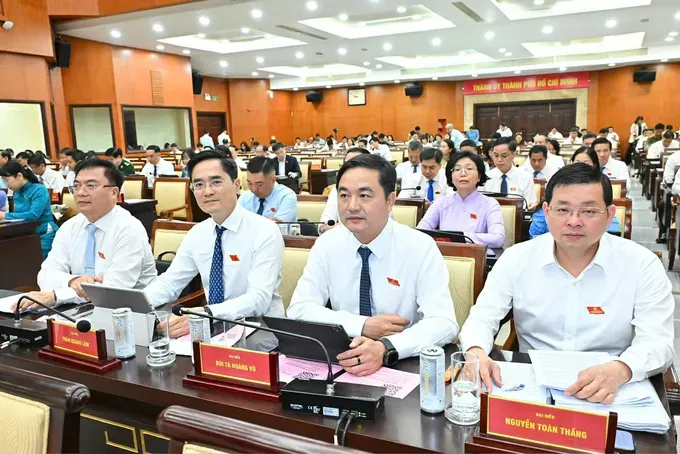
The Ho Chi Minh City People's Council for the 2026–2031 term convened its fifth session on September 21 to consider key resolutions to institutionalize the Urban Development Law.
Result are the ultimate goal

In his remarks, Secretary of the Ho Chi Minh City Party Committee Tran Luu Quang reiterated the requirement set out at a conference on implementing the Urban Development Law nearly a month ago: the focus must go beyond disseminating legal documents to assigning specific tasks, deadlines, and responsibilities. This session must mark a shift from policy directions to decisions, from decisions to action, and from action to tangible results.
The Urban Development Law gives the Ho Chi Minh City People’s Council, People’s Committee and Chairman of the People’s Committee approximately 240 areas in which they can proactively formulate regulations, make decisions, and organize implementation. According to Mr. Tran Luu Quang, this represents the broadest level of decentralization granted to the city to date, opening up new space for development while also placing greater responsibilities on the city.
“The greater the authority, the clearer the accountability must be, and the more tangible and verifiable the results must be,” the Secretary of the Ho Chi Minh City Party Committee stressed.

According to him, what matters is not the number of resolutions adopted, but the quality, feasibility, and capacity of each resolution to bring about tangible changes in practice. A resolution is not the destination; results are the ultimate goal. A resolution has real value only when it helps remove bottlenecks, unlock resources, and create fresh momentum for development.
Therefore, each resolution must comply with the law and be clear and feasible, while each policy must fall within the proper authority, remain consistent with the legal system, and clearly define its target beneficiaries, resources, implementation responsibilities, and enabling conditions.
The Secretary of the Ho Chi Minh City Party Committee urged delegates to ask three questions when considering each resolution: What bottleneck will it remove? What resources will it unlock or what new impetus will it create? Who will ultimately be accountable for the results? If these questions cannot yet be clearly answered, further clarification is needed before a decision is made.
Devolution must go hand in hand with power oversight

The Secretary of the Ho Chi Minh City Party Committee called for the city to fully utilize the policy space granted to it without exceeding the limits of the law. The city must not unnecessarily restrict its own authority out of fear or concern about accountability, nor can it invoke creativity and innovation as a pretext for acting outside the law.
He stressed that initiative must go hand in hand with discipline, innovation with transparency, and decentralization with power oversight and accountability. Policies concerning the budget, land, planning, science and technology, education, healthcare, human resources, and other key areas must be geared toward unlocking and effectively utilizing resources for the city’s development.
Any resolution adopted must be immediately linked to implementation, with clear identification of the lead agency, coordinating agencies, completion deadlines, and expected outputs.
“Every task must have someone accountable; every responsibility must have a deadline; and every deadline must be tied to a measurable and verifiable result,” he stressed.
Alongside this, the Standing Committee of the Ho Chi Minh City People’s Council, its committees, and each delegate must closely monitor the implementation of resolutions through to completion, promptly identifying which tasks are delayed, where bottlenecks have arisen, their causes, and who is responsible. Stronger decentralization must go hand in hand with stronger post-implementation oversight, with control exercised through openness, transparency, supervision, and results, rather than by adding more procedures.
He stressed that officials who make decisions within their authority, act openly and transparently, and have the courage to think, act, and take responsibility for the common good must be encouraged and protected. At the same time, there must be no haven for shirking or shifting responsibility, exploiting mechanisms for personal gain or group interests, or causing the State and the people to lose valuable resources. A clear distinction must be made between shortcomings arising in the course of innovation and creativity for the common good and violations stemming from personal motives.
He called for every resolution to be translated immediately into concrete tasks. Residents and businesses do not measure effectiveness by the number of documents issued but by whether procedures are streamlined, work is completed more quickly, difficulties are resolved, resources are unlocked, and the city is developing more effectively. This is the ultimate measure of decentralization and officials’ accountability to the Party Committee and the people of the city.

The Secretary of the Ho Chi Minh City Party Committee expressed confidence that the session would adopt sound and necessary resolutions, leading to decisions that can be implemented immediately, are feasible in practice, and deliver tangible results.
According to Mr. Tran Luu Quang, the Ho Chi Minh City People’s Council provides the legal framework, while the Ho Chi Minh City People’s Committee and specialized agencies must immediately translate it into concrete tasks. Authority delegated from the central government to the city must not become trapped within the city’s own administrative apparatus, nor should additional layers of “requests for approval” emerge, delaying decisions and undermining the purpose of decentralization.
The Secretary of the Ho Chi Minh City Party Committee called for an end to the practice of documents being circulated repeatedly among departments and agencies for comments and approval. If implementation shows that adopted resolutions or decisions are inappropriate or unreasonable, officials must have the courage to rectify and adjust them.
















)