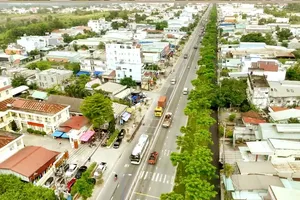
"On the morning of December 17, Ho Chi Minh City appears hazy from above, with visibility from Tan Hung Ward toward the city center significantly reduced due to the dense air pollution. (Photo: SGGP)")
The Ho Chi Minh City Department of Agriculture and Environment reported that, according to recent air quality monitoring results, the city’s air pollution is primarily attributable to particulate matter. At certain times, concentrations of total suspended particles (TSP) and fine dust particles (PM10 and PM2.5) at high-traffic locations exceeded permissible limits, while other pollution indicators remained within acceptable thresholds.
Air quality fluctuates throughout the day and shows seasonal variation over the year. Pollution levels are generally higher during the dry season compared to the rainy season, with PM2.5 concentrations typically peaking at the turn of the year.
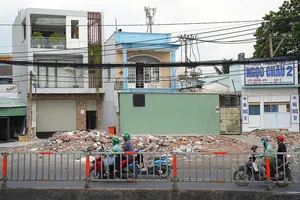
According to the Ho Chi Minh City Department of Agriculture and Environment, the main sources of air pollution have been identified as transportation activities, industrial production, construction work, and agricultural and residential practices.
It cannot intervene in meteorological conditions, nor can it control the impact of long-range air pollution sources. The most critical task is to reduce local emissions, and a green transition is imperative across all sectors. Currently, Ho Chi Minh City has implemented a range of measures to mitigate air pollution and ensure air quality remains at levels safe for public health. Specifically, the city is pursuing urban planning oriented toward sustainability and green development. In addition to technical solutions, the city continuously invests in capacity-building for environmental management personnel and promotes public awareness on air pollution, a representative of the Ho Chi Minh City Department of Agriculture and Environment stated.
On the morning of December 17, Ho Chi Minh City was shrouded in a dense haze, with visibility significantly reduced in some areas. According to several monitoring applications, the city’s air quality index (AQI) reached levels as high as 160 in certain locations, with PM2.5 identified as the primary pollutant posing health risks.