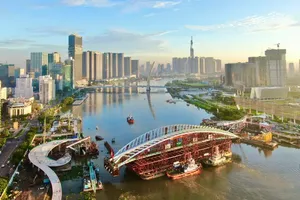
From the requirement of double-digit growth to a 100-year vision, experts argue that Ho Chi Minh City needs a sufficiently ambitious master plan to build a high-value economic ecosystem, strategic infrastructure, regional connectivity, green development, and international integration.
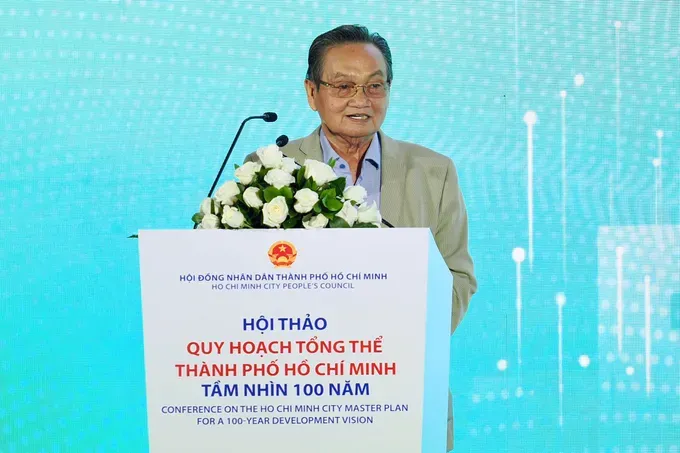
Speaking at the seminar titled “Ho Chi Minh City’s 100-year master plan," held in the city on June 2, Dr. Tran Du Lich, former Deputy Head of the Ho Chi Minh City National Assembly Delegation, expressed his agreement with the proposals in the master plan while also analyzing the highly challenging current issue of achieving double-digit growth. “How can the challenge of growth be addressed through planning?” Dr. Tran Du Lich posed the question.
In addition, Dr. Tran Du Lich placed strong emphasis on the need to renew planning thinking. He noted that with an area of over 6,700 km² and a population of around 14 million people, Ho Chi Minh City is no longer a single urban center but is moving toward a megacity region model. Therefore, planning must shift from an urban expansion mindset to building a globally competitive center for economics and innovation and from land-use planning to ecosystem-based economic planning.
According to him, if in the past planning mainly answered the question "What is this land used for?”, the new mindset must address broader questions such as which economic sectors generate the highest added value, how people will live and work, which infrastructure can create productivity breakthroughs, and what factors ensure sustainable development and climate change adaptation. Modern planning must also answer a key question: What role will Ho Chi Minh City play in the network of global cities in Asia and the world in the next 25, 50, or 100 years?
Architect-Doctor of Science Tran Ngoc Chinh, former Deputy Minister of Construction and Chairman of the Vietnam Urban Planning and Development Association (VUPDA), stated that to achieve long-term development goals, planning work must take the lead and be accurate, targeted, scientific, and aligned with development needs as well as the process of international integration. He emphasized that Ho Chi Minh City is no longer a single urban area but has evolved into a coastal megacity, playing a significant economic role nationally, regionally, and globally.
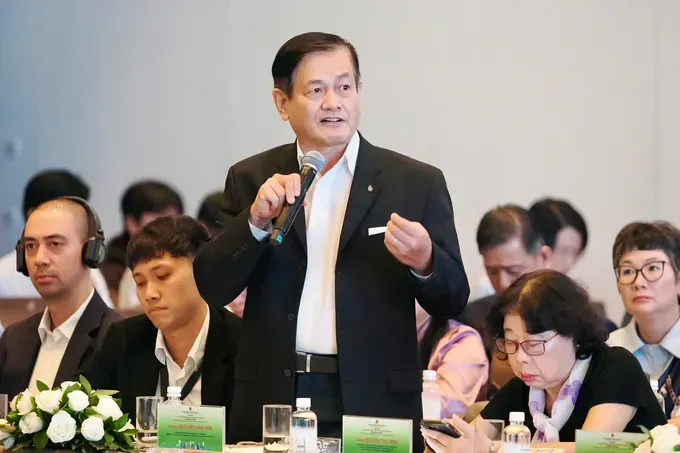
Architect Ngo Viet Nam Son believed that Ho Chi Minh City could achieve double-digit growth if it adopted the appropriate mindset, namely a development-oriented and regional connectivity mindset. He noted that the city should strengthen linkages with Dong Nai City and Tay Ninh Province toward border gates, the Central Highlands, and the Northern region. Meanwhile, areas such as Can Gio and Vung Tau should be oriented toward the East Sea through the Cai Mep–Thi Vai port system.
In addition, there are urban development models in Ho Chi Minh City that are unprecedented in Vietnam, such as transit-oriented development (TOD) and free trade zones. Therefore, an appropriate legal framework is needed to implement these models effectively.
Furthermore, the market-oriented economic mindset has moved beyond a stage of public budget expenditure and is now entering a phase of “budget generation.” As a result, it is necessary to innovate implementation mechanisms, apply key performance indicators (KPIs), and establish clear and transparent reward-and-penalty mechanisms.
Mr. Vu Doan Thai Long, Senior Project Manager at Roland Berger Vietnam, noted that Ho Chi Minh City is not lacking in potential; the key issue lies in how to translate that potential into a robust growth model for the coming time. He also proposed that the city focus on high-value industries such as semiconductors and biotechnology, while strongly developing healthcare, education, logistics, and the digital economy.
In terms of implementation, he recommended establishing a sufficiently strong city-level coordination mechanism, boldly piloting institutional sandbox frameworks, and developing a portfolio of symbolic and spillover projects.
Regarding resources for implementing the master plan, Ms. Vu Hoang Uyen, representative of the World Bank (WB), proposed restructuring Ho Chi Minh City’s financial and public investment programs, with a focus on key initiatives such as transit-oriented development (TOD).
By changing the approach to resource allocation, Ho Chi Minh City could potentially absorb capital flows equivalent to 3–5 times the VND800 trillion (US$30.4 billion) allocated for public investment over a five-year period. The World Bank representative also recommended breakthrough financial instruments such as green bonds and carbon credits.
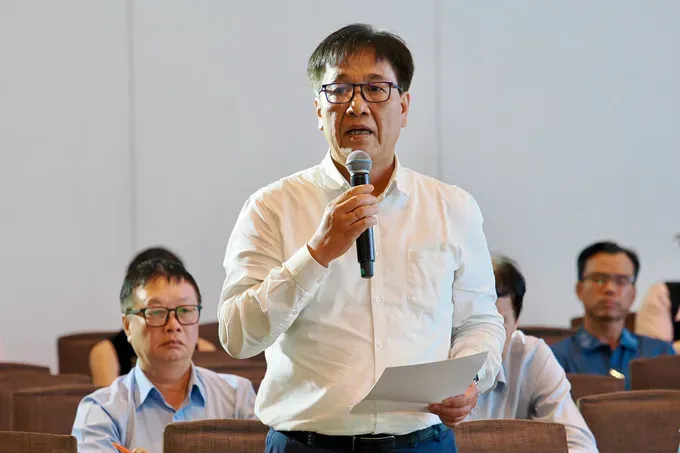
Representatives of several diplomatic missions affirmed their readiness to cooperate with Ho Chi Minh City in developing its 100-year master planning vision.
Mr. Pang Te Cheng, Consul General of Singapore in Ho Chi Minh City, expressed his strong impression of the city’s master plan, highlighting its sustainable, green, and internationally integrated vision, with a strong emphasis on quality of life and the development of living spaces based on multimodal connectivity. He reaffirmed that Singapore stands ready to support Ho Chi Minh City in its future development phases.
Meanwhile, Mr. Etienne Ranaivoson, Consul General of France in Ho Chi Minh City, underscored the importance of transport planning. He noted that France has a strong interest in Ho Chi Minh City’s master plan, particularly in the field of infrastructure. He affirmed France’s willingness to contribute and provide support in the development of the city’s overall planning framework.


)