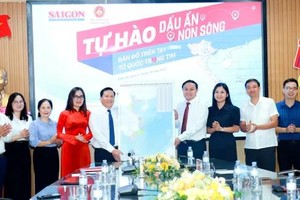
On June 2, the Ho Chi Minh City People's Council convened a seminar titled “Ho Chi Minh City’s 100-year master plan".
Attendees included Chairman of the Ho Chi Minh City People's Council Vo Van Minh; Vice Secretary of the municipal Party Committee Dang Minh Thong; Vice Chairman of the People's Council of the city Nguyen Van Dung; Vice Chairman of the Ho Chi Minh City People's Committee Bui Xuan Cuong; Director of the Ho Chi Minh City Institute for Development Studies Truong Minh Huy Vu; Hoang Tung, Head of the Urban Affairs Committee of the HCMC People's Council, among others.
The seminar marked Ho Chi Minh City's first scientific forum in the process of formulating the city's master plan in accordance with National Assembly Resolution No. 260/2025 and Politburo Resolution No. 09-NQ/TW on the construction and development of Ho Chi Minh City in the new era.
HCMC targets a US$800 billion economy by 2050
")
The master plan, developed by the National Institute of Urban and Rural Planning (VIUP) under the Ministry of Construction in collaboration with Boston Consulting Group (BCG), sets out ambitious growth milestones grounded in scientific research and evidence-based planning.
Presenting the planning report on behalf of the research team, Deputy Director of VIUP, Sam Minh Tuan, emphasized that Ho Chi Minh City’s greatest challenge does not lie in a lack of development potential but rather in its ability to reorganize resources and development space into a unified, multi-centered structure capable of operating efficiently.
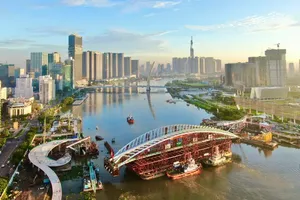
Based on a SWOT (strengths, weaknesses, opportunities, and threats), the master plan outlines a 100-year vision that positions Ho Chi Minh City as a globally competitive megacity characterized by innovation, a high quality of life, and long-term resilience and adaptability. Development objectives are structured around three key milestones: 2030, 2045, and 2075.
By 2030, Ho Chi Minh City aims to achieve a Gross Regional Domestic Product (GRDP) of approximately US$120 billion, with a population of 16 million and sustained annual economic growth of more than 10 percent. By 2050, the city's economy is projected to expand to US$800 billion, while its population is expected to reach 22–25 million.
GRDP per capita is targeted to rise from at least US$14,000 by 2030 to US$75,000 by 2045 and further increase to US$100,000 by 2075. The digital economy has been identified as a key growth driver and is expected to account for 60 percent of GRDP by 2035.
A multi-centric megacity model
According to Mr. Sam Minh Tuan, the core principle of the new master plan is a shift away from the traditional model of outward expansion from a central urban core toward a multi-centric megacity model.
Under the plan, Ho Chi Minh City will operate based on a 5-5-10 framework, comprising five growth poles, five strategic corridors, and ten development governance zones. These components will be interconnected through five strategic corridors, with a multi-layered urban infrastructure network, including metro lines, transit-oriented development (TOD) zones, underground facilities, and elevated urban spaces, serving as the backbone of the city’s development.
Notably, the “green and blue” corridor, encompassing the Saigon River, Dong Nai River and the Can Gio mangrove forest, is envisioned as a foundational ecological infrastructure system, enhancing the city’s resilience and capacity to adapt to climate change.
Six special development zones to enhance global competitiveness
To strengthen Ho Chi Minh City’s integration into global value chains, the master plan proposes the establishment of six special development zones, each supported by breakthrough mechanisms and policy frameworks.
These include a high-tech innovation zone centered in Thu Duc and neighboring areas formerly belonging to Binh Duong, with a focus on semiconductors, integrated circuits, and robotics; a free trade zone linked to the Cai Mep–Can Gio port cluster, integrating logistics services and export-oriented manufacturing; and an international financial center located in the former District 1 and Thu Thiem area, operating under a legal framework aligned with international standards and practices.
The plan also envisions a digital technology and data hub, prioritizing computing infrastructure, artificial intelligence and cybersecurity; a national energy center developing liquefied natural gas (LNG), hydrogen and offshore wind power in Phu My and Long Son; and a commercial and cultural development zone, with a focus on cultural industries, major events and creative tourism in Rach Chiec and Thanh Da.
Quality of life and sustainable development
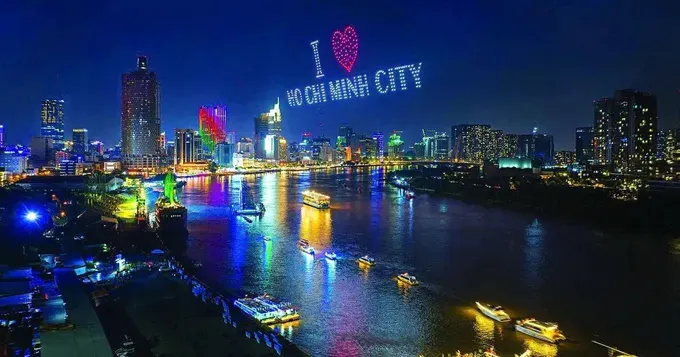
Beyond economic targets, the master plan places people at the center of development. Ho Chi Minh City aims to achieve a Human Development Index (HDI) of above 0.8, while ensuring that, by 2030, there are at least 300 classrooms for every 10,000 residents of school age.
Amid growing climate-related risks, the plan adopts a development approach guided by the environmental carrying capacity of the city’s ecosystems. Critical ecological areas, including the Can Gio mangrove forest, will be placed under strict protection and serve as a natural buffer against climate impacts.
Ho Chi Minh City also plans to accelerate its transition toward a low-carbon urban model, prioritizing electric buses, waterborne transport and energy-efficient buildings as part of its long-term sustainable development strategy.
Five key growth poles
International central core: A hub for finance, governance and global services, centered on Saigon, Cho Lon and Thu Thiem.
Eastern innovation pole: Focused on artificial intelligence (AI), semiconductors, research and development (R&D), and knowledge-based urban development in Thu Duc, Di An, and Thuan An.
Northern industrial and logistics pole: Dedicated to advanced manufacturing and smart industrial urban development in Binh Duong.
Southern seaport and free trade pole: Serving as an international transshipment gateway and maritime economic center in Can Gio and Cai Mep.
Coastal tourism pole: Positioned as a destination for international resort tourism and the nighttime economy in Vung Tau, Long Hai, and Ho Tram.



)