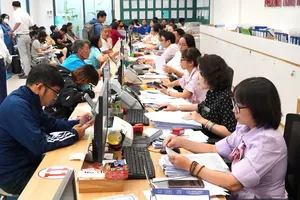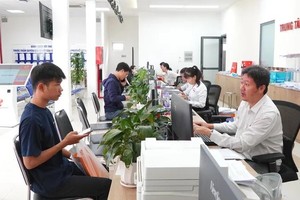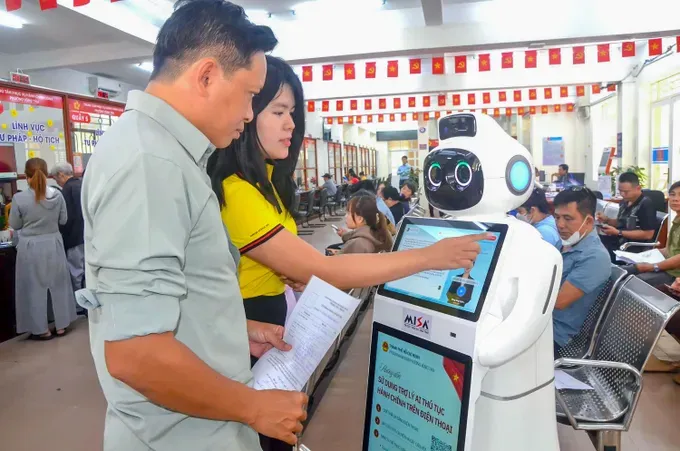
On an early weekday morning at the Binh Hung Commune Public Administration Service Center, despite a massive influx of submissions, the processing of administrative procedures went off without a hitch. Every zone was meticulously delineated, and the specialists navigated the software system with seasoned fluency. Interlinked data protocols are being urgently executed to aggressively slash waiting times.
For Mr. Nguyen Hoang Nam, a local resident executing an “interlinked birth registration, permanent residency registration, and health insurance issuance for children under 6,” the system is a breath of fresh air. “I only need to hand over my chip-based ID card. Once the official scans the QR code, all my information pops right up,” he explained. Instead of tackling each procedure individually, the interlinked database allowed him to finalize his dossier in under 20 minutes, praising the staff’s warm attitude.
Similarly, at the Saigon Ward Public Administration Service Center, 100 percent of dossiers are processed on the city’s dedicated system and synchronized with the National Public Service Portal. Impressively, online submissions hit 99.9 percent. The center definitively cleared its backlog and equipped the hub with smart robots and online kiosks to elevate service quality.
In Vung Tau Ward, authorities haven’t just deployed an AI-integrated receptionist robot; they’ve reportedly rolled out a chatbot ecosystem allowing citizens to handle public service inquiries remotely via QR codes without visiting the Public Administration Service Center. Consequently, during the first quarter of 2026, the ward processed over 5,700 dossiers, achieving a staggering 100 percent online submission rate, with over 99 percent resolved correctly and ahead of schedule. Similarly, An Phu Dong Ward’s newly invested smart kiosk system actively helps citizens execute online procedures far more conveniently.
This practical reality demonstrates that when the grassroots apparatus genuinely serves the public, heavily backed by modern tech, financial pressures don’t morph into roadblocks. Instead, they ignite innovation.
For Chairman Vu Hong Thuan of the Vung Tau Ward People's Committee, the mandate is crystal clear. He stated civil servants must proactively leverage technology to maximize efficacy. Ultimately, by vigorously pushing the digital transformation and deeply embedding IT applications, officials guarantee smooth operations, proactively troubleshooting hurdles to drastically limit late-file scenarios.
Recently, the Prime Minister directed a mandatory minimum cutback of 10 percent on recurrent expenditures for 2026, firmly illustrating the Government’s ironclad determination to heighten the efficacy of public financial management, strictly tighten administrative discipline, and aggressively channel resources toward sustainable developmental targets.
Reality proves that when recurrent spending is rationally trimmed down, the budget inherently gains the bandwidth to focus heavily on essential tasks that directly serve the public. In multiple localities, it appears these saved funds can be prioritized for critical civil works, such as upgrading internal traffic infrastructure, overhauling drainage networks, executing urban beautification, investing in information technology, elevating the caliber of public administrative services, and nurturing broader social welfare.
Residents across Hoc Mon, Dong Thanh, and Xuan Thoi Son communes have recently reaped the direct rewards of recurrent expenditure savings, freeing extra capital to fund vital infrastructure projects. This includes constructing the 1,600m2 Thoi Tu Stadium, the 4,300m2 Le Van Phien Primary School, and comprehensively upgrading Thoi Tam Thon 6 Street. Funded by the residual wage reform budget following Hoc Mon District’s administrative reshuffling, these structures actively elevate the overall quality of life, seamlessly meeting the public's core demands for education and recreation.
For Chairman Vu Hong Thuan of the Vung Tau Ward People’s Committee, this financial constraint acts as a “positive pressure,” forcing agencies and civil servants to completely overhaul their management mindset toward a highly efficient model. Slicing away unnecessary expenses tied to meetings, public procurement, and utilities inherently eradicates wasteful squandering while heightening cadre accountability.
Concurrently, local IT infrastructure continues receiving serious investment, perfectly serving administrative procedures. Ultimately, ruthlessly streamlining procedures and deploying online dossiers slashes “social costs,” minimizing waiting periods and travel, thereby contributing to a healthier local investment environment.
Beyond technology, the physical presence of grassroots government is crucial. Hoc Mon Commune rolled out the “Public Service at the Hamlet” model to actively bring administrative services to people’s doorsteps. This supports citizens in executing tasks within their neighborhoods, aggressively supercharging administrative reform and localized digital transformation.
For Chairwoman Le Thi Ngoc Thanh of the Hoc Mon Commune People’s Council, this model fosters favorable conditions for folks to quickly access procedures where they live. Furthermore, it heavily promotes serving the people “anytime, anywhere,” generating widespread public satisfaction.
During various working sessions, HCMC Chairman Nguyen Van Duoc has demanded recurrent expenditure reductions and a surge in developmental investment. Specifically, this entails a minimum 10 percent cutback on recurrent spending, striving for an additional 5-percent savings, while bumping developmental investment past 50 percent of the 2026 budget and approaching 70 percent by 2030.
Alongside this, there’s a strict mandate to reinforce financial discipline. This involves rigorously controlling budget reserves, exclusively greenlighting genuinely urgent tasks, ruthlessly slashing unnecessary expenses, and flat-out refusing supplementary funding for non-critical endeavors.