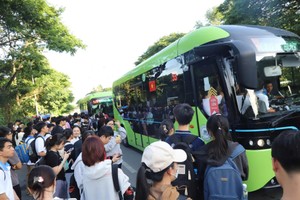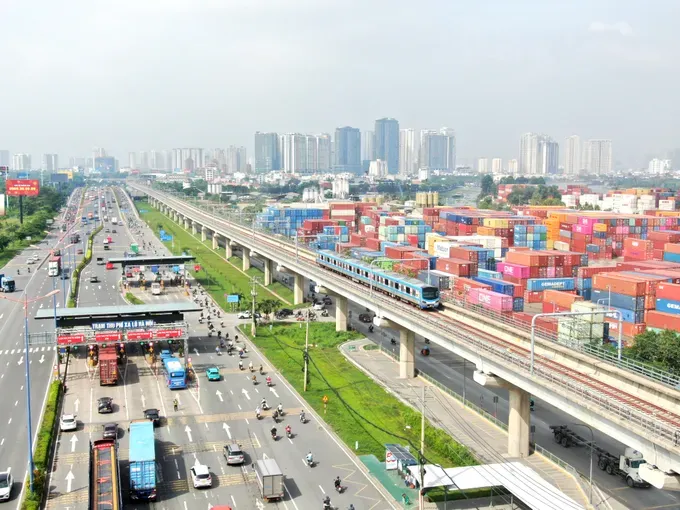
On a weekend morning in mid-May, Tran Van Bien, a resident of Thanh My Tay Ward in HCMC, took his relatives from his hometown of Bac Giang Province to experience the electric train and subsequently stopped by the National History and Culture Park. Sitting in the modern cabin and gazing at the city through the glass windows, everyone was left in sheer awe, signalling a joyful excursion.
For Mr. Bien, this train ride carries a different meaning. Previously, visiting the park meant a hot, dusty 30-minute motorbike ride. Now, he leisurely takes the electric train to enjoy the miraculous transformation of the streets, where new urban areas expand with vitality.
“I was once hesitant about handing over my premises when the project passed through Thanh My Tay Ward,” he explained. “Initially, I was annoyed because I dreaded change, but now seeing such modern traffic and how conveniently our people can commute, I realize that accepting the compensation money and handing over the site back then was definitely the right call.”
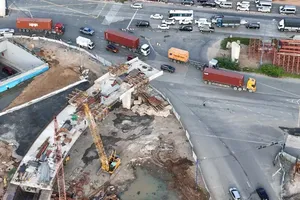
The vicinity around Tan Son Nhat International Airport was a notorious traffic bottleneck during holidays. However, recently, traffic flow through the Tran Quoc Hoan – Phan Thuc Duyen underpass has become significantly clearer. The project connecting Tran Quoc Hoan and Cong Hoa streets is proving its efficacy, alleviating congestion on gateway routes.
Behind this convenience lies a protracted site clearance process because some households hadn’t reached a consensus. Simultaneously, speculative information surfaced online alleging the city opened roads merely to inflate land prices. This project, along with the Duong Quang Ham street expansion, Can Gio International Transshipment Port, Ward 6 school cluster (in the former Tan Binh District), and Ly Thai To No.1 Park have all faced similar malicious distortions.
Nevertheless, reality demonstrates that these completed structures do directly serve the public. The expanded Duong Quang Ham Street mitigates traffic jams, Ly Thai To No. 1 Park transformed into a vibrant community space, and the Ward 6 school cluster resolves the educational needs of thousands of students.
For commuter Tran Minh Sy, the contrast on Duong Quang Ham street is palpable. “Previously, this area was plagued by constant traffic congestion,” he noted. “Now, getting around is significantly more convenient.” He hopes the city finalizes remaining sections for synchronized traffic.
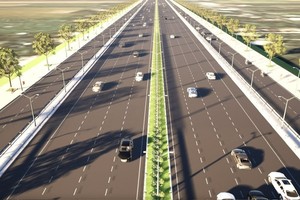
Once Metro Line 1 trains started operating, the efficiency became pronounced. Citizens now have an additional fast and safe travel option, gradually easing traffic pressure and unlocking fresh developmental opportunities along the route. Similarly, completing the Ring Road 3 project will seamlessly connect HCMC with southern provinces, easing burdens on the inner city and generating new developmental room. This proves infrastructure must stay ahead, directly benefiting the citizens themselves daily.
It isn’t hard to discern the ulterior motive behind these distorted narratives. they desperately want to sow seeds of doubt and wedge a divide between the public and the government during the rollout of key projects. However, throughout the developmental journey of the city bearing Uncle Ho’s name, the profound perspective of “taking the people as the root” has constantly served as the overarching guideline.
For over two decades, the grassroots movement advocating citizens to donate land to widen alleys has vividly exemplified this. When the collective benefit materializes in the form of spacious alleys where ambulances can pull right up to the front door and doing business becomes much smoother, citizens are perfectly willing to surrender a portion of their land so the locality can expand its infrastructure to get the ball rolling.
Hostile actors frequently use site clearance to instigate unrest. In reality, the city is perfecting its approach by transparently publicizing master plans. Once a project is approved, local authorities systematically host dialogues to gather citizens’ feedback. More importantly, compensation prices are increasingly aligning with actual market values, and resettlement plans are calculated appropriately so residents’ lives aren’t excessively disrupted.
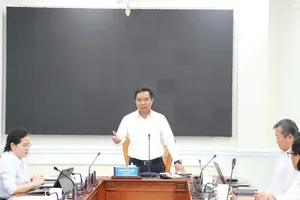
Simultaneously, elected bodies are stepping up oversight. For instance, Binh Trung Ward is preparing a conference regarding the Rach Chiec National Sports Complex to disseminate crucial information and address previous concerns. This steady public transparency has remarkably garnered immense community consensus.
For MSc. Vu Son from the Institute of Regional Development Consulting under HCMC University of Economics, researching urban planning yields a clear conclusion.
He stated the city must view these projects through a long-term lens. While revoking land might trigger short-term upheaval, long-term benefits encompass superior infrastructure, an upgraded living environment, and surging employment. Conversely, failing to proceed with infrastructure projects carries a steep price, namely prolonged gridlock, chronic flooding, severe pollution, and declining urban competitiveness, directly impacting citizens.
“During implementation, there’re inevitably cases lacking consensus,” MSc. Vu Son analyzed. “This is normal in development; you can’t maliciously extrapolate specific snags into baseless claims of group interests.”
Ranging from metro lines to modernized schools, completed structures actively renovate the urban landscape and elevate citizens’ quality of life. These projects effectively showcase the efficacy of transparent compensation and site clearance.
During a recent working session, General Secretary and State President To Lam emphasized that under HCMC’s 2025-2050 planning orientation, the city strives to become a sustainable, truly livable megacity. To materialize this grand ambition, alongside massive projects, HCMC desperately needs to refine mass mobilization, foster open dialogues, and guarantee stark public transparency so citizens will trust and reap the developmental fruits.
Proposing the completion of 58 urgent projects for the 2026-2030 period
- The metro lines currently being deployed in strict accordance with the National Assembly’s Resolution 188;
- 27 distinct road projects, such as HCMC Ring Road 4, the Ho Tram - Long Thanh International Airport Expressway, the cross-sea road connecting Can Gio and Ba Ria – Vung Tau (formerly), the East-West axis (an extension of Vo Van Kiet Street) stretching toward Tay Ninh Province, and Thu Thiem 4 Bridge;
- The massive expansion of major traffic arteries like National Highway 1, National Highway 22, National Highway 13, the North-South arterial road, Truong Chinh – Cong Hoa Street, Xo Viet Nghe Tinh Street, and Dinh Bo Linh Street;
- 14 rigorous urban embellishment projects situated along rivers and canals, 8 vital anti-flooding and wastewater treatment plant projects, alongside 8 ambitious social housing and resettlement initiatives.