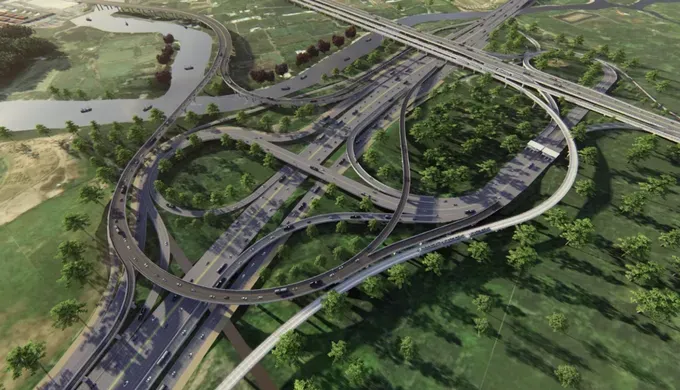
The project will connect to the Ho Chi Minh City – Long Thanh – Dau Giay Expressway and link with the Ho Chi Minh City Ring Road 3.
This is seen as a critical transport project intended to relieve persistent traffic bottlenecks at the city’s largest port entrance.
According to the proposal, the interport road will have a total length of approximately 5.9 kilometers with a cross-sectional width of 60 meters. The starting point will intersect Nguyen Thi Dinh Street, while the endpoint will directly connect to the expressway interchange and Ho Chi Minh City Ring Road 3.
Along the route, Ba Cua Bridge will be constructed with ten traffic lanes.
The section from Phu Huu Port to the interchange between the Ho Chi Minh City – Long Thanh – Dau Giay Expressway and Ho Chi Minh City Ring Road 3 will include a four-lane elevated viaduct, combined with three access points to the lower road, ensuring flexible and smooth traffic flow.
The project is expected to be funded by the state budget, with a total investment of nearly VND8,800 billion (US$334 million). Of this, compensation, resettlement, and technical infrastructure relocation costs are estimated at over VND1,350 billion (US$51.3 million) and construction costs around VND7,400 billion (US$281 million).
If approved in the first quarter of 2026, preparatory work will begin shortly after, with construction scheduled for the third quarter of 2026 and completion expected by the end of 2028.
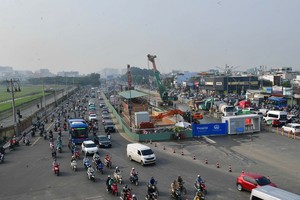
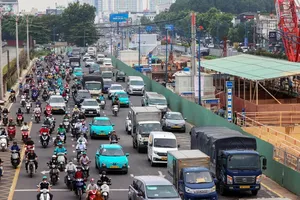
According to the Ho Chi Minh City Department of Construction, the Cat Lai – Phu Huu port cluster along the Dong Nai River is a strategic hub, playing a vital role in import-export activities for Ho Chi Minh City and the Southern key economic region. Currently, access to the ports mainly relies on Nguyen Duy Trinh, Nguyen Thi Dinh, Vo Chi Cong, Dong Van Cong and Mai Chi Tho streets to connect with Hanoi Highway and the Ho Chi Minh City – Long Thanh – Dau Giay Expressway, which are frequently overloaded and heavily congested.






)