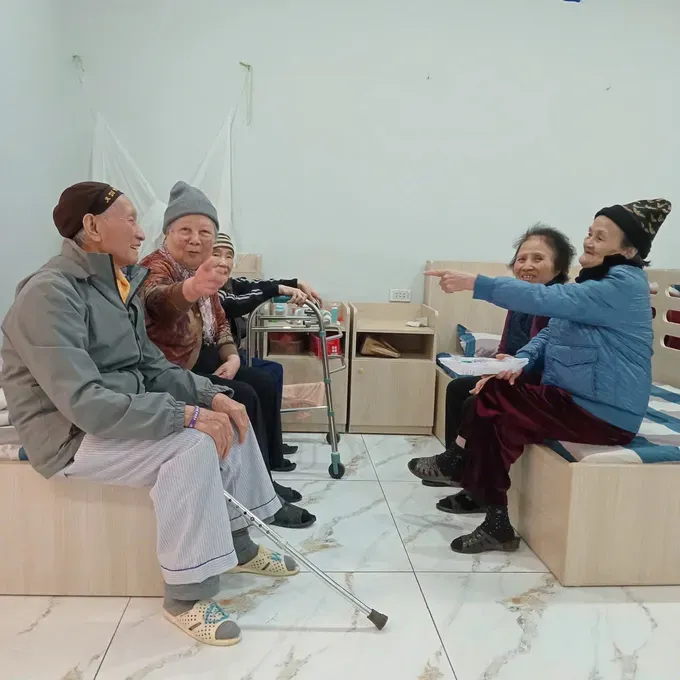
Every morning, the spacious courtyard of Tam An Nursing Home in HCMC transforms into a sunbathing spot for nearly 50 seniors from HCMC and neighboring provinces. They engage in light physical activities under the guidance of caregivers, while many others relax in wheelchairs amidst the fresh air. Occasionally, some seniors wander off to pick flowers or mumble incomprehensible words.
“Where are you going, Dad? Come here and tell me a story,” Manager Mai Thi Thu Ha of Tam An Nursing Home, called out as she chased after an elderly man suffering from dementia, disoriented in time and space.
At Tam An Nursing Home, the elderly are affectionately called “Dad” and “Mom.” As their minds cloud, many disoriented seniors attempt climbing fences instead of sleeping. Consequently, staff must gently coax them back into bed. Upon waking and realizing their disruption, some thoughtfully write sincere apology letters to the manager.
“Living alongside these seniors, we memorize their personalities by listening to their stories,” Ms. Ha explained. “Profoundly lonely, they yearn to communicate. Interestingly, dementia patients rarely mention their children, but frequently reminisce about their childhoods and deeply miss their mothers.”
For years, 80-year-old Nguyen Thi Them endured high blood pressure, requiring extensive hospitalization before transitioning to a nursing home. Previously, despite living with her eldest son, her sole companion was the television within four lonely walls. Because her children worked and grandchildren attended school, her unexpected health deteriorations caused immense concern. Consequently, her family sought a nearby facility.
“My children reportedly said this place rivals a hospital, boasting medical staff and a pleasant environment,” Ms. Them confided. “It’s true! The spaciousness and engaging activities, like planting vegetables and exercising, keep my mind incredibly relaxed.”
Although her family occasionally takes her home for visits, she insists on returning by nightfall for peace of mind. “Recently, I fainted with severe cramping limbs. If the vigilant staff hadn’t administered timely first aid, I probably would not have survived. If I were home alone, it sounds terrifying.”
Bui Thanh Nghia (94 years old, a former company director in HCMC) is quite satisfied with his career and his children’s accomplishments. However, his children are also aging, have their own families and careers, and some have settled abroad. He lived alone in a vast, empty house. Eventually, he decided to tour nursing homes in HCMC with his children to find a haven for his twilight years.
“On September 27, 2024, my child drove me to Tam An Nursing Home. I took a look around and decided to stay right then. It’s never dull here; the ‘grandchildren’ (the staff here) are youthful and enthusiastic, and they organize very fun birthday parties for me,” Mr. Nghia recounted.
Chanh Phu Hoa Social Protection Center in HCMC is an establishment that receives, manages, nurtures, and cares for the elderly, individuals with disabilities, and psychiatric patients who are solitary and lack support. The center is currently managing and caring for 332 elderly individuals.
Director Nguyen Van Thach of Chanh Phu Hoa Social Protection Center stated that seniors at the center enjoy exceptionally high standards of living and receive comprehensive physical as well as spiritual care. Besides ensuring healthcare regimens and adequate nutritional meals for the elderly, the center also organizes cultural and artistic exchange activities between zones on weekends. “Many seniors consider this their home and have no desire to leave,” Director Thach noted.
With 14 years of “seniority” at the center, 89-year-old Nguyen Thi Thanh from Gia Lai Province shared that after living at the center for a month or two, she realized how fortunate she was to be cared for by others. Here, she enjoys “luxurious” meals three times a day, complete with fruits and milk; when she falls ill, she receives medical attention, freeing her from future worries.
“The center’s Board of Directors treats us like family, frequently visiting and checking on us. I suffer from diabetes, high blood pressure, heart disease, and osteoarthritis, and the center provides my medication. If I were to leave now and return to my hometown, I wouldn’t have any relatives, so I choose to stay here permanently,” Ms. Thanh shared.
Prior to entering the center, 72-year-old Tran Thi Vinh from Ha Tinh Province worked as a janitor and a mason in Thu Duc Ward. Her income was unreliable, and having no husband or children, her life was incredibly precarious. She mentioned that at the center, she receives adequate meals, is cared for when sick, participates in cultural and sports activities, and engages in light labor, alleviating the heavy worries she previously carried.
“Now, I’m determined to stay here permanently; I’m not going back. I no longer remember the faces of my relatives in my hometown, and I have no children. If I were to return, I wouldn’t have anyone to care for me when I’m sick; that would be agonizing,” Ms. Vinh expressed.
In another story, persuading his family to relocate to a lower level residence, Nguyen Chi Dang prioritizes caring for his completely senile father, who reportedly suffers from a traumatic brain injury. He currently manages all feeding and hygiene. Despite meticulous care, his father recently fractured his thighbone during a bathroom fall. Although many advised placing him in a nursing home for professional assistance, Mr. Dang adamantly refused. “Sending my father to an unfamiliar place causes immense anguish,” he explained.
However, while rejecting it for his father, Mr. Dang is actively researching eldercare facilities for his own future. Intimately understanding the relentless hardship of caregiving, he absolutely doesn’t want his daughter bearing such heavy pressure. “We really must gradually adapt,” he firmly concluded.
From a sociological perspective, the traditional Vietnamese family culture of “the young relying on their parents, the old relying on their children” embodies mutual reliance between generations in a family. When children are young, they depend on their parents for nurturing; when parents age, their offspring will care for them.
Devotion towards parents is the pillar of family ethics, encompassing both obligation and duty. However, in modern society, the escalating aging population will exert immense pressure on families. Under these circumstances, relying solely on the family to care for the elderly will prove inadequate, necessitating an infrastructure better suited to elderly care models that adapt to population aging.







)