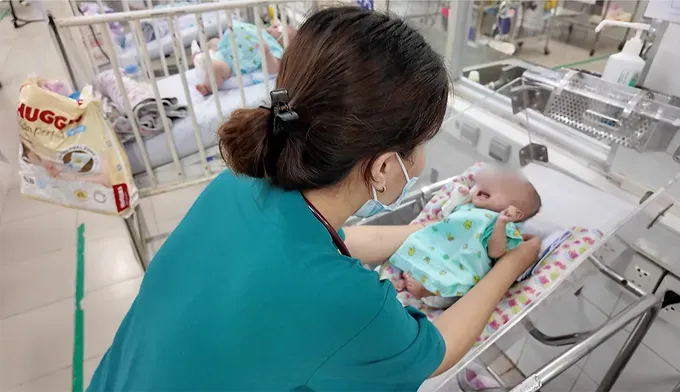
Meticulously sanitizing her hands before cradling a five-month-old pediatric patient, Nguyen Thi Kim Nhi, MD PhD, Head of the Neonatology Department at Children’s Hospital 2 in HCMC, softly stated, “This is an abandoned baby, yet incredibly resilient.”
Arriving prematurely and severely underweight, the boy battles critical pathologies, including respiratory failure, meningitis complications, sepsis, and necrotizing enterocolitis, necessitating prolonged oxygen therapy. His medical dossier is staggeringly thick, dwarfing his fragile frame.
After grueling days, the infant is gradually making a robust recovery, albeit completely devoid of parental presence. Doctor Nhi notes the mother grapples with dire circumstances; she has a large brood and simply might not have the financial bandwidth for the child’s protracted treatment. Relying on the admission registry, medical staff insistently reached out numerous times, yet received no response.
In the adjacent crib lies a four-month-old patient sharing the exact same predicament, his tiny body crisscrossed with intravenous lines. Whenever he kicks up a fuss and cries, a dedicated nurse swiftly scoops him up, tenderly soothing him.
Children’s Hospital 2 reportedly takes in roughly 10 to 12 abandoned newborns annually, mostly plagued by severe ailments. The same situation can be found in numerous medical facilities across HCMC, which frequently take in these profoundly vulnerable, abandoned infants.
In 2024, the Neonatal Pathology Department at Gia Dinh People’s Hospital undertook the monumental task of simultaneously caring for five abandoned newborns. Without any formal identification in their medical dossiers, these youngsters were temporarily logged as “nameless male” or “nameless female.”
Following rigorous periods of intensive treatment and highly specialized care, many of these kids successfully bounced back, steadily packing on weight and hitting normal developmental milestones. However, rather than heading back to the warmth of their families like conventional pediatric patients, a multitude of these children are forced to sit tight and wait for convoluted legal protocols to wrap up before being officially handed over to social welfare institutions.
Over at the Social Protection and Work Center under the HCMC Department of Health, three-month-old baby L.M.N. was taken in when he was a mere nine days old. It appears little N. was callously abandoned right after birth at Vung Tau General Hospital.
The mother supposedly left behind a full name, address, and phone number in the logs, but it turned out every piece of information was fabricated. When representatives from the Tam Thang Ward People’s Committee and HCMC police physically tracked down the location, the address didn’t exist; dialing the phone number merely led to a stranger.
For Ms. Le Thi Quynh Nhu, a dedicated staffer there, the daily reality is clear as she noted that N. is exceptionally well-behaved, rarely kicks up a fuss, and is a breeze to feed.
Currently, the facility actively nurtures 94 underprivileged children, including 29 under five. Beyond providing healthcare, dedicated cadres frequently roll out recreational activities and life skills training, paving the way for these youngsters to flourish within a secure environment.
According to Director Le Thi Hong Chin of the Social Protection and Work Center, the entire cohort of public employees and workers remains fiercely devoted to their duties. They nurture the children with unwavering accountability, desperately striving to soothe their profound traumas and genuinely help them thrive.
Nevertheless, an agonizingly common hurdle when executing the intake protocols is the sheer volume of time squandered verifying background details, compiling dense dossiers, broadcasting notices to hunt down the babies’ relatives, and painstakingly coordinating across relevant agencies. In instances where infants lack sufficient data or establishing contact with their families proves utterly impossible, the verification timeline tends to drag on endlessly, severely bottlenecking the finalization of their official paperwork.
Shedding more light on the crippling roadblocks encountered while transferring these kids to welfare facilities, Deputy Head Nguyen Thi Thuy of the Social Work Department at Children’s Hospital 2 in HCMC explicitly pointed out that even after hitting medical stability, abandoned patients still have to endure an excruciating wait of three to four months before hitting the protection center. This is predominantly due to the agonizingly sluggish pace of finalizing paperwork.
There are heartbreaking cases where a child ends up practically growing up inside the hospital ward for nearly a solid year, taking their very first wobbly steps right between the clinical beds, a sight that leaves the medical personnel profoundly gutted.
“No matter how fiercely we love them, we simply don’t want these little ones to grow up confined within a hospital, as it’s absolutely not a suitable environment to foster a child’s holistic development,” she lamented.
To devise a viable solution, Children’s Hospital 2 has officially inked a collaborative protocol with the Saigon Ward Public Security Division and the HCMC Bar Association, strictly aiming to streamline background verifications and determinedly track down the infants’ relatives.
“If these bureaucratic procedures can be fast-tracked and interdisciplinary coordination operates more efficiently, the babies will inherently receive superior care much sooner, comfortably nestled in a far more appropriate and highly secure environment,” Deputy Head Nguyen Thi Thuy shared.