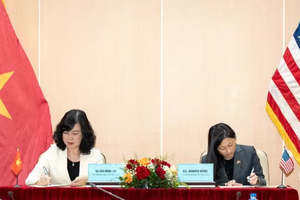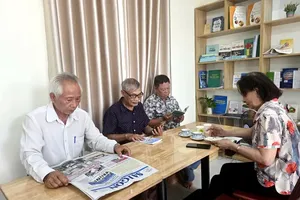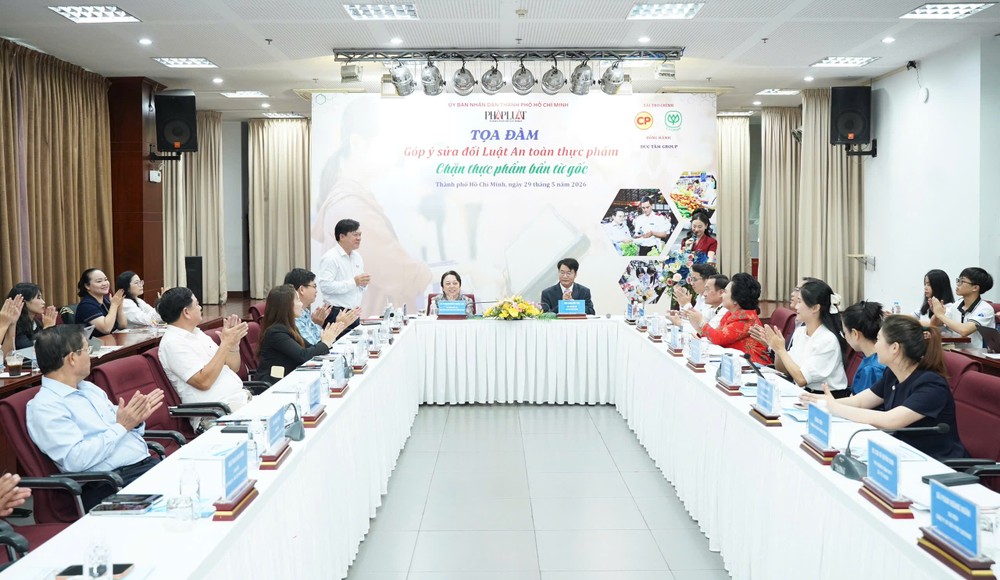
The seminar, titled “Amending the Law on Food Safety: Blocking Unsafe Food at the Source,” was organized by Phap Luat HCMC Newspaper on May 29 to contribute practical recommendations toward a more effective and feasible legal framework.
Speaking at the event, Mr. Tran Phu Cuong, Head of HCMC’s Sub-Department of Livestock Production and Animal Health, said the city currently has one disease-safe zone and 285 livestock facilities certified as free from terrestrial animal diseases.

He emphasized that the veterinary sector plays a pivotal role in ensuring food safety at the source through pre-transport animal quarantine, slaughterhouse oversight, disease surveillance, and early warnings of potential food safety threats.
However, many small-scale slaughterhouses still fail to store information on incoming livestock and lack proper identification and traceability systems. Data across farming, transportation, slaughtering, and distribution stages also remain disconnected, making traceability and incident response difficult when violations occur.
To tackle these shortcomings, HCMC’s livestock and veterinary authority proposed that the city adopt a slaughterhouse development plan through 2030 focused on phasing out small-scale facilities and expanding standardized centralized slaughterhouses.
At the seminar, Ms. Ly Kim Chi, Chairwoman of the HCMC Food and Foodstuff Association, noted that the food market is evolving rapidly amid the strong growth of e-commerce and multi-platform supply chains.
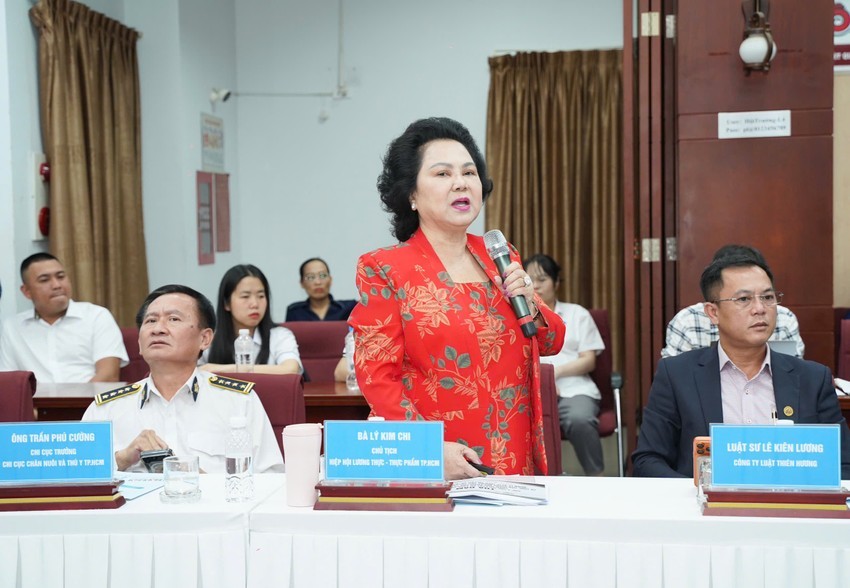
Despite those developments, food safety management data remain fragmented, traceability systems are limited, and post-inspection as well as inter-agency coordination remain inconsistent.
She therefore proposed that Vietnam modernize its food safety management model through a unified national data platform, risk-based governance, and more substantive inter-sector coordination.
Regarding the Ministry of Health’s proposal to establish Food Safety Departments at provincial and municipal levels, Ms. Ly Kim Chi said the model is suitable for major urban centers such as HCMC, where food production and consumption density is exceptionally high and practical implementation has already taken shape.
For many other localities, however, she said the model should be carefully assessed to ensure long-term stability and suitability to local conditions.
The association also recommended that the revised Law on Food Safety shift decisively away from a pre-inspection mindset toward a modern system centered on risk management and post-market inspection.
Under such an approach, compliant businesses would benefit from more favorable conditions, while violators would face strict penalties.
Mr. Dinh Duc Tho, Deputy Editor-in-Chief of Phap Luat HCMC Newspaper, said the amendment process presents an opportunity to fundamentally restructure food safety governance with the spirit of “blocking unsafe food at the source.”
According to him, authorities should shift from reactive enforcement to risk prevention, from broad and overlapping inspections to supply chain- and risk-based management, and from fragmented oversight to clearer accountability and stronger inter-agency coordination.
Ms. Pham Khanh Phong Lan, Director of the HCMC Department of Food Safety, said the draft amendments currently focus on four major policy groups: improving the State management apparatus on food safety; managing food safety along the value chain; preventing the misuse of substances in food production and processing; and encouraging investment in food supply chains.
Ms. Pham Khanh Phong Lan noted that the biggest gap in the current Law on Food Safety and related regulations lies in the fragmented and inconsistent management system, while informal markets, spontaneous street markets, and unlicensed food businesses remain widespread.
She added that many existing regulations still focus heavily on pre-inspection procedures, paperwork, and administrative licensing. Meanwhile, post-market surveillance and on-the-ground enforcement remain insufficiently robust to effectively curb violations.