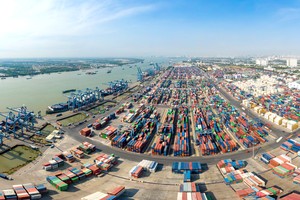
The newly expanded development space is opening opportunities for HCMC to reorganize its industrial map, connecting high-tech industries, supporting industries, manufacturing and processing, logistics, and seaports into value chains. The goal is not only to expand production capacity but also to raise productivity and added value, creating momentum for double-digit economic growth.
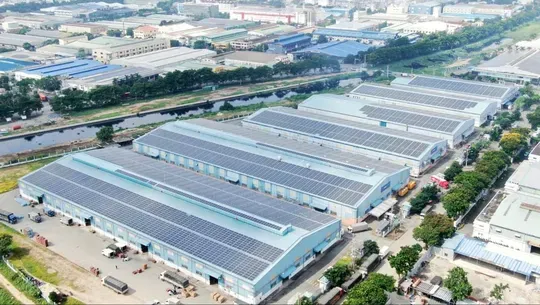
In the first nine months of 2026, HCMC's Industrial Production Index (IIP) rose 10.9 percent; manufacturing and processing increased 11.3 percent; and the city's four key industries, including mechanical engineering, electronics-information technology, chemicals-pharmaceuticals-rubber-plastics, and food processing, grew 10.8 percent.
To sustain stronger growth, the city needs to reorganize industrial space and reallocate resources, land and infrastructure toward sectors with higher productivity and added value.
Businesses face relocation choices
Pressure for transformation has emerged in many industrial parks for decades. Limited land availability, rising costs, and increasingly stringent requirements on technology, environmental standards and competitiveness are forcing many businesses to reassess their production locations.
At Tan Binh Industrial Park, Au Lac Plastic Engineering Application One Member Company is preparing to invest about VND200 billion (US$7.8 million) to build a factory in Tay Ninh Province.
However, not all businesses are ready to relocate. At Tan Thuan Export Processing Zone, Huynh Cong Khanh, workshop manager at Usui Brush Vietnam Company, said the company wants to invest in a new factory but must carefully consider the payback period as well as the risk of losing highly skilled workers who have been trained over many years.
Sharing the same view, Vu Anh Tuan, chief executive officer of Tien Tuan Company at Tan Binh Industrial Park, said businesses need clear information on the future orientation of industrial parks, extension timelines if any, and conversion conditions so they can proactively plan investments.
Trinh Thi Dung from TCL Smart Electronics Vietnam Company in VSIP II-A Industrial Park said the company at one point needed around 1,000 workers but was only able to recruit about 100 after a month.
This highlights that locations receiving new production activities must simultaneously meet requirements for labor supply, transportation, logistics, energy and supplier networks.
Relocation is not simply a matter of moving factories from land-scarce areas to places with available land. It must ensure uninterrupted operations, workforce stability and investment efficiency.
Without a clear roadmap and suitable receiving conditions, businesses may incur additional costs without improving production capacity.
Transformation does not necessarily require relocation
Tran Quang Truong, chief executive officer of Tanimex, said some secondary investors in Tan Binh Industrial Park have already shifted from manufacturing to services and logistics. Tanimex has proposed reorganizing the area toward clean industry, services and logistics to better suit its urban location.
As such, transforming industrial parks does not necessarily mean relocating all factories. Instead, industries and land-use functions should be reorganized according to the advantages of each area.
Head Bui Minh Tri of the HCMC Export Processing and Industrial Zones Authority (HEPZA) stressed that some industrial parks located within the urban core still operate under outdated models and fail to meet the requirements of modern industry, while some are approaching the expiration of their land-use terms.
The city is developing a plan to transform existing industrial parks, clearly defining models, roadmaps and implementation mechanisms to safeguard the legitimate rights and interests of businesses and workers. However, transformation will only be feasible if businesses are given sufficient preparation time.
HEPZA has been assigned to lead and coordinate with agencies and departments in drafting two resolutions on industrial park transformation, which are expected to be submitted to the HCMC People's Council for consideration at its final session of 2026.
The first draft resolution, titled “Regulations on mechanisms and policies for converting operating export processing zones and industrial parks in the city into new functional zones,” is aimed at developing high-tech, specialized, supporting-industry and concentrated digital-technology models.
The second draft resolution, titled “Regulations on ecological industrial park and industrial cluster criteria in the city and roadmaps, mechanisms and policies supporting the conversion of operating industrial parks and industrial clusters into ecological industrial parks and industrial clusters,” focuses on efficient resource use, technological innovation and reducing environmental impacts.
A notable proposal is a 30 percent reduction in subleased land rental costs during the first five years for secondary investors required to relocate to receiving industrial parks or industrial clusters.
However, land and credit incentives address only part of the cost burden. Policies must link transformation roadmaps with receiving-site conditions, infrastructure, financing, workforce training and technological modernization to minimize the risk of disruptions to production and supply chains.
More importantly, relocation should create opportunities to upgrade production lines. If old production lines are simply transferred to new locations, the city will only solve factory distribution issues without generating additional productivity or added value.
At the same time, automation, smart manufacturing, emissions reduction and demands from global supply chains are compelling businesses to modernize technology, improve product quality and optimize resources.
Policies should encourage the combination of investment in new sites with equipment modernization, process improvements and stronger supply-chain participation.
The relocation process must be aligned with industrial development goals in the new economic space. Industrial parks located deep within urban areas should be transformed to capitalize on advantages in technology, human resources and services, while production activities requiring large land areas should be relocated to areas with suitable infrastructure.
This restructuring should facilitate the development of high-tech industries, supporting industries, green manufacturing and sectors with high added value. It will provide the foundation for more efficient industrial land use, lower pressure on urban infrastructure and greater room for economic growth.