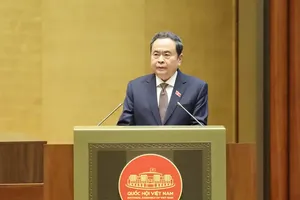
Discussing in groups on the draft Law on Small and Medium Enterprise Development, National Assembly Chairman Tran Thanh Man voiced concern that the sector can only grow if substantive priority is given to micro-enterprises and household businesses undergoing transformation.
On the afternoon of October 17, National Assembly deputies discussed in groups the draft Law on Small and Medium Enterprise Development, the draft Law amending and supplementing a number of articles of the Law on Securities, and the draft Law amending and supplementing a number of articles of the Law on Accounting and the Law on Independent Audit.
Breaking the vicious cycle
During group discussions among the Ho Chi Minh City National Assembly Delegation, deputies expressed concerns over how to help small and medium enterprises (SMEs) develop and achieve sustainable growth, contributing to the nation's overall economic development goals.

National Assembly Chairman Tran Thanh Man cited figures showing that SMEs currently account for 98 percent of all active enterprises, yet only represent about 20 percent of total outstanding credit in the economy. Banks have announced preferential credit packages totaling over VND407 trillion (US$16.3 billion) with interest rates lower by 1 to 2 percent per year. However, most businesses still find it difficult to access capital. The unfulfilled financial gap for SMEs remains substantial, estimated at approximately US$21.7 billion.
According to National Assembly Chairman Tran Thanh Man, businesses have been unable to access capital sources because banks rely excessively on collateral assets. "Most banks still require real estate or high-value assets as security. Meanwhile, SMEs, especially newly established micro-enterprises, lack or do not have these assets," the National Assembly Chairman raised the issue.
Another reason SMEs fail to access capital sources is the lack of information transparency and cash flow management capacity. Specifically, financial statements of many businesses remain inaccurate, with personal finances and corporate finances not properly separated. Consequently, banks find it difficult to evaluate actual debt repayment capacity.
In addition, capital absorption capacity among enterprises remains limited. Many businesses, even when granted loans, lack clear business plans and proper cash flow management, leading to high risks and making banks hesitant to expand lending. Furthermore, capital shortages prevent enterprises from expanding production, investing in technology, enhancing competitiveness, or participating in value chains. As a result, revenue and cash flow remain weak, making borrowing even harder.
"This is a vicious cycle that has lasted for many years. To remove this bottleneck, we need to take stronger measures in the new law this time," the National Assembly Chairman analyzed, suggesting a pilot data-based sandbox mechanism. At the same time, he recommended reforming and increasing SME credit guarantee funds, improving financial transparency and corporate financial management capacity, providing support in accounting, software, and training, and diversifying capital sources from bank loans, investment funds, bonds, and financial leasing.
The National Assembly Chairman also requested that the new law must link accountability with clear, public output results and give substantive priority to micro-enterprises and converted household businesses. Doing these well will ensure the law acts not merely as support, but as a real tool to help SMEs grow in quality, contributing to achieving double-digit growth targets.
Recommendations for SME support mechanisms
Offering feedback on the draft Law on Small and Medium Enterprise Development, Deputy Nguyen Van Than from Ho Chi Minh City, who is Chairman of the Vietnam Association of Small and Medium Enterprises, pointed out the reality that household businesses face capital shortages, leading to supply failing to meet demand.

To solve this capital shortage, Deputy Nguyen Van Than proposed that loan interest rates must definitely be low. "Non-deposit-taking financial institutions could lend capital. Currently, there are many foreign financial institutions, but we have not been truly aggressive in pursuing this," Deputy Nguyen Van Than suggested, referencing digital banks as a solution for household businesses and SMEs to access capital and address interest rate and uncollateralized lending challenges.
Deputy Phan Duy Anh from the Central City of Da Nang also highlighted the reality that although the 2017 Law on Support for Small and Medium Enterprises contained a full set of mechanisms and policies, implementation revealed bottlenecks (in accessing capital, state financial funds, and production sites). The deputy argued that if the draft Law on Small and Medium Enterprise Development fails to take a comprehensive and transparent approach, current difficulties will recur.
The deputy proposed that mechanisms and policies to support SMEs must be designed clearly, publicly, and transparently. All policies should have explicit regulations and rules, minimizing subjective selection processes at a time when enterprises face severe administrative hurdles in accessing policy support.