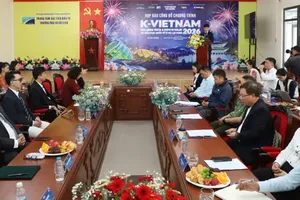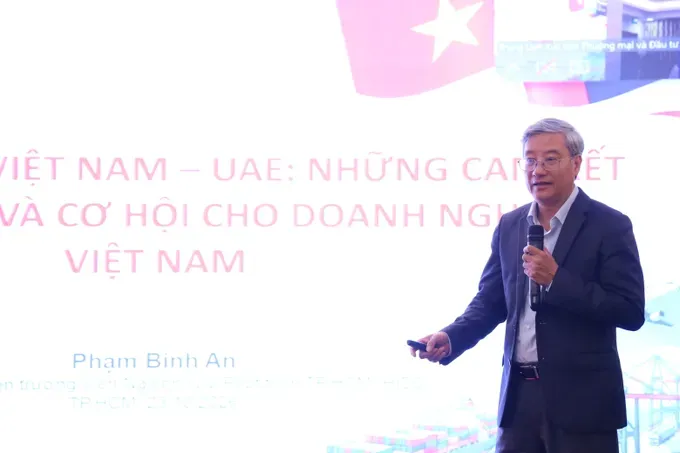
On October 23, the Ho Chi Minh City Investment and Trade Promotion Center (ITPC), in coordination with the Ministry of Industry and Trade's Agency for Foreign Trade, organized a seminar titled “Vietnam-UAE CEPA: Export Potential in the Middle East and Africa for Vietnamese Businesses” in Ho Chi Minh City.
At the seminar, Pham Binh An, former deputy director of the Ho Chi Minh City Institute for Development Studies, said the UAE's gross domestic product in 2025 was estimated at about US$517.7 billion, with the non-oil sector accounting for 77 percent of the economy.
Due to natural constraints on agricultural production, the UAE imports about 85 percent to 90 percent of its food demand. In addition, foreign residents account for 88.5 percent of the country's population, creating a diverse consumer market and opening significant opportunities for Vietnamese agricultural products, seafood, processed foods and consumer goods.
The UAE also serves as a major trade and logistics hub linking Asia, Europe and Africa. Its advanced seaport system, logistics infrastructure and re-export activities enable goods to reach markets across the region quickly. This provides Vietnamese businesses with an opportunity to use the UAE as a strategic distribution hub rather than solely as a direct consumer market.
Market access opportunities have expanded further since the Vietnam-UAE Comprehensive Economic Partnership Agreement took effect on February 3, 2026.
Truong Xuan Trung, head of the Vietnam Trade Office in the UAE, said CEPA aims to eliminate tariffs on 99 percent of Vietnamese-origin goods covered by the UAE's commitments, subject to implementation schedules and conditions.
Products with strong potential include agricultural goods, processed foods, seafood, textiles and garments, footwear, wood products, furniture and consumer goods.
However, tariff preferences do not automatically guarantee market access. Businesses should prioritize using the UAE as a testing ground to assess demand, improve product quality and build strong relationships with importers.
Once a stable distribution network has been established, companies can expand into member states of the Gulf Cooperation Council (GCC) and then move into other Middle Eastern and African markets suited to their products.
To maintain long-term supply chains, businesses need to carefully select capable partners, fully calculate transportation, warehousing and distribution costs, and strictly comply with regulations on food safety, traceability and Halal standards for applicable products.
In particular, Vietnamese goods exported to the UAE and subsequently re-exported to third countries will not automatically qualify for CEPA tariff preferences.
Head Tran Ngoc Binh of Import-Export Management Office No. III under the Ministry of Industry and Trade's Agency for Foreign Trade stated that the Ministry will focus on providing market intelligence, offering training on Halal standards, facilitating connections with importers, and supporting businesses in participating in specialized trade exhibitions across the UAE, the Middle East, and Africa. These efforts are intended to help enterprises enhance their supply capacity, gradually build distribution networks, and expand their export market share.