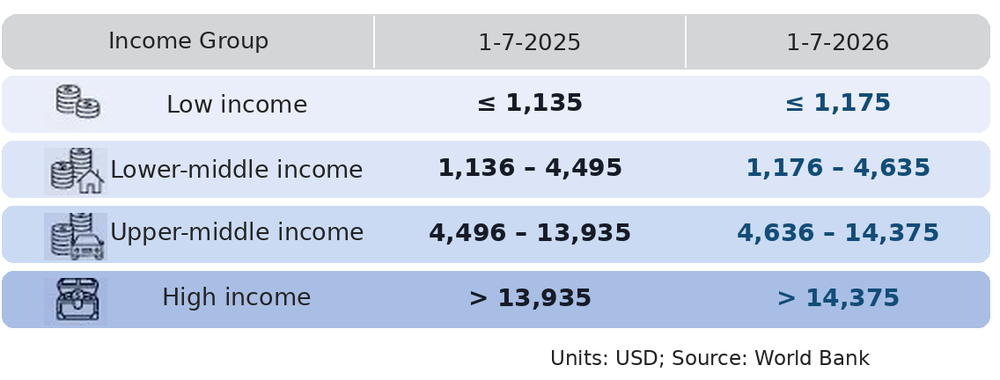
As of July 2026, the World Bank has classified Vietnam as an upper-middle-income country—a proud achievement following four decades of Doi Moi (renewal). To ascend to the high-income tier, the economy can no longer rely solely on traditional growth drivers. Should it be slow to innovate its development model, Vietnam risks falling into the middle-income trap, even while maintaining a relatively high rate of economic growth.

The middle-income trap looms as growth constraints tighten
Vietnam’s goal is to become a developing nation with a modern industrial base and an upper-middle-income status by 2030 targeting a GDP per capita of approximately US$8,500 and an average annual GDP growth rate of 10 percent or higher. By 2045, the objective is for Vietnam to become a high-income nation.
In 2025, Vietnam’s GDP per capita reached US$5,026 (with the World Bank’s estimate for Gross National Income (GNI) per capita at US$4,970). Bridging the gap from the current US$5,026 to the 2030 target of US$8,500 per capita presents a significant challenge.
Globally, many countries have transitioned rapidly from low-income to middle-income status, only to subsequently stagnate. Consequently, the path toward 2030 requires more than just high GDP growth; it demands the capacity to master technology, boost productivity, foster the growth of domestic enterprises, and strengthen the economy’s overall resilience.
Chairman Le Minh Nghia of the Vietnam Financial Consultants Association (VFCA) observed that while an economy may experience rapid growth for a few years which has been driven by investment, credit, or favorable export conditions, sustaining high growth requires the continuous creation of new value.
Drawing on international experience, Chairman Le Minh Nghia warned that many countries have fallen into the so-called “middle-income trap,” where traditional growth drivers lose momentum before new competitive advantages can take hold.
Labor is no longer cheap, natural resources are being depleted, and capital efficiency is declining. At the same time, domestic enterprises often lack the capacity for research and development, product design, brand building, and supply chain leadership, he said.
He added that as a result, the economy becomes caught in a pincer movement: it is no longer low-cost enough to compete with less-developed economies, yet not sufficiently advanced to challenge more developed ones.
Explaining the two sides of this “pincer,” the VFCA Chairman noted that the first stems from the erosion of traditional growth engines. The scope for shifting labor from agriculture to industry has narrowed, rising wages have weakened the advantages of low-cost manufacturing, the population is beginning to age, and land and natural resources are becoming increasingly constrained. Growth driven by expanding scale alone is therefore becoming more expensive and less efficient.
The second arm of the "pincer", he said, is the slow development of new sources of competitiveness. While Vietnam has established itself as a major manufacturing and export hub, the share of value retained within the domestic economy remains relatively limited, reflecting the country’s continued dependence on lower-value segments of global supply chains.
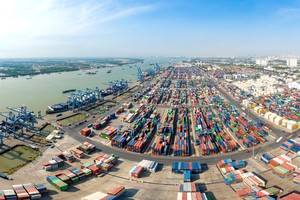
Data from the General Statistics Office under the Ministry of Finance show that Vietnam’s merchandise exports exceeded US$434 billion in the first nine months of 2026, up 24.5 percent from a year earlier. However, the composition of exports highlights the economy’s continued reliance on foreign-invested enterprises. The domestic sector accounted for just 19.3 percent of total export turnover, while foreign-invested firms contributed the remaining 80.7 percent.
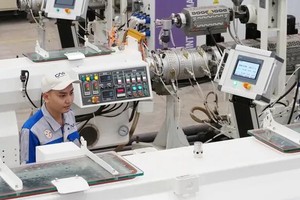
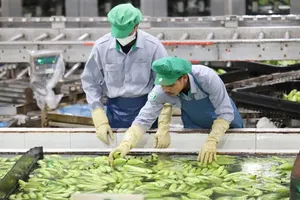
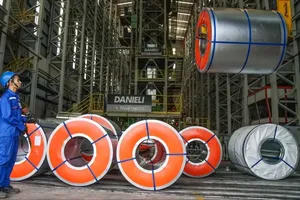
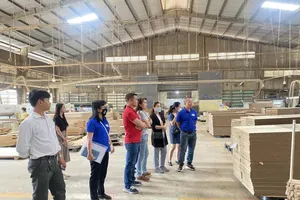
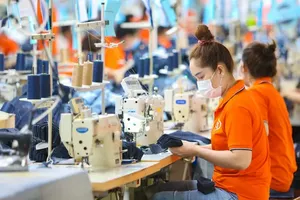
The figures point to a striking reality. Although products manufactured in Vietnam have gained a strong presence in global markets, the capabilities of domestic enterprises have not advanced at the same pace. Many Vietnamese firms remain concentrated in processing and assembly activities, which generate relatively low added value.
Higher-value segments of the production chain, including technology development, product design, data management, and brand ownership, continue to be dominated by foreign companies. As a result, while export volumes have expanded rapidly, a significant share of the value created is captured outside the domestic economy.
The skills gap is also a cause for concern. Many young people hold academic degrees but lack proficiency in digital literacy, foreign languages, and problem-solving. "Statistics indicate that the pool of formally skilled labor remains limited relative to the requirements for developing emerging sectors such as artificial intelligence, big data, information security, semiconductors, automation, smart logistics, digital finance, and cross-border e-commerce," observes lecturer Ngo Tri Trung from CMC University.

Furthermore, data from the General Statistics Office shows that in the first nine months of 2026, the proportion of the workforce with formal training—evidenced by a degree or certificate—stood at less than 30 percent.
Innovation and productivity to drive Vietnam's next economic leap
According to the World Bank, since 1990, only 27 economies have successfully transitioned from middle-income to high-income status. Vietnam still shares several characteristics with economies that have yet to escape the middle-income trap: growth remains heavily reliant on the foreign direct investment (FDI) sector, primarily in assembly-based activities, with low domestic value-added; investment in research and development (R&D) is limited; and resource allocation remains suboptimal, with capital failing to flow toward its most efficient uses.
Nevertheless, Vietnam possesses significant advantages not shared by every nation caught in the middle-income trap. As noted by Mariam J. Sherman, World Bank Country Director for Vietnam, Cambodia, and Laos, Vietnam benefits from a young and dynamic workforce, a stable macroeconomic environment, and a geostrategic location at the heart of Asia’s most vibrant growth region. Most importantly, the country demonstrates a strong commitment to reform, alongside a proven capacity to adapt.
These advantages can only serve as a new engine for growth if they are transformed into the capacity to generate higher value. Director Vo Tri Thanh of the Institute for Brand and Competitiveness Strategy emphasizes that the core objective extends beyond mere growth figures; it centers on the ability to master technology and supply chains. Vietnamese enterprises cannot simply coexist alongside the FDI sector; they must actively absorb technology, build internal capabilities, and ascend to higher-value segments of the value chain.
Furthermore, continuous productivity enhancement is the key to escaping the middle-income trap. However, increasing productivity is not simply about working faster; it is about generating greater value from the same amount of capital, labor, land, and energy. This requires better technology, improved management, and the allocation of resources to the enterprises that utilize them most effectively.
Lecturer Ngo Tri Trung from CMC University emphasized that Vietnam cannot achieve a modern industrial economy by relying on an outdated industrial mindset. Science and technology, innovation, digital transformation, and a high-quality workforce must be placed at the core of the national development strategy.
According to Chairman Le Minh Nghia of the Vietnam Financial Consultants Association (VFCA), escaping the middle-income trap requires more than just a single policy; it demands a synchronized, persistent, and consistent approach across several key pillars: upgrading technology, developing human capital, refining institutional frameworks, and building robust domestic enterprises. These tasks must be prioritized during the 2026–2030 period.
A successful transition would mean that the 2030 milestone represents more than just an income target—it would signify a shift from resource-driven growth to capability-driven growth, from mere participation in value chains to moving up within them, and from rapid growth alone to development that is fast, sustainable, autonomous, and more human-centered. This serves as the foundation for Vietnam to move closer to its aspiration of becoming a developed and high-income nation by the middle of the 21st century.