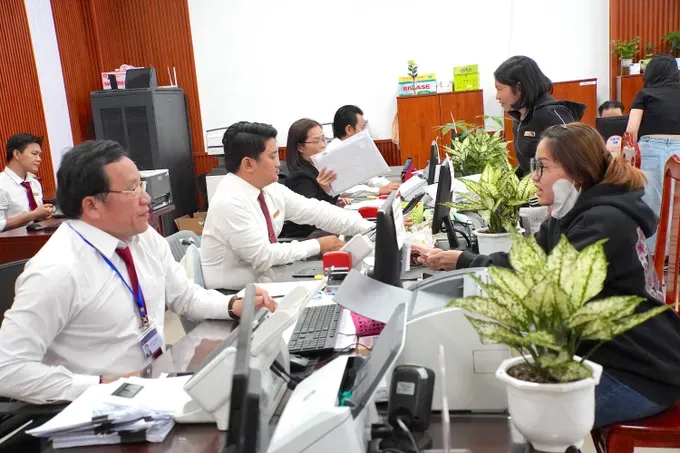
Before the implementation of the two-tier local government model, Le Thuong Duy Lap served as the Head of the Natural Resources and Environment Division in Thu Duc City. Upon the establishment of Thu Duc Ward, assuming the role of Ward People’s Committee Vice Chairman while concurrently serving as Director of the Public Administration Service Center, Mr. Lap found himself shouldering five or six major sectors comprising 156 distinct tasks.
Beyond his forte in natural resources, environment, land and urban management, he was tasked with overseeing fields like economics, planning, investment, and budget. Managing areas outside his expertise proved difficult, and the sheer volume of work meant he simply didn’t have enough time to conduct deep research into these new fields.
Similarly, in Linh Xuan Ward, People’s Committee Chairwoman Nguyen Thi Kim Cuc noted that a single Vice Chairman typically has to advise seven or eight city-level departments while overseeing three to five major sectors. This often leaves them in a state of “reactive mode”, constantly chasing after incidents rather than managing the area with a strategic vision. Furthermore, this overload doesn’t just pressure the officials; it creates a breeding ground for potential risks and errors in public service execution.
It appears this is a common reality across many wards in HCMC. Consequently, the policy to add one Vice Chairman to communal and ward People’s Committees, pursuant to Conclusion 187-KL/TW by the Politburo and the Secretariat, is instrumental in relieving pressure on the front lines. This move is expected to streamline workflows and ensure management permeates deeper into every residential area.
Chairman Pham Kieu Hung of the Cu Chi Commune People’s Committee likened their administration to an overburdened machine serving 125,000 residents. He described adding personnel as “adding a new lane to a traffic jam” to unclog workflows.
Echoing this, Thoi An Ward Chairman Nguyen Duc Hiep, whose locality faces rapid urbanization and security complexities, welcomed the policy. With over 120,000 residents, he noted that an additional Vice Chairman is crucial for relieving pressure, allowing the local authorities to monitor the area more closely and handle grassroots violations decisively.
Parallel to increasing personnel, the Standing Committee of the HCMC Party Committee has agreed on the policy to stop the model where the Vice Chairman of the communal People’s Committee concurrently serves as the Director of the Public Administration Service Center. Localities assess that this will “liberate” Vice Chairmen from specific operational tasks, allowing them to focus on macro issues such as planning, investment, and site clearance compensation, which are serious “bottlenecks” in many areas.
Chairwoman Nguyen Thi Kim Cuc assessed that when stripped of this concurrent role, the Ward Vice Chairman becomes an objective supervisor and independent inspector of the Center, thereby increasing transparency in administrative procedure resolution.
This helps eliminate the “being both player and referee” scenario when processing files for citizens. Crucially, files for citizens and businesses will be rotated more professionally, minimizing procedural congestion caused by leaders stretching themselves too thin.
Echoing this view, Chairman Nguyen Duc Hiep affirmed that the policy of not assigning the Vice Chairman to concurrently head the Public Administration Service Center aligns with the requirements of professionalizing administrative reform. When the Center Director is a dedicated full-time position, they will have the bandwidth to focus their entire time and resources on organizing and operating the center, closely monitoring the progress and quality of administrative processing for residents and businesses.
The clear separation between the state management function of the Ward People’s Committee leadership and the implementation function of the Public Administration Service Center will contribute to enhancing the validity and effectiveness of grassroots government operations. At the end of the day, the goal is to build a modern, service-oriented administration that meets the demands of urban development and ensures public satisfaction.
The Standing Committee of the HCMC Party Committee has issued Conclusion 235-KL/TU regarding the framework for the number of Vice Chairpeople of communal People’s Committees and the number of deputies in specialized divisions and Public Administration Service Centers. The HCMC People’s Committee has also just issued a document to deploy and guide the implementation of this conclusion.
Accordingly, administrative units at the commune level with a population of 50,000 or more; wards with an area of 5.5 square kilometers or more; communes with a natural area of 30 square kilometers or more; and key areas with complex social order and safety issues will be supplemented with one Vice Chairman. Based on these standards, HCMC has 83 wards and communes eligible for three Vice Chairpeople.