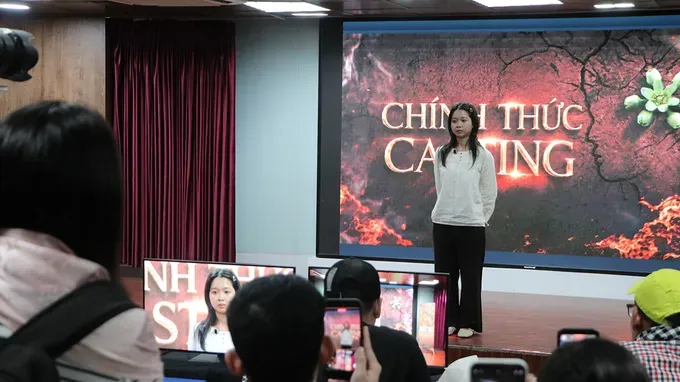
Over 1,200 profiles have been submitted for the casting call of the cinematic endeavor “Dat Do” (Red Earth), helmed by director Le Van Kiet. Numerous familiar faces such as Lam Thanh My, Dinh Khang, Hao Khang, and Huynh Thanh Truc, have officially shown up at the in-person auditions. For producer Hoang Quan, finding the right talent is an intricate balancing act.
“The steadfast support from established names is incredibly precious, but for this particular film, our most profound aspiration is still tracking down an actor perfectly suited for the heroic image of Vo Thi Sau, rather than simply grabbing a box office star,” he explained. “Whether it’s a completely fresh face or someone already widely recognized, the element of perfectly fitting the role remains our utmost priority.”
Currently, highly anticipated Vietnamese blockbusters like “Nu Biet Dong Sai Gon” (Saigon Female Commandos), “Can Ke Cai Chet” (Nearing Death), “Vung Troi Lua” (Sky of Fire), and “Loan The” (Chaotic Times) are actively pushing to scout suitable candidates.
For massive-scale projects, it appears the casting pipeline can sometimes drag on for months, or even stretch across entire years. It routinely takes screening through thousands of fresh hopefuls just to unearth the absolute right factor. For instance, “Lat Mat 8” (Face Off 8), directed by Ly Hai, shattered records when it magnetized a staggering crowd of over 5,000 individuals to its casting sessions.
The common factor in today’s actor selection process is profound precision and utmost seriousness. To actually snag a role, many actors have to survive four or five grueling casting rounds, subsequently joining in an immersive direct training phase lasting for several months before the cameras even start rolling.
According to the crew of “Hoang Hau Cuoi Cung” (The Last Empress), directed by Bao Nhan and Namcito, the successful candidates don’t just attend standard acting workshops; they are also heavily required to participate in rigorous training regimens covering royal etiquette and specialized skills spanning several months.
Similarly, for massive productions like “Dia Dao: Mat Troi Trong Bong Toi” (Tunnels: Sun in the Dark) by director Bui Thac Chuyen, and “Dat Rung Phuong Nam” (Song of the South) by director Nguyen Quang Dung, actors underwent incredibly grueling, highly specific boot camps for months on end.
Vietnamese cinema is undeniably recording a highly positive signal right now, as films completely lacking massive blockbuster stars can still pull off stellar commercial success at the box office. This monumental shift has heavily contributed to granting young actors a golden chance to genuinely prove their skills, ensuring they don’t fall into the bleak scenario of scrambling for roles like in the old days.
For director Nguyen Phan Quang Binh, the casting standard has unequivocally shifted. “If in the past, selecting an actor heavily prioritized someone who could magnetically draw audiences to the theaters, nowadays the most crucial element is their sheer capacity to genuinely embody the character and deliver a profoundly real and deeply emotional persona to the viewers,” he noted.
“Because of this, when hunting down the cast for ‘Ho Linh Trang Si: Bi An Mo Vua Dinh’ (The Guardian Warrior: The Mystery of King Dinh’s Tomb), whether someone is a total rookie getting their feet wet or a highly renowned star, I welcome them all exactly the same.”
Beyond the baseline prerequisites of acting skills and visual appeal, today’s actors inherently need a robust arsenal of other soft skills like martial arts, dynamic choreography, vocal talents, musical instrument proficiency, and athletic agility.
Most notably, numerous production crews are weaving an actor’s private life directly into their strict casting criteria to aggressively mitigate risks. After all, if a cast member gets entangled in even a minor scandal, it can instantly spark a ferocious wave of backlash and brutal boycotts from the online community, severely crippling the entire project.
The production team of “Tay Son That Ho Tuong” shared that since numerous characters are inextricably linked to historical heroes, actors’ private lives are heavily scrutinized. Producer Hoang Quan shares this perspective, saying that for films tethered to historical elements, producers must place actors’ private lives at the forefront. Generally, if an actor portrays a virtuous character but harbors an incongruous lifestyle, audiences cannot genuinely accept their on-screen transformation.
“All it takes is a misguided statement or action, and minutes later the entire country knows, inflicting severe damage,” Quan explained. “Because of this harsh reality, actors must view safeguarding their personal image as the ultimate deciding factor. Production units are tightening personal background criteria because no matter how ironclad the contract is, when an incident explodes, heavy collateral damage is unavoidable.”
Film crews becoming draconian in casting clearly indicates that Vietnamese cinema is entering a vastly more professional phase. Landing a role now solidly rests on capability, precise character alignment, and unblemished professional prestige, offering dedicated young faces a brilliant opportunity.