Mr. Nguyen Van Huong, Head of the Weather Forecasting Division at the National Center for Hydro-Meteorological Forecasting, said that from May 2 to 4, thunderstorms, tornadoes, lightning, and hail caused damage in many localities in the North and North Central regions, with a focus on the northern mountainous provinces.
Specifically, in the late afternoon and night of May 2, thunderstorms, tornadoes, and hail occurred in Dien Bien, Lai Chau, Lao Cai, Tuyen Quang, Phu Tho, Thai Nguyen, and Hanoi. In the late afternoon and night of May 3, these phenomena continued to occur in Nghe An and Ha Tinh.
From the late afternoon of May 2 to the morning of May 4, widespread thunderstorms affected the Northern and North Central regions. Some areas recorded heavy to very heavy rainfall, such as the Tan Pheo station in Phu Tho with 171 mm, Lam Thao in Phu Tho with 168 mm, and Ky Giang in Ha Tinh with 156 mm.

According to experts from the National Center for Hydro-Meteorological Forecasting, thunderstorms, tornadoes, and lightning commonly occur during the seasonal transition period, typically in April, May, September, and October in the Northern region. These are not unusual phenomena. However, at the beginning of May 2026, the simultaneous occurrence of hail in mountainous, midland, and lowland areas is considered relatively rare.
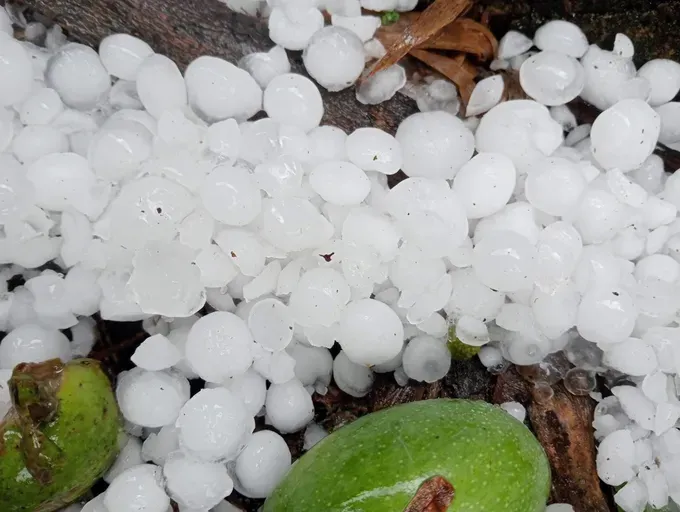
Mr. Nguyen Van Huong said that the large hailstorms, with ice pellets reaching the size of chicken eggs or tennis balls in Phu Tho and Thai Nguyen, were associated with strongly unstable atmospheric conditions.
In recent days, the region has maintained hot and humid conditions, with sunshine during the daytime, leading to the accumulation of convective energy. At higher altitudes, a trough has been present within a strong westerly wind belt at around 5,000 meters. At the same time, a weak cold air mass from the north has moved southward, compressing the low-pressure trough over the Northern region.
In the afternoon, rising temperatures caused the warm and humid air mass to ascend strongly, forming vertically developing thunderclouds. The strong updrafts kept ice particles within the clouds aloft for a longer period, allowing them to grow in size before falling to the ground. If ice particles fully melt before reaching the ground, they turn into rain; if they do not completely melt, they become hail.
According to the assessment of the National Center for Hydro-Meteorological Forecasting, the likelihood of an El Niño event emerging from mid-2026 is estimated at 80 percent to 90 percent. This phenomenon could reach strong intensity by the end of the year, with a probability of 20 percent to 25 percent, and may persist into 2027.
The year 2026 is forecast to experience more hot days than the long-term average, along with fewer storms and reduced rainfall. However, thunderstorms, tornadoes, and hail during transitional seasons, as well as localized heavy rainfall, may still occur. Intense short-duration rainfall can trigger flash floods, landslides, and urban flooding, particularly in mountainous areas with steep terrain.
The National Center for Hydro-Meteorological Forecasting has warned that around May 8 and 9, another cold air mass is expected to affect the Northern region, bringing thunderstorms and the risk of tornadoes, hail, and strong gusty winds.
From May 5 to 7, widespread showers and thunderstorms are likely to occur in the southern Central Highlands and the Southern region, mainly in the afternoon and evening. During these thunderstorms, people should be cautious of tornadoes, lightning, hail, and strong winds.










)