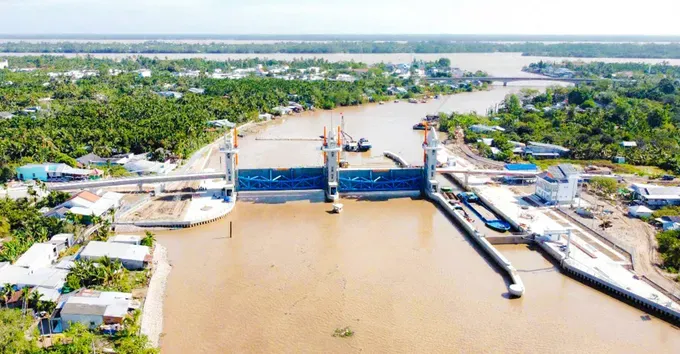
In response, authorities across the Mekong Delta have simultaneously closed salinity-control sluice gates, operated freshwater reservoirs, dredged canals, and implemented response scenarios.
Ensuring water for production
According to monitoring data, the 4‰ salinity level has intruded about 41.6 kilometers into the Cua Dai River, 23 kilometers into the Ham Luong River, 25.3 kilometers into the Co Chien River and 16.2 kilometers into the Hau River.
Specialized agencies under the Ministry of Agriculture and Environment reported that from late February to May this year, flows from the Mekong River to the Mekong Delta will continue to decline. In March, the 4‰ salinity boundary is forecast to penetrate 42–55 kilometers inland at river mouths, and by late April, it could reach 65–70 kilometers.
In Ca Mau, canals in the freshwater zones of Tran Van Thoi and U Minh have seen water levels drop due to drought. Irrigation sluices along the Ong Doc River and the western sea dike have been closed to prevent salinity intrusion and store freshwater for production and domestic use.
The Director of the provincial Irrigation Works Management and Operation Center said that the unit is closely monitoring hydrological developments and salinity levels to consult farmers on crop scheduling to ensure productivity and quality.
In the province of Dong Thap, authorities have closed seven key salinity-control sluices in the Go Cong freshwater zone to protect more than 24,000 hectares of winter–spring rice for 2025–2026 crop and fruit-growing areas. Farmer Tran Van Ai from Vinh Huu Commune said that salinity is rising rapidly, prompting farmers to store freshwater to irrigate his 1.5 hectares of rice currently in the tillering stage.
Mr. Duong Van Hoa, Vice Chairman of Vinh Huu Commune People’s Committee, stated that local authorities proactively dredged field canals this year to increase freshwater storage capacity. Thanks to early water storage and improved irrigation systems, pumping stations continue to operate effectively. Previously, the Go Cong rice area could only produce two crops per year due to salinity and freshwater shortages. With proactive water storage and the application of scientific and technical advances, farmers can now cultivate three rice crops annually.
Facing complex developments in the 2025–2026 dry season, Vinh Long Province’s authorities issued a freshwater storage order in mid-January 2026, instructing localities to flexibly operate sluices and pumping stations to take advantage of low-salinity periods. The province has also accelerated canal dredging and improved internal water circulation to enhance storage capacity. At the same time, two response scenarios based on disaster risk levels have been developed to ensure coordinated action from provincial to grassroots levels.
On February 27, authorities of Dong Thap Province approved the operation of ten backup wells by Tien Giang Water Supply Company to secure domestic water during the 2025–2026 dry season.
On the same day, Ca Mau Province’s Rural Water Supply and Sanitation Center announced that the center operates 144 centralized rural water facilities, ensuring sufficient clean water for more than 121,600 households during the 2026 dry season.
Preventing clean water shortages
According to Mr. Le Quang Rang, Deputy Director of the Vinh Long Province Department of Agriculture and Environment, the province has strengthened water security by investing in and efficiently operating its freshwater reservoirs. Key projects include Lang The Reservoir with a storage capacity of around ten million cubic meters; Lac Dia Reservoir spanning about 120 hectares with nearly 2 million cubic meters of capacity, serving the eastern area of the province; and Kenh Lap Reservoir, nearly four kilometers long, capable of storing approximately 800,000 cubic meters of water.
Salinity-control sluice gates are closely regulated according to tidal fluctuations, while water treatment plants maintain steady operations and remain prepared to increase capacity when needed. In cases of severe saltwater intrusion, the province will deploy all available manpower and resources to deliver freshwater to affected areas as local supplies diminish.
Meanwhile, Can Tho authorities have rolled out a 2026 action plan to tackle drought, water scarcity and saltwater intrusion. Measures are aligned with the ministry’s dry-season water resource projections for the Mekong basin.
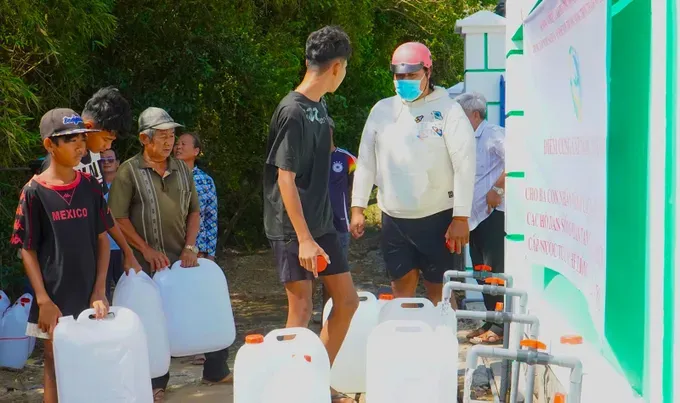
Can Tho has also launched 37 free freshwater distribution points for coastal residents, each equipped with tanks exceeding 10,000 liters and automatic pumping systems to ensure a constant supply. For remote households, local forces will deliver water directly, with tanker trucks and barges on standby to guarantee uninterrupted access to clean water.